Recent Posts From DIV-Net Members

Weekend Reading Links - July 31, 2011

For your weekend reading pleasure, the articles listed below contain some of the best dividend and value investing insights found on the web. They were written by various members of the Dividend Investing and Value Network over the past week:

Articles From DIV-Net Members

There are some really good articles here, please take time and read a few of them.


Continue Reading »

Medtronic Stock Analysis

Medtronic, Inc. (MDT) manufactures and sells device-based medical therapies worldwide. Medtronic is a dividend chamption which has paid uninterrupted dividends on its common stock since 1977 and increased payments to common shareholders every year for 34 years.

The most recent dividend increase was in June 2011, when the Board of Directors approved a 7.80% increase to 24.25 cents/share. The largest competitors of Medtronic include Becton Dickinson (BDX), C.R. Bard (BCR) and Baxter International (BAX).


Over the past decade this dividend growth stock has delivered a negative annualized total return of 0.6% to its shareholders. A major reason for that was the fact that the stock was grossly overvalued in 2001, trading at a P/E of over 60.

The company has managed to deliver an increase in EPS of 15.20% per year since 2002. Analysts expect Medtronic to earn $3.46 per share in 2012 and $3.79 per share in 2013. In comparison Medtronic earned $2.86 /share the company earned in 2011.


The company has been able to generate consistently high returns on equity in the 18% -23% range over the past decade, with the exception of 2002, 2006 and 2007. Rather than focus on absolute values for this indicator, I generally want to see at least a stable return on equity over time.

The annual dividend payment has increased by 17% per year over the past decade, which is higher than the growth in EPS.

A 17% growth in distributions translates into the dividend payment doubling almost every four years. If we look at historical data, going as far back as 1978, we see that Medtronic has actually managed to double its dividend every four years on average.

Over the past decade the dividend payout ratio increased slightly from 25% to almost 29%. A lower payout is always a plus, since it leaves room for consistent dividend growth minimizing the impact of short-term fluctuations in earnings.

Currently Medtronic is trading at 13.30 times earnings, yields 2.60% and has a sustainable dividend payout. I find the stock attractively valued per my entry criteria and I will considering adding to my position in the stock as funds become available.

Full Disclosure: Long MDT

Relevant Articles:


This article was written by Dividend Growth Investor. If you enjoyed this article, please subscribe to my feed [RSS], or have future articles emailed to you [Email] or follow me on Twitter [Twitter].


Continue Reading »

Ready For Banks?

Before the financial crisis of 2008-2009, financial stocks (especially banks) made up large portions of dividend investor's portfolios. This was for good reason. There were many dividends to be had from banks and other financial institutions. I started dividend growth investing in mid-2010, so I didn't have the pleasure (note the sarcasm) of watching my bank holdings plummet in value after various dangerous and risky investments came to light, forcing dividend cuts across the board. On Monday banks were touting the ability to maintain the dividend, and on Tuesday they were cutting it down to almost nothing.

I currently have no allocation to any banks at all. My only financial position is in Harleysville Group, an insurance company. My portfolio is instead heavily concentrated on energy, consumer staples and health care. Is this a good time to initiate positions with banks? Foresight is a superpower and hindsight is 20/20...so only time will tell if this is historically a good time to get into banks.

Of all the banks, I have my eye on two.

1. Wells Fargo & Company (WFC)

They have rebounded pretty nicely from the financial crisis. The economy is still lingering in stigma and lacks growth catalysts. Unemployment is stubbornly high. People don't have the credit or money to borrow and banks don't want any risky loans on the books. This creates a bit of a standoff that is not conducive to growth. However, they have grown earnings substantially from .70 EPS in 2008 to 2.21 EPS in 2010. The acquisition of Wachovia provides them an opportunity to become a nationwide bank with a larger footprint and much greater base of deposits. This bodes well for future growth. The debt is in line and earnings should pick up steam with the rest of the economy. The dividend yield is currently at 1.68%, with a lowly payout ratio of 21%. There is a lot of room for growth here, as they are free to raise their dividend after repaying their TARP funds. They are trading at a very attractive forward P/E ratio of 8.2.

2. U.S. Bancorp (USB)

The same catalysts that are needed for growth at Wells Fargo are also needed at U.S. Bancorp. The general growth of the economy, relaxed lending and cash flowing freely will bode well for this bank. U.S. Bancorp has also rebounded very nicely since the crisis. They grew EPS from 1.61 in 2008 to EPS of 1.73 in 2010. Revenues largely grew at a steady clip. The entry yield is at 1.91%, which isn't anything to be excited about. The payout ratio is very low, however, at 27% which leaves a ton of room for dividend growth assuming a return to normalized earnings. They are trading at a forward P/E ratio of 9.7.

Overall, banks are still dicey in my opinion. The low yields leave a lot to be desired, but I believe patient investors will be rewarded with swift raises in the payouts for both of these companies. The valuations are low, but I wonder if they are low enough to make one of these companies an addition to a well-oiled portfolio. The volatility is a little high with banks, so weak stomachs are to stay away.

Of the two banks, I'm more bullish on Wells Fargo. Warren Buffett has investments with both banks, with a substantial position size in Wells Fargo. I'm currently adopting a wait-and-see approach with banks.

Full Disclosure: None

Are you ready for banks?

Thanks for reading.

This article was written by Dividend Mantra . If you enjoyed this article, please consider subscribing to my feed.


Continue Reading »

RadioShack Separates Short-Term From Long-Term Investors

Market participants can be roughly divided into two groups: short-term speculators and long-term investors. Nowhere is this dichotomy more clear than in shares of RadioShack (RSH), which have taken a beating for most of this year.

From a short-term perspective, this company's recent operations look downright awful. EPS is expected to come in some 40% lower than last year, for a number of reasons. Problems with suppliers (a disagreement with T-Mobile has put a crimp in that sales category), supplier policy changes (Sprint toughened-up its upgrade policy for consumers), problems with partners (Sam's Club takes control of RadioShack-operated kiosks) and operational changes (closure of its Chinese manufacturing facility) are all contributing to what will be a sub-par year financially for the firm.

But for long-term investors, many of these problems appear transitory. The company will be shifting to a bigger wireless player in Verizon (from T-Mobile), it has ramped up its kiosk business at Target to replace the Sam's Club loss, and it can now source its private-label products in Asia without the fixed costs associated with having a dedicated facility.

For most of this year, the short-termers have beaten the stock price down. But this has created an opportunity for those who can see past these temporary difficulties. Over the last ten years, RadioShack has averaged earnings of $225 million per year. Today, the company trades at just 7 times that number, despite the fact that its net debt to equity level is under 15%.

Managements, too, can have either a long-term or short-term perspective. RadioShack's management appears to be of the former suasion. The company has shown a willingness to take the short-term hits to profits in order to position the company for a brighter future. Furthermore, management has used the weakness in the price of the shares to buy back shares with a vengeance; the company has 20% fewer shares outstanding than it did at this time last year.

There are those who would extrapolate this year's profit drop indefinitely, on the premise that RadioShack's business model is dead. This would be a mistake. Last year, the company's return on equity was over 20%. Furthermore, the company is poised to take advantage of the growth of smartphones and other mobile devices (e.g. tablets), which are "high-touch, high-service transactions" for many consumers. Furthermore, management believes it has not executed well at attaching its high-margin accessories to mobile product sales; this means there is an opportunity for improvement as management strives to get it right.

Short-term profit drops can be deceiving. A better gauge of what a company can earn in the long-term is provided through the use of several years worth of earnings data. For more on RadioShack, see this article.

Disclosure: Author has a long position in shares of RSHThis article was written by Saj Karsan of Barel Karsan. If you enjoyed this article, please consider subscribing to the feed.


Continue Reading »

Kinder Morgan's High Dividend Yield

Investors are familiar with how great limited partnerships are as a source of dividend income. Companies like Kinder Morgan Energy Partners LP pays a high dividend. While investors may be familiar with this company, some investors may not be so familiar with the parent company. Energy infrastructure company Kinder Morgan Inc (KMI) is the parent company and general partner of Kinder Morgan Energy L.P. Kinder Morgan delivers fuel, natural gas, oil, and all forms of energy through its massive pipelines. Kinder Morgan has 37,000 pipelines and 180 terminals. The company’s operations are primarily based in North American with locations in both America and Canada.

Kinder Morgan is a very young company that has just been made newly available to common stockholders. Kinder Morgan just had an initial public offering this past February. The offering was well received as the stock was priced at $30 a share. This was well higher than the $26 price that the stock was expected to price at.

Kinder Morgan has a market cap of $20 billion dollars and trades at $27.50 per share. The stock trades at 26 times this year’s earnings and 2.8 times the projected earnings growth. Kinder Morgan has a massive debt burden of $15 billion dollars and only a few hundred million in cash. Fortunately, the company generates nearly $2 billion in cash flow. Investors are attracted to the company because of its high dividend.

The pipeline company is attractive to investors because it is already paying out a pretty reasonable dividend for a brand new stock. The stock has only been on the market for 6 months and has already increased its dividend substantially. The company increased its annual dividend payout from $1.16 per share to $1.20. The dividend increase has made the company one of the better dividend stocks in the industry. Kinder Morgan has a dividend yield of 4.3%. That yield is attractive to any investor in this market.


This article was written by [Buy Like Buffett]. If you enjoyed this article, please consider subscribing to my feed at [RSS].


Continue Reading »

Stock Analysis: Exxon Mobil Corporation (XOM)

Linked here is a detailed quantitative analysis of Exxon Mobil Corporation (XOM). Below are some highlights from the above linked analysis:

Company Description: Exxon Mobil Corp. (XOM), formed through the merger of Exxon and Mobil in late 1999, is the world's largest publicly owned integrated oil company.

Fair Value: In calculating fair value, I consider the NPV MMA Differential Fair Value along with these four calculations of fair value, see page 2 of the linked PDF for a detailed description:

1. Avg. High Yield Price
2. 20-Year DCF Price
3. Avg. P/E Price
4. Graham Number

XOM is trading at a premium to all four valuations above. The stock is trading at a 23.5% premium to its calculated fair value of $66.94. XOM did not earn any Stars in this section.

Dividend Analytical Data: In this section there are three possible Stars and three key metrics, see page 2 of the linked PDF for a detailed description:

1. Free Cash Flow Payout
2. Debt To Total Capital
3. Key Metrics
4. Dividend Growth Rate
5. Years of Div. Growth
6. Rolling 4-yr Div. > 15%

XOM earned two Stars in this section for 1.) and 2.) above. A Star was earned since the Free Cash Flow payout ratio was less than 60% and there were no negative Free Cash Flows over the last 10 years. The stock earned a Star as a result of its most recent Debt to Total Capital being less than 45%. The company has paid a cash dividend to shareholders every year since 1882 and has increased its dividend payments for 29 consecutive years.

Dividend Income vs. MMA: Why would you assume the equity risk and invest in a dividend stock if you could earn a better return in a much less risky money market account (MMA) or Treasury bond? This section compares the earning ability of this stock with a high yield MMA. Two items are considered in this section, see page 2 of the linked PDF for a detailed description:

1. NPV MMA Diff.
2. Years to > MMA

The negative NPV MMA Diff. means that on a NPV basis the dividend earnings from an investment in XOM would be less than a similar amount invested in MMA earning a 20-year average rate of 4.1%. If XOM grows its dividend at 5.6% per year, it will never equal a MMA yielding an estimated 20-year average rate of 4.1%.

Memberships and Peers: XOM is a member of the S&P 500, a Dividend Aristocrat, a member of the Broad Dividend Achievers™ Index and a Dividend Champion. The company's peer group includes: BP plc (BP) with a 3.8% yield, Chevron Corp. (CVX) with a 2.9% yield and ConocoPhillips (COP) with a 3.5% yield.

Conclusion: XOM did not earn any Stars in the Fair Value section, earned two Stars in the Dividend Analytical Data section and did not earn any Stars in the Dividend Income vs. MMA section for a total of two Stars. This quantitatively ranks XOM as a 2 Star-Weak stock.

Using my D4L-PreScreen.xls model, I determined the share price would need to decrease to $51.49 before XOM's NPV MMA Differential decreased to the $600 minimum that I look for in a stock with 29 years of consecutive dividend increases. At that price the stock would yield 3.59%.

Resetting the D4L-PreScreen.xls model and solving for the dividend growth rate needed to generate the target $600 NPV MMA Differential, the calculated rate is 10.2%. This dividend growth rate is well above the 5.6% used in this analysis, thus providing no margin of safety. XOM has a risk rating of 1.50 which classifies it as a Low risk stock.

Through a relentless pursuit of efficiency through technology and operational improvement, XOM has sets itself apart among the other supermajors and has delivered higher returns on capital than its competitors. XOM has enjoyed superior earnings and dividend growth and stability. The company should benefit from upstream growth opportunities in deepwater, LNG, onshore unconventional and ventures with state-owned companies.

This is a company I have watched for many years looking for an opportunity to buy. Unfortunately, its dividend yield and dividend growth are too low to make the numbers work, as evidenced by the 23% premium it is trading to my calculated fair value price of $66.94. For now, I will remain on the sidelines.

Disclaimer: Material presented here is for informational purposes only. The above quantitative stock analysis, including the Star rating, is mechanically calculated and is based on historical information. The analysis assumes the stock will perform in the future as it has in the past. This is generally never true. Before buying or selling any stock you should do your own research and reach your own conclusion. See my Disclaimer for more information.

Full Disclosure: At the time of this writing, I held no position in XOM (0.0% of my Income Portfolio) and was long in CVX and COP. See a list of all my dividend growth holdings here.

Related Articles:
- Watsco, Inc. (WSO) Dividend Stock Analysis
- AFLAC Incorporated (AFL) Dividend Stock Analysis
- 3M Company (MMM) Dividend Stock Analysis
- Cincinnati Financial Corp. (CINF) Dividend Stock Analysis
- More Stock Analysis

This article was written by Dividends4Life. If you enjoyed this article, please subscribe to my feed [RSS], or have future articles emailed to you [Email] or follow me on Twitter [Twitter].


Continue Reading »

Weekend Reading Links - July 24, 2011

For your weekend reading pleasure, the articles listed below contain some of the best dividend and value investing insights found on the web. They were written by various members of the Dividend Investing and Value Network over the past week:

Articles From DIV-Net Members

There are some really good articles here, please take time and read a few of them.


Continue Reading »

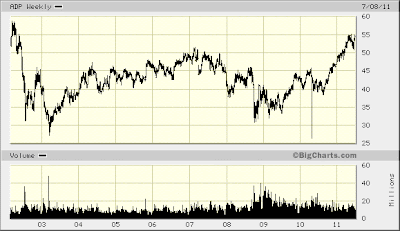
Stock Analysis: ADP

Automatic Data Processing, Inc.(ADP) provides technology-based outsourcing solutions to employers, and vehicle retailers and manufacturers worldwide. It operates in three segments: Employer Services, Professional Employer Organization Services, and Dealer Services. This Dividend Aristocrat has paid uninterrupted dividends on its common stock since 1974 and increased payments to common shareholders every year for 36 years.

The most recent dividend increase was in November 2010, when the Board of Directors approved a 6% increase to 36 cents/share. The largest competitors of Automatic Data Processing include Paychex (PAYX), Convergys (CVG) and CSG Systems International (CSGS).

Over the past decade this dividend growth stock has delivered an annualized total return of 3.70% to its loyal shareholders.

The company has managed to deliver an increase in EPS of 5.90% per year since 2001. Analysts expect ADP to earn $2.52 per share in 2011 and $2.73 per share in 2012. In comparison Automatic Data Processing earned $2.40 /share the company earned in 2010.


The company has been able to generate consistently high returns on equity in the 17.50% -25% range over the past decade. Rather than focus on absolute values for this indicator, I generally want to see at least a stable return on equity over time.

The annual dividend payment has increased by 14.50% per year over the past decade, which is much higher than the growth in EPS.

A 14% growth in distributions translates into the dividend payment doubling almost every five years. If we look at historical data, going as far back as 1979, we see that Automatic Data Processing has actually managed to double its dividend every five years on average.

Over the past decade the dividend payout ratio has been on the increase, mostly due to the fact that dividend growth was higher than earnings growth. Since the ratio is at 56% now, future dividend growth would be limited by earnings growth and less on the expansion in the payout ratio. A lower payout is always a plus, since it leaves room for consistent dividend growth minimizing the impact of short-term fluctuations in earnings.

Currently Automatic Data Processing is trading at 22 times earnings, yields 2.60% and has a sustainable dividend payout. The stock is slightly over valued per my entry criteria but I will consider adding to my position on dips below $50.

Full Disclosure: Long ADP

Relevant Articles:


This article was written by Dividend Growth Investor. If you enjoyed this article, please subscribe to my feed [RSS], or have future articles emailed to you [Email] or follow me on Twitter [Twitter].


Continue Reading »

Ensure Your Dividends With These Insurance Stocks

As any other dividend growth investor knows, maintaining dividends is of the utmost priority for an investment. Raising dividends is, of course, extremely important as well, but a dividend cut is disastrous. It would result in the loss of income and the likely significant drop in share price/market value. This is, for the most part, unacceptable so we try to shield ourselves from such events through diversification, research, maintaining relatively strict entry criteria and most importantly investing in companies with rising earnings and sustainable payout ratios.

The insurance industry has many different companies that have sustainable, and rising, dividend payouts. I really like the insurance industry. An insurance company can be extremely profitable if the underwriting is performed correctly. An insurance company profits by charging a client a premium up front for coverage and then investing that premium (called the "float) from which they (hopefully) receive a high rate of return. It is from that return that they pay out claims, or reinvest the money. Insurance is wonderful because they are basically investing others people's money and they get to keep the capital gains on those investments. Why do you think Warren Buffett loves Geico so much? The float is a very powerful aspect of the insurance business model.

Here's a look at three different insurance companies that I currently find attractive:

Harleysville Group Inc. (HGIC)

Harleysville Group provides insurance services. The company underwrites property and casualty insurance policies, primarily in the Eastern and Midwestern regions of the U.S. It offers commercial automobile, workers' compensation, and multiperil insurance, as well as personal automobile and homeowner's insurance. The company markets its policies through almost 2,000 insurance agencies, and maintains offices in about a dozen states. 

Forward P/E Ratio: 10.6
Dividend Yield: 4.55
Years of Dividend Growth: 24

Aflac Incorporated (AFL)

Aflac offers supplemental health insurance and life insurance in the two largest insurance markets in the world, the U.S. and Japan. In addition to its cancer policies, the company has broadened its product offerings to include accident, disability, and long-term care insurance. It markets its products through independent distributors, selling most of its policies directly to consumers at their places of work.
 

Forward P/E Ratio: 7.2
Dividend Yield: 2.66
Years of Dividend Growth: 28

The Chubb Corporation (CB)

With roots dating back to 1882, Chubb began in marine insurance, but over the years expanded to become a global, multiline insurer focused in property and casualty. Today, Chubb is the 12th-largest property-casualty insurer in the United States; it went public in 1984. Most of Chubb's revenue (75%) comes from the United States, but its international operations are growing. Chubb's largest unit is commercial insurance, followed by personal and specialty.

Forward P/E Ratio: 10.6
Dividend Yield: 2.54
Years of Dividend Growth: 46

Insurance companies have their own risks. Losses due to bad underwriting policies, excessive claims due to natural events or other disasters, and bear markets which lead to distressed investments can all have a negative impact on the balance sheet and lead to low margins or loss of revenue.

I really like insurance companies but due diligence is always required before investing. Currently, all three of the aforementioned securities are trading at low valuations and multiples. However, the tsunami in Japan and distressed investments make investing in Aflac a little shaky in this environment. Harleysville has had slow revenue growth and has a limited footprint. Chubb has a low yield and lack of any type of economic moat. With that being said, all three are currently on my shopping list.

Are you buying any insurance companies?

Full Disclosure: I'm long HGIC.

Thanks for reading.

This article was written by Dividend Mantra. If you enjoyed this article, please consider subscribing to my feed.


Continue Reading »

The Higher The EBITDA, The Lower The Profit

Contingent bonuses can be a great way to reward employees. But a poorly designed bonus structure can lead to disaster. As such, proper design of a compensation structure is imperative. But a flawless system is nearly impossible to design, as even the simplest of bonus structures can have less than ideal implications.

Offering bonuses to executives related to company profit levels are considered normal, in order to increase the impetus to drive bottom-line improvement. Consider Meade (which has been discussed on this site as a potential value investment), a company which recently instituted a simple bonus policy based on EBITDA levels. The bonuses paid out to executives are as follows:

EBITDABonus
≥ $112,000 < $224,000$21,000
≥ $224,000 < $336,000$42,000
≥ $336,000 < $448,000$63,000
≥ $448,000 < $560,000$84,000
≥ $560,000$105,000

Even a simple, innocent-looking bonus structure such as this one can have profound negative effects. For one thing, because the bonus is based on EBITDA, manager compensation is not hurt by depreciation charges. This could cause them to ratchet up capital expenditures (or re-classify current expenses to capital expenditures) with the intent of driving up EBITDA.

Furthermore, because no considerations are given to ROIC metrics, management is hereby incented to borrow money to help increase EBITDA. Using leverage increases risk for shareholders, but because bonuses make no allowance for risk factors, management may find incurring debt to be of great help in financing assets that may help the company achieve higher profit levels.

Finally, because of the step-up nature of the bonus escalations, one could end up in a situation where a higher EBITDA results in lower profit levels for shareholders. For example, if EBITDA before bonuses comes in at $559K, EBITDA after bonuses equals $475K. But if EBITDA before bonuses comes in higher, at say $560K, EBITDA after bonuses is actually lower than in the previous case by $20,000! In this case, shareholders are actually worse off as a result of a higher EBITDA number. Furthermore, near the edge of each EBITDA range, management is given an incentive to "manage" its reporting of expenses order to receive a windfall.

Designing a bonus structure that perfectly aligns shareholders and managers is very difficult to achieve. The best investors can hope to do is own companies in which management is also heavily invested. This is likely the only way of truly aligning manager and shareholder interests.

Disclosure: Author has a long position in shares of MEAD

This article was written by Saj Karsan of Barel Karsan. If you enjoyed this article, please consider subscribing to the feed.


Continue Reading »

M&T Bank Has A Solid Dividend

M&T Bank (MTB) is a regional bank that services customers in the MidAtlantic region of the county. The bank has been in operation for over 150 years having quietly grown its assets and influence over time. M&T Bank is noted for its long time history of profitability and great history of managing risk. The bank was a major beneficiary during the financial crisis using the economic weakness to acquire more depositors. Unlike many of its big banking brethren, M&T did not require a government bailout to stay afloat. M&T has expanded its deposit base in recent years by acquiring Provident Bank, Wilmington Bank & Trust, and Bradford Bank. These acquisitions should only increase the profitability for a bank that has produced quarter after quarter of profitably for nearly 40 years. The company is a fixture on the S&P 500’s list and is one of only two banks that did not have to lower its dividend back in 2008.

The bank’s stock currently trades in line with other bank competitors. M&T trades at 13.6 times this year’s earnings and 11 times forward earnings. M&T trades at 1.3 times book value, 3 times sales, and 5.6 times cash flow. The company has been able to solidly grow its revenue in the single digits and now holds over $70 billion dollars of client assets. The company continues to look for safe ways to grow its banking operations.

M&T Bank is a great dividend play because it is one of the few stocks that did not lower its dividend during the financial crisis. The company has been able to consistently maintain its dividend and has a fantastic payout at a time when most of the big banks have very low yields. M&T Bank is currently paying investors $2.80 per share which is a very solid 3.3% yield. The $2.80 dividend represents a 44% payout which is reasonable. The dividend is not at risk since the company has been a wise steward of investor capital for years.

The stock even has the endorsement of Warren Buffett himself having purchased shares last years. Investors interested in owning a solid financial institution with a good dividend should give M&T Bank a look.

This article was written by [Buy Like Buffett]. If you enjoyed this article, please consider subscribing to my feed at [RSS].


Continue Reading »

Stock Analysis: Lockheed Martin Corp. (LMT)

Linked here is a detailed quantitative analysis of Lockheed Martin Corp. (LMT). Below are some highlights from the above linked analysis:

Company Description: Lockheed Martin Corp. is the world's largest military weapons manufacturer and is also a significant supplier to NASA and other non-defense government agencies. LMT receives about 93% of its revenues from global defense sales.

Fair Value: In calculating fair value, I consider the NPV MMA Differential Fair Value along with these four calculations of fair value, see page 2 of the linked PDF for a detailed description:

1. Avg. High Yield Price
2. 20-Year DCF Price
3. Avg. P/E Price
4. Graham Number

LMT is trading at a discount to 1.) and 3.) above. Since LMT's tangible book value is not meaningful, a Graham number can not be calculated. The stock is trading at a 15.5% discount to its calculated fair value of $93.5. LMT earned a Star in this section since it is trading at a fair value.

Dividend Analytical Data: In this section there are three possible Stars and three key metrics, see page 2 of the linked PDF for a detailed description:

1. Free Cash Flow Payout
2. Debt To Total Capital
3. Key Metrics
4. Dividend Growth Rate
5. Years of Div. Growth
6. Rolling 4-yr Div. > 15%

LMT earned two Stars in this section for 1.) and 3.) above. A Star was earned since the Free Cash Flow payout ratio was less than 60% and there were no negative Free Cash Flows over the last 10 years. LMT earned a Star for having an acceptable score in at least two of the four Key Metrics measured.

Rolling 4-yr Div. > 15% means that dividends grew on average in excess of 15% for each consecutive 4 year period over the last 10 years (2001-2004, 2002-2005, 2003-2006, etc.) I consider this a key metric since dividends will double every 5 years if they grow by 15%. The company has paid a cash dividend to shareholders every year since 1995 and has increased its dividend payments for 9 consecutive years.

Dividend Income vs. MMA: Why would you assume the equity risk and invest in a dividend stock if you could earn a better return in a much less risky money market account (MMA) or Treasury bond? This section compares the earning ability of this stock with a high yield MMA. Two items are considered in this section, see page 2 of the linked PDF for a detailed description:

1. NPV MMA Diff.
2. Years to > MMA

LMT earned a Star in this section for its NPV MMA Diff. of the $13,637. This amount is in excess of the $2,600 target I look for in a stock that has increased dividends as long as LMT has. If LMT grows its dividend at 15.0% per year, it will take 1 years to equal a MMA yielding an estimated 20-year average rate of 4.1%. LMT earned a check for the Key Metric 'Years to >MMA' since its 1 years is less than the 5 year target.

Memberships and Peers: LMT is a member of the S&P 500. The company's peer group includes: Boeing Co. (BA) with a 2.3% yield, Northrop Grumman Corporation (NOC) with a 3.0% yield and United Technologies Corp. (UTX) with a 2.2% yield.

Conclusion: LMT earned one Star in the Fair Value section, earned two Stars in the Dividend Analytical Data section and earned one Star in the Dividend Income vs. MMA section for a total of four Stars. This quantitatively ranks LMT as a 4 Star-Strong stock.

Using my D4L-PreScreen.xls model, I determined the share price would need to increase to $140.24 before LMT's NPV MMA Differential increased to the $2,600 minimum that I look for in a stock with 9 years of consecutive dividend increases. At that price the stock would yield 2.14%.

Resetting the D4L-PreScreen.xls model and solving for the dividend growth rate needed to generate the target $2,600 NPV MMA Differential, the calculated rate is 9.6%. This dividend growth rate is well below the 15.0% used in this analysis, thus providing a margin of safety. LMT has a risk rating of 2.00 which classifies it as a Medium risk stock.

LMT is the largest defense contractor in the world and dominates next-generation defense platforms. It owns supply contracts for key programs such as the F-35, which assure multiple years of revenue. The company will see significant upside in Aeronautics, with nearly $20 billion in annual revenue projected by 2015, mostly as the result of production increases of the F-35.

However, U.S. budgetary concerns and a large unfunded pension plan will likely slow earnings growth, and thus, dividend growth. I will continue to add to my position as long as LMT trades below its calculated fair value of $93.50 and as my allocation allows.

Disclaimer: Material presented here is for informational purposes only. The above quantitative stock analysis, including the Star rating, is mechanically calculated and is based on historical information. The analysis assumes the stock will perform in the future as it has in the past. This is generally never true. Before buying or selling any stock you should do your own research and reach your own conclusion. See my Disclaimer for more information.

Full Disclosure: At the time of this writing, I was long in LMT (0.7% of my Income Portfolio) and long in UTX. See a list of all my income holdings my income holdings here.

Related Articles:
- Watsco, Inc. (WSO) Dividend Stock Analysis
- AFLAC Incorporated (AFL) Dividend Stock Analysis
- 3M Company (MMM) Dividend Stock Analysis
- Cincinnati Financial Corp. (CINF) Dividend Stock Analysis
- More Stock Analysis

This article was written by Dividends4Life. If you enjoyed this article, please subscribe to my feed [RSS], or have future articles emailed to you [Email] or follow me on Twitter [Twitter].


Continue Reading »

Weekend Reading Links - July 17, 2011

For your weekend reading pleasure, the articles listed below contain some of the best dividend and value investing insights found on the web. They were written by various members of the Dividend Investing and Value Network over the past week:

Articles From DIV-Net Members

There are some really good articles here, please take time and read a few of them.


Continue Reading »

Stock Analysis: Aflac

Aflac Incorporated (AFL), through its subsidiary, American Family Life Assurance Company of Columbus (Aflac), provides supplemental health and life insurance. Aflac is a dividend aristocrat which has paid uninterrupted dividends on its common stock since 1973 and increased payments to common shareholders every year for 28 years.

The most recent dividend increase was in 2010, when the Board of Directors approved a 7.10% increase to 30 cents/share.


Over the past decade this dividend growth stock has delivered an annualized total return of 5.20% to its loyal shareholders.

The company has managed to deliver an increase in EPS of 16.20% per year since 2001. Analysts expect Aflac to earn $6.21 per share in 2011 and $6.45 per share in 2012. In comparison Aflac earned $4.95 /share the company earned in 2010.


The company has been able to increase its return on equity from 13.60% in 2001 to 22% by 2010. Rather than focus on absolute values for this indicator, I generally want to see at least a stable return on equity over time.

The annual dividend payment has increased by 21.30% per year over the past decade, which is much higher than the growth in EPS.

An 21% growth in distributions translates into the dividend payment doubling almost every three and a half years. If we look at historical data, going as far back as 1984, we see that Aflac has actually managed to double its dividend every four and a half years on average. Most recently however, dividend growth has waned to the high single digit percentage increases.

Over the past decade the dividend payout ratio has been on the increase, mostly due to the fact that dividend growth was higher than earnings growth. The ratio is low at 23%, so there is room for future dividend growth. A lower payout is always a plus, since it leaves room for consistent dividend growth minimizing the impact of short-term fluctuations in earnings.

Currently Aflac is trading at 10 times earnings, yields 2.70% and has a sustainable dividend payout. The stock is attractively valued per my entry criteria and I have recently added to my position on the dip below $48.

Full Disclosure: Long AFL

Relevant Articles:


This article was written by Dividend Growth Investor. If you enjoyed this article, please subscribe to my feed [RSS], or have future articles emailed to you [Email] or follow me on Twitter [Twitter].


Continue Reading »

Do You DRIP?

DRIP stands for Dividend Reinvestment Plan. This plan is offered by corporations as a way to reinvest cash dividends by purchasing shares or fractions of shares on the dividend payment date. A lot of retail investors participate in such plans as a way to cheaply reinvest dividends back into the company that paid them.

There are many benefits of participating in a DRIP. It allows you to build a sizable position over time through reinvesting your dividends. Some dividend reinvestment plans even discount the share price at time of reinvestment. Usually the plans come with no commission fees, or very low commission fees. It also allows you to buy fractional shares that wouldn't be available otherwise.

I don't personally DRIP.

Here's what I do:
 

I wait for my dividends to accumulate over the course of a month, as I usually invest once per month. I inject fresh capital into my brokerage account shortly after receiving my large commission check from my day job and combine that fresh capital with my dividends that I've received over the past month. I take these two combined sources of capital and invest it in the most attractively valued business available at the time of investment. This investment could be in the company that paid a majority of the dividends from the past month. It also could be a new company, that I don't have any investments with before time of purchase. It might be with a company that I currently have a position with, but didn't pay dividends in the previous month. The key is, it doesn't matter to me whether I reinvest the dividends back into the company that paid them. Once I receive the dividends in my brokerage account, I try to reinvest that capital in the best way I see fit.

Here's why I do it:

I don't DRIP because I like to have control of how I reinvest my dividends. If all my dividends were set on auto-pilot and reinvested themselves back into the company that paid them out I would feel a severe lack of control. I like to have control of my destiny and finances, whether it's for the best or not. Another reason I don't DRIP is because the company that paid the dividends may or may not be attractively valued on the day the dividend is paid. For instance, if Coca-Cola is trading for 30 times earnings on the day the dividend is paid I don't necessarily want to reinvest that dividend into Coke. I could probably find a better value in the market to reinvest that fresh capital into. There are also tax consequences to consider when participating in a dividend reinvestment plan, as the fees and commissions a DRIP administrator pays on the investors behalf counts as taxable income.

I can certainly see the benefits and the drawbacks to dividend reinvestment plan. I have decided that for me, personally, I would rather reinvest my dividends as I see fit.

What about you? Do you DRIP?

Thanks for reading. 


This article was written by Dividend Mantra. If you enjoyed this article, please consider subscribing to my feed.


Continue Reading »

Electronics Retail: High P/E Investing

Even if a company performs well, it can still make for a lousy investment. This is because the price paid plays a massive role in determining whether an investment will work out or not.

Six months ago, three electronics retailers were discussed on this site and compared to their respective asking prices. While not a single one of those companies has seen its price appreciate in these last six months, the merits of investing based on price (and not earnings growth or recent company performance) are still clear. Consider the following table:

NameJanuary P/EEarningsStockP/E Today
Best Buy
11
Down 5%Down 13%
10
RadioShack
9
Down 18%Down 24%
8
hhgregg
17
Up 44%Down 35%
11

As the table shows, though hhgregg continues to grow its earnings as it adds stores and expands, its stock actually fell dramatically over this period. The stock fell much further than the stock of its competitors even though Best Buy and RadioShack have been struggling, posting declining net income. Why is this? Because of how high hhgregg's P/E was at the beginning of the period.

Of course, this is just one example of low P/E versus high P/E investing. Nevertheless, it is consistent with research that suggests that stocks with the lowest P/E's outperform. In fact, research by David Dreman suggests that this performance difference based on P/E even occurs between firms in the same industry, as are the three stocks we have compared here.

What's interesting now is the fact that hhgregg, which is aggressively growing its store count while maintaining solid returns on capital, has now become cheap. So while it didn't look like a great investment 6 months ago, it looks a lot more enticing today. The company hasn't changed much in the last six months. But more importantly, its price has, and that is what will play the dominant role in determining whether the investment works out.

Disclosure: Author has a long position in shares of BBY and RSH

This article was written by Saj Karsan of Barel Karsan. If you enjoyed this article, please consider subscribing to the feed.


Continue Reading »

Making Money With Avon

Everybody knows the name of Avon (AVP) but very few people know that the company is a publicly traded company. Avon is famous for manufacturing a line of beauty products that is bought by a large number of people. Avon generates nearly $11 billion dollars in annual sales by selling its popular cosmetic products. The company relies on door to door sales to execute its multilevel marketing strategy.

Avon is a large cap stock with a $12 billion dollar market cap. The company generates more than $600 million dollars in free cash flow and has over $1 billion dollars in cash on the balance sheet. Avon has a large debt load of $3.1 billion dollars. The company’s sales had been rising before 2009 when sales regressed during that year.

Avon’s stock is not incredibly cheap. The company trades at 6.6 times book value which is high for any value investor. Avon trades at 18 times the company’s cash flow and one times sales. Avon has a P/E ratio of 17 and a forward P/E of 12. This is high for a company that could be classified as a slow growth stock.

Avon’s greatest strength is the company’s management. The company’s management has been able to turn the company into a largely recognizable name. Company management has also done a good job of maximizing it assets. Avon has a 45% return on equity year to date. Avon has been able to survive throughout a recession in which many retailers saw demand for their products fall substantially.

While Avon is not the value that the company would be in the teens, Avon does pay a healthy dividend. Avon currently pays its shareholder 92 cents per share which is very sustainable since it is only 45% of the expected earnings for this year. Avon has a dividend yield of 3.2% which is quite good in the current market. Avon has an impressive streak of 22 consecutive years of dividend increase.

Investors should not expect a homerun with Avon but should expect consistent dividend payments and increases year after year.

This article was written by [Buy Like Buffett]. If you enjoyed this article, please consider subscribing to my feed at [RSS].


Continue Reading »

Stock Analysis: H.J. Heinz Company (HNZ)

Linked here is a detailed quantitative analysis of H.J. Heinz Company (HNZ). Below are some highlights from the above linked analysis:

Company Description: The H.J. Heinz Company produces a wide variety of food products worldwide, primarily condiments, convenience meals and snacks.

Fair Value: In calculating fair value, I consider the NPV MMA Differential Fair Value along with these four calculations of fair value, see page 2 of the linked PDF for a detailed description:

1. Avg. High Yield Price
2. 20-Year DCF Price
3. Avg. P/E Price
4. Graham Number

HNZ is trading at a premium to all four valuations above. Since HNZ's tangible book value is not meaningful, a Graham number can not be calculated. The stock is trading at a 75.3% premium to its calculated fair value of $30.50. HNZ did not earn any Stars in this section.

Dividend Analytical Data: In this section there are three possible Stars and three key metrics, see page 2 of the linked PDF for a detailed description:

1. Free Cash Flow Payout
2. Debt To Total Capital
3. Key Metrics
4. Dividend Growth Rate
5. Years of Div. Growth
6. Rolling 4-yr Div. > 15%

HNZ earned two Stars in this section for 1.) and 2.) above. A Star was earned since the Free Cash Flow payout ratio was less than 60% and there were no negative Free Cash Flows over the last 10 years. The stock earned a Star as a result of its most recent Debt to Total Capital being less than 45%. The company has paid a cash dividend to shareholders every year since 1911 and has increased its dividend payments for 8 consecutive years.

Dividend Income vs. MMA: Why would you assume the equity risk and invest in a dividend stock if you could earn a better return in a much less risky money market account (MMA) or Treasury bond? This section compares the earning ability of this stock with a high yield MMA. Two items are considered in this section, see page 2 of the linked PDF for a detailed description:

1. NPV MMA Diff.
2. Years to > MMA

The NPV MMA Diff. of the $243 is below the $2,700 target I look for in a stock that has increased dividends as long as HNZ has. If HNZ grows its dividend at 3.6% per year, it will take 5 years to equal a MMA yielding an estimated 20-year average rate of 4.1%.

Memberships and Peers: HNZ is a member of the S&P 500. The company's peer group includes: Campbell Soup Co. (CPB) with a 3.4% yield, General Mills, Inc. (GIS) with a 3.3% yield and Kellogg Company (K) with a 3.2% yield.

Conclusion: HNZ did not earn any Stars in the Fair Value section, earned two Stars in the Dividend Analytical Data section and did not earn any Stars in the Dividend Income vs. MMA section for a total of two Stars. This quantitatively ranks HNZ as a 2 Star-Weak stock.

Using my D4L-PreScreen.xls model, I determined the share price would need to decrease to $26.46 before HNZ's NPV MMA Differential increased to the $2,700 minimum that I look for in a stock with 8 years of consecutive dividend increases. At that price the stock would yield 7.25%.

Resetting the D4L-PreScreen.xls model and solving for the dividend growth rate needed to generate the target $2,700 NPV MMA Differential, the calculated rate is 10.4%. This dividend growth rate is well above the 3.6% used in this analysis, thus providing no margin of safety. HNZ has a risk rating of 2.00 which classifies it as a Medium risk stock.

HNZ has a solid brand portfolio and is well-positioned for long-term growth. The company enjoys relatively stable end markets and is able to generate strong cash flows. In addition, its low debt level and dividend payout provide an excellent environment for future dividend increase. Unfortunately, a low dividend growth rate of 3.6% resulted in a low calculated fair value of $30.50. So for now, I plan to watch HNZ and not buy it.

Disclaimer: Material presented here is for informational purposes only. The above quantitative stock analysis, including the Star rating, is mechanically calculated and is based on historical information. The analysis assumes the stock will perform in the future as it has in the past. This is generally never true. Before buying or selling any stock you should do your own research and reach your own conclusion. See my Disclaimer for more information.

Full Disclosure: At the time of this writing, I held no position in HNZ (0.0% of my Income Portfolio). See a list of all my income holdings my income holdings here.

Related Articles:
- 3M Company (MMM) Dividend Stock Analysis
- Cincinnati Financial Corp. (CINF) Dividend Stock Analysis
- UGI Corporation (UGI) Dividend Stock Analysis
- The Procter & Gamble Company (PG) Dividend Stock Analysis
- More Stock Analysis

This article was written by Dividends4Life. If you enjoyed this article, please subscribe to my feed [RSS], or have future articles emailed to you [Email] or follow me on Twitter [Twitter].


Continue Reading »

Weekend Reading Links - July 10, 2011

For your weekend reading pleasure, the articles listed below contain some of the best dividend and value investing insights found on the web. They were written by various members of the Dividend Investing and Value Network over the past week:

Articles From DIV-Net Members

There are some really good articles here, please take time and read a few of them.


Continue Reading »

Stock analysis: Chubb

The Chubb Corporation (CB), through its subsidiaries, provides property and casualty insurance to businesses and individuals. Chubb is a dividend aristocrat which has paid uninterrupted dividends on its common stock since 1902 and increased payments to common shareholders every year for 46 years.

The most recent dividend increase was in 2010, when the Board of Directors approved a 5.40% increase to 39 cents/share. The largest competitors of Cincinnati Financial include Berkshire Hathaway (BRK.B). Cincinnati Financial (CINF) and Travelers Corp (TRV).


Over the past decade this dividend growth stock has delivered an annualized total return of 7.40% to its loyal shareholders.

The company has managed to deliver an increase in EPS of 10.90% per year since 2005. Analysts expect Chubb to earn $5.60 per share in 2011 and $5.85 per share in 2012. In comparison Chubb earned $6.76 /share the company earned in 2010.

The company has been able to increase its return on equity from 2% in 2001 to 14% by 2010. The reason for the massive increase was due to the depressed state of earnings in 2001- 2002. Rather than focus on absolute values for this indicator, I generally want to see at least a stable return on equity over time.

The annual dividend payment has increased by 8.30% per year over the past decade, which is much higher than the growth in EPS. I expect future growth in dividends to be closer to 10% over the next decade.

An 8% growth in distributions translates into the dividend payment doubling almost every nine years. If we look at historical data, going as far back as 1984, we see that Chubb has actually managed to double its dividend every eight years on average.

Over the past decade the dividend payout ratio has remained below 50%, with the exception of 2001 and 2002. A lower payout is always a plus, since it leaves room for consistent dividend growth minimizing the impact of short-term fluctuations in earnings.

Currently Chubb is trading at 8.80 times earnings, yields 2.50% and has a sustainable dividend payout. The stock is attractively valued per my entry criteria which is why I would consider adding to my position in the stock subject to availability of funds.

Full Disclosure: Long CB

Relevant Articles:


This article was written by Dividend Growth Investor. If you enjoyed this article, please subscribe to my feed [RSS], or have future articles emailed to you [Email] or follow me on Twitter [Twitter].


Continue Reading »

Five Core Dividend Stocks

There are all kinds of investments available to the average investor. You have stocks, bonds, commodities, currency, real estate...and the list goes on. I think there can be a case made for many different types of investments, and one should always diversify properly. I'm still a young investor (29), and I've been very open in my investment thesis; where I want to go and how I plan to get there. My primary investment, which is where most of my net worth will lie, will be in dividend growth stocks.

As such, I believe that one should always have some margin of safety. Having a solid core in which you build your portfolio around will prevent the structure from coming down in a catastrophe (market collapse). I believe that there are many great dividend stocks in the market, but here is a list of five stocks that I believe are solid companies with wide economic moats, very low likelihood of failure, excellent dividend growth and wonderful products.

The Coca-Cola Company (KO)

Coca-Cola is the world's largest manufacturer, distributor, and marketer of nonalcoholic beverage concentrates and syrups. The firm also sells a variety of noncarbonated drinks such as water, juices, and teas. With almost three fourths of the company's revenue generated outside the United States, Coke's footprint extends throughout the world. Coke's core brands include Coca-Cola, Sprite, Dasani, Powerade, and Minute Maid.

Forward P/E Ratio: 15.7
Dividend Yield: 2.79
Years of Dividend Growth: 49

McDonald's Corporation (MCD)

McDonald's generates revenue through company-owned restaurants, franchise royalties, and licensing pacts. Restaurants offer a uniform value-priced menu, with some regional variations. As of March 2011, there were 32,800 locations in 117 countries, including 26,400 operated by franchisees/affiliates and 6,400 company units.

Forward P/E Ratio: 15
Dividend Yield: 2.89
Years of Dividend Growth: 34

Wal-Mart Stores, Inc. (WMT)

Wal-Mart is the largest retailer in the United States and is gaining ground internationally. The firm is divided into three segments: Wal-Mart U.S. (63% of revenue, 3,800 stores), international (24%, 4,200), and Sam's Club (12%, 600). Wal-Mart U.S. revenue consists primarily of grocery (49% of revenue), entertainment goods (13%), and hardlines (12%).

Forward P/E Ratio: 10.8
Dividend Yield: 2.75
Years of Dividend Growth: 37

Johnson & Johnson (JNJ)

Johnson & Johnson ranks as the world's largest and most diverse health-care company. The company comprises three divisions: pharmaceutical, medical devices and diagnostics, and consumer. While the pharmaceutical division currently represents 35% of total sales, we expect patent losses and the Synthes acquisition to reduce this proportion to 25% over the next 10 years, with the device segment picking up the majority of the share.

Forward P/E Ratio: 12.7
Dividend Yield: 3.43
Years of Dividend Growth: 49

The Procter & Gamble Company (PG)

Since its founding in 1837, Procter & Gamble has become the world's largest consumer product manufacturer, with a lineup of famous brands. The brands are sold through three global business units and include Tide laundry detergent, Charmin toilet paper, Pantene shampoo, Cover Girl cosmetics, and Iams pet food. Since 2001, the company has doubled the sales it derives from developing markets, acquired and integrated Wella and Gillette, and sold its pharmaceutical and coffee businesses.

Forward P/E Ratio: 14.8
Dividend Yield: 3.30
Years of Dividend Growth: 55

There can be a case made to double or triple this list and, ultimately, I hope to have 30 or more dividend stocks in my portfolio from which I draw income. However, I think these five are extremely strong businesses that an investor could be safe to build a core around. I'm actively invested in all five companies and am adding to my positions as capital is available.

Full Disclosure: I'm long KO, MCD, WMT, JNJ, PG

Thanks for reading.

This article was written by Dividend Mantra. If you enjoyed this article, please consider subscribing to my feed .


Continue Reading »

Urbana Corp: Management Communication

A lot of managers are unclear in communicating their stock buyback plans. They won't buy back shares, but nor will they tell shareholders that they have no intention of doing so. Shareholders are left holding the bag, wondering if management is being shareholder friendly or just pretending to be so. At the other end of the spectrum, however, are managers that are clear about their buyback intentions; these can generate extraordinary returns for shareholders. Consider Urbana Corp (URB), an investor in securities exchanges around the world.

Urbana has been previously discussed as a potential value investment on this site. At the time, its price tag seemed rather elevated. But since then, it has come down significantly. It is now at the point where once again the stock trades at a significant discount to the company's net assets, which are mostly comprised of publicly-traded exchanges such as the NYSE and CBOE.

Because of the large discount, management has bought back 10% of its shares. The company's cash position isn't large, so to effect the buyback program, management has shown a willingness to go so far as to liquidate net assets to some extent. If it weren't for certain regulatory restrictions on buybacks, it's likely that even more shares would have been repurchased.

Shareholders are not left guessing as to management's intentions going forward, either. As per the company's proxy statement:

"In regard to Urbana's share price, the environment...was...exacerbated by a few major Fund holders...becoming sellers in order to match their own fund redemptions. The resulting discount of Urbana's share price to the underlying asset value represented a significant opportunity for Urbana to profitably buy back and cancel...shares...Urbana's management anticipates continuing this program, to the extent allowed...as long as a significant discount continues to exist." (emphasis added)

Furthermore, the company's #1 goal for the coming year is to "Narrow the price/asset share discount or use it to redeem additional 'A' shares." This situation is reminiscent of the one we saw with Quest Capital, where management was very clear that as its portfolio converted to cash, it would seek to buy back shares to eliminate its discount to book value. That situation rewarded shareholders with strong returns, and hopefully this one is no different.

The stock exchanges are littered with companies with director authorizations for buybacks that go unutilized, even when said companies trade at massive discounts to liquid assets. This lack of communication does a disservice to shareholders. But when a management team is clear about its intentions and can be seen carrying through on them, shareholders can find themselves in a great position to achieve abnormal returns.

Disclosure: Author has a long position in shares of URB.A

This article was written by Saj Karsan of Barel Karsan. If you enjoyed this article, please consider subscribing to the feed.


Continue Reading »

Stock Analysis: AFLAC Incorporated (AFL)

Linked here is a detailed quantitative analysis of AFLAC Incorporated (AFL). Below are some highlights from the above linked analysis:

Company Description: Aflac Incorporated provides supplemental health and life insurance in the U.S. and Japan. Products are marketed at work sites and help fill gaps in primary insurance coverage. Approximately 80% of earnings comes from Japan and 20% from the U.S.

Fair Value: In calculating fair value, I consider the NPV MMA Differential Fair Value along with these four calculations of fair value, see page 2 of the linked PDF for a detailed description:

1. Avg. High Yield Price
2. 20-Year DCF Price
3. Avg. P/E Price
4. Graham Number

AFL is trading at a discount to only 3.) above. The stock is trading at a 19.4% discount to its calculated fair value of $57.9. AFL earned a Star in this section since it is trading at a fair value.

Dividend Analytical Data: In this section there are three possible Stars and three key metrics, see page 2 of the linked PDF for a detailed description:

1. Free Cash Flow Payout
2. Debt To Total Capital
3. Key Metrics
4. Dividend Growth Rate
5. Years of Div. Growth
6. Rolling 4-yr Div. > 15%

AFL earned three Stars in this section for 1.), 2.) and 3.) above. A Star was earned since the Free Cash Flow payout ratio was less than 60% and there were no negative Free Cash Flows over the last 10 years. The stock earned a Star as a result of its most recent Debt to Total Capital being less than 45%. AFL earned a Star for having an acceptable score in at least two of the four Key Metrics measured.

Rolling 4-yr Div. > 15% means that dividends grew on average in excess of 15% for each consecutive 4 year period over the last 10 years (2001-2004, 2002-2005, 2003-2006, etc.) I consider this a key metric since dividends will double every 5 years if they grow by 15%. The company has paid a cash dividend to shareholders every year since 1973 and has increased its dividend payments for 29 consecutive years.

Dividend Income vs. MMA: Why would you assume the equity risk and invest in a dividend stock if you could earn a better return in a much less risky money market account (MMA) or Treasury bond? This section compares the earning ability of this stock with a high yield MMA. Two items are considered in this section, see page 2 of the linked PDF for a detailed description:

1. NPV MMA Diff.
2. Years to > MMA

AFL earned a Star in this section for its NPV MMA Diff. of the $4,399. This amount is in excess of the $600 target I look for in a stock that has increased dividends as long as AFL has. If AFL grows its dividend at 15.0% per year, it will take 4 years to equal a MMA yielding an estimated 20-year average rate of 4.%. AFL earned a check for the Key Metric 'Years to >MMA' since its 4 years is less than the 5 year target.

Memberships and Peers: AFL is a member of the S&P 500, a Dividend Aristocrat and a member of the Broad Dividend Achievers™ Index and a Dividend Champion. The company's peer group includes: Delphi Financial Group, Inc. (DFG) with a 1.7% yield, Unum Group (UNM) with a 1.5% yield and CNO Financial Group, Inc. (CNO) with a 0.0% yield.

Conclusion: AFL earned one Star in the Fair Value section, earned three Stars in the Dividend Analytical Data section and earned one Star in the Dividend Income vs. MMA section for a total of five Stars. This quantitatively ranks AFL as a 5 Star-Very Strong stock.

Using my D4L-PreScreen.xls model, I determined the share price would need to increase to $92.66 before AFL's NPV MMA Differential decreased to the $900 minimum that I look for in a stock with 29 years of consecutive dividend increases. At that price the stock would yield 1.29%.

Resetting the D4L-PreScreen.xls model and solving for the dividend growth rate needed to generate the target $600 NPV MMA Differential, the calculated rate is 8.7%. This dividend growth rate is well below the 15.0% used in this analysis, providing a significant margin of safety. AFL has a risk rating of 1.25 which classifies it as a Low risk stock.

Operating in the two largest insurance markets in the world (U.S. and Japan,), AFL has built a tremendous low-cost distribution system. Concerns about AFLs investment portfolio, which holds European bank hybrid bonds and European sovereign debt, have eased. The recent earthquake in Japan could result in higher, but manageable, claims.

AFL is starting to look more interesting. Its yield of 2.57% is well above its long-term average. I sold AFL in August 2010 at $51.38 when it failed to raise its dividend (which it did subsequently). AFL is currently trading below
my fair value price of $57.90 and below the $51.38 that I sold it for in 2010. I will continue to evaluate the stock for possible buy.

Disclaimer: Material presented here is for informational purposes only. The above quantitative stock analysis, including the Star rating, is mechanically calculated and is based on historical information. The analysis assumes the stock will perform in the future as it has in the past. This is generally never true. Before buying or selling any stock you should do your own research and reach your own conclusion. See my Disclaimer for more information.

Full Disclosure: At the time of this writing, I held no position in MCD (0.0% of my Income Portfolio). See a list of all my income holdings my income holdings here.

Related Articles:
- Cincinnati Financial Corp. (CINF) Dividend Stock Analysis
- UGI Corporation (UGI) Dividend Stock Analysis
- The Procter & Gamble Company (PG) Dividend Stock Analysis
- The Clorox Company (CLX) Dividend Stock Analysis
- More Stock Analysis

This article was written by Dividends4Life. If you enjoyed this article, please subscribe to my feed [RSS], or have future articles emailed to you [Email] or follow me on Twitter [Twitter].


Continue Reading »