Recent Posts From DIV-Net Members

Power Corporation (POW) Dividend Analysis


Power Corporation of Canada

Power Corporation (POW) is at the top of the food chain if you consider that it owns Power Financial which in turns own Great-West LifeCo and IGM Financial Inc. When I think of Power Corporation, I tend to simplistically compare it to Berkshire Hathaway on a smaller scale, much smaller scale.

Since an image is worth a thousand words, I will let the graph below speak for itself. You can see the ownership structure where POW sits at the top.


Quick Facts

  • Stock Ticker: POW on TSX
  • Market Cap.: 11.80B$
  • P/E: 15.23
  • Forward P/E: 10.35
  • EPS: $1.89
  • Beta: 0.90
  • Quarterly Dividends: $0.29
  • Dividend Yield: 4.04%
  • Dividend Payout Ratio: 61.38%
  • ROE: 7.66%
  • 5 Year EPS Growth Average: 9.30%
  • 5 Year Dividend Growth Average: 12.63%
  • 52-Week Low: $24.98
  • 52-Week High: $31.11
  • 52-Week Range: 61.01%
The one year graph shows an up trend from earlier last year, a slow but steady trend. What I like to look at these days is how it compares to the times before the financial crash of late 2008. At that time, POW was flirting with the $40.00 range which would translate in a 40% growth plus a 4.04% dividend. The last time it traded in the current range was back in 2004. Interestingly, PWF and GWO are following a similar pattern where as IGM is more agressive.

POW 1 Year Graph


Dividend Growth

This is the graph you like to see as an investor. Over the past 10 years, the dividends have double twice only to flat line over the past couple of years. The flat line over the last 2 years saw POW being dropped from the Canadian Dividend Aristocrats list just like most financial and insurance companies. 2010 was the only year in the past 11 years where they did not raised their dividends as per my graph.

POW Dividend Growth

Dividend Payout Ratio

The payout ratio has peaked quite a bit over the past 2 years. I am hoping to see a down trend this year otherwise it would signify a slower recover by POW. Both Power Financial (PWF) and Great-West LifeCo (GWO) are exhibiting the same pattern.

POW Payout Ratio

EPS Growth

The EPS growth exhibits the same pattern as most other financial institutions. Earnings dropped over the past few years and is showing sign of growth.

POW EPS Growth

Thoughts

When it comes to Power Corporation, the question as an investor should be how much diversification of your holdings do you want to own. Power Corp. controls Power Financial but it only represents 66% of its assets as per the graph. The more you go up the food chain, the less risk you have but you also dilute the impact of all the investments below it. I look at it as a 3 layer investment
POW - Lower risk and slower growth

PWF - Medium risk and medium growth

GWO / IGM - Higher risk and higher growth
The current P/E is attractive and the future P/E is even more attractive. A dividend of 4% with a company like POW is really good. Many of these companies have seen price appreciation which lowers the yield in the past year. Interest has grown and many analysts are actually having 'buy' recommendations. I don't put much weight in that, but it certainly can indicate a trend.

Full Disclosure: At the time of writing, I hold no position in POW, PWF, GWO, or IGM

Enhanced by Zemanta

This article was written by The Passive Income Earner. If you enjoyed this article, please consider subscribing to my feed.


Continue Reading »

Walmart And The 2.8% Yield

[Walmart is finally a decent value play at $52 per share. The stock has traded like a bond with the stock now moving much for the past decade. Walmart now has a 2.8% yield which makes the company a decent dividend play.  Walmart generates significant cash flows and has enough earnings power to start pumping up the dividend. Let's take a look at the company's most recent earnings results for the past quarter]

[Walmart had total revenues of $5.02 billion. Earnings per share came in at $1.41 a share. Both numbers are an improvement over last year’s Q4 numbers.  Earnings rose 6.3 percent to $15.4 billion dollars. Same store sales growth was down 1.8% this past quarter after declining 1.3% two quarters ago. This makes it seven straight quarters of negative same store sales growth. Next quarter, same-store sales for the first quarter should are projected to be flat to negative 2 percent.

The stock currently  trades at 11.7 times earnings and 10.9 times future earnings. Walmart trades at 0.44 times sales, 2.7 times book value, and 1.1 times earnings growth. Those are all reasonable valuations for the big box retailer. The stock is not as attractive because of its tepid growth rate but because of its dividend yield.


Sales in the United States account for $71 billion dollars in revenue and overseas sales account for $31.4 billion dollars annually. The nearly 9% international growth is a lot more attractive than the domestic growth. Walmart pays out almost 30% of earnings via dividend distributions. That yield is right in line with the payout of competitors. The current 2.8% yield is good but there is room for a significant increase in the future.

Dividend investors could finally consider picking up shares if the yield hits 3%]

This article was written by [Buy Like Buffett]. If you enjoyed this article, please consider subscribing to my feed at [RSS].


Continue Reading »

Stock Analysis: Microsoft Corporation (MSFT)

Linked here is a detailed quantitative analysis of Microsoft Corporation (MSFT). Below are some highlights from the above linked analysis:

Company Description: Microsoft is the world's largest software company, develops PC software, including the Windows operating system and the Office application suite.

Fair Value: In calculating fair value, I consider the NPV MMA Differential Fair Value along with these four calculations of fair value, see page 2 of the linked PDF for a detailed description:

1. Avg. High Yield Price
2. 20-Year DCF Price
3. Avg. P/E Price
4. Graham Number

MSFT is trading at a discount to 1.), 2.) and 3.) above. The stock is trading at a 6.6% discount to its calculated fair value of $27.44. MSFT earned a Star in this section since it is trading at a fair value.

Dividend Analytical Data: In this section there are three possible Stars and three key metrics, see page 2 of the linked PDF for a detailed description:

1. Free Cash Flow Payout
2. Debt To Total Capital
3. Key Metrics
4. Dividend Growth Rate
5. Years of Div. Growth
6. Rolling 4-yr Div. > 15%

MSFT earned two Stars in this section for 1.) and 2.) above. A Star was earned since the Free Cash Flow payout ratio was less than 60% and there were no negative Free Cash Flows over the last 10 years. The stock earned a Star as a result of its most recent Debt to Total Capital being less than 45%. The company has paid a cash dividend to shareholders every year since 2003 and has increased its dividend payments for 8 consecutive years.

Dividend Income vs. MMA: Why would you assume the equity risk and invest in a dividend stock if you could earn a better return in a much less risky money market account (MMA)? This section compares the earning ability of this stock with a high yield MMA. Two items are considered in this section, see page 2 of the linked PDF for a detailed description:

1. NPV MMA Diff.
2. Years to > MMA

The NPV MMA Diff. of the $1,707 is below the $2,700 target I look for in a stock that has increased dividends as long as MSFT has. If MSFT grows its dividend at 12.0% per year, it will take 5 years to equal a MMA yielding an estimated 20-year average rate of 3.9%.

Memberships and Peers: MSFT is a member of the S&P 500. The company's peer group includes: Apple Inc. (AAPL) with a 0.0% yield, Hewlett-Packard Company (HPQ) with a 0.8% yield and Google Inc. (GOOG) with a 0.0% yield.

Conclusion: MSFT earned one Star in the Fair Value section, earned two Stars in the Dividend Analytical Data section and did not earn any Stars in the Dividend Income vs. MMA section for a total of three Stars. This quantitatively ranks MSFT as a 3 Star-Hold.

Using my D4L-PreScreen.xls model, I determined the share price would need to decrease to $21.60 before MSFT's NPV MMA Differential increased to the $2,700 minimum that I look for in a stock with 8 years of consecutive dividend increases. At that price the stock would yield 2.96%.

Resetting the D4L-PreScreen.xls model and solving for the dividend growth rate needed to generate the target $2,700 NPV MMA Differential, the calculated rate is 13.6%. This dividend growth rate is slightly above the 12.0% used in this analysis, thus providing no margin of safety. MSFT has a risk rating of 1.50 which classifies it as a Low risk stock.

MSFT was one of the first large tech. companies to pay a dividend in 1990. Since then several other large tech. companies have followed suit, including Intel (INTC) in 1992, Oracle (ORCL) in 2009 and just this month Cisco (CSCO) announced its first dividend. MSFT has seen a slow recovery in IT spending, and suffered market share losses in smartphones and other mobile devices. The company's free cash flow payout and debt to total capital is low, the combination of its yield, dividend growth rate and years of dividend growth fall short of my expectations. In addition, it failed to raise its dividend for 8 consecutive quarters between November 2008 and August 2010. For these reasons I will remain on the sidelines even though the stock is trading below by calculated fair value of $27.44. For additional information, including the stock’s dividend history, please refer to its data page.

Disclaimer: Material presented here is for informational purposes only. The above quantitative stock analysis, including the Star rating, is mechanically calculated and is based on historical information. The analysis assumes the stock will perform in the future as it has in the past. This is generally never true. Before buying or selling any stock you should do your own research and reach your own conclusion. See my Disclaimer for more information.

Full Disclosure: At the time of this writing, I held no position in MSFT (0.0% of my Income Portfolio), but was long in INTC. See a list of all my income holdings here.

Related Articles:
- Walgreen Co. (WAG) Dividend Stock Analysis
- Medtronic Inc. (MDT) Dividend Stock Analysis
- Weyco Group, Inc. (WEYS) Dividend Stock Analysis
- T. Rowe Price Group Inc. (TROW) Dividend Stock Analysis
- More Stock Analysis

This article was written by Dividends4Life. If you enjoyed this article, please subscribe to my feed [RSS], or have future articles emailed to you [Email] or follow me on Twitter [Twitter].


Continue Reading »
Weekend Reading Links - March 27, 2011

For your weekend reading pleasure, the articles listed below contain some of the best dividend and value investing insights found on the web. They were written by various members of the Dividend Investing and Value Network over the past week:

Articles From DIV-Net Members

There are some really good articles here, please take time and read a few of them.


Continue Reading »

Stock Analysis: T. Rowe Price Group

T. Rowe Price Group, Inc. (TROW) is a publicly owned asset management holding company. The firm primarily provides its services to individual and institutional investors, retirement plans, and financial intermediaries. The company is a dividend achiever which has increased distributions for 24 years in a row. The most recent dividend increase was in February, when the Board of Directors approved a 14.80% increase to 31 cents/share. The major competitors of T. Rowe Price Group include Blackrock Inc (BLK), Eaton Vance (EV) and Franklin Resources (BEN).

Over the past decade this dividend stock has delivered an annualized total return of 13.90% to its loyal shareholders.

The company has managed to deliver an impressive increase in EPS of 14.30% per year since 2001. Analysts expect T.Rowe Price Group to earn $3.23 per share in 2011 and $3.81 per share in 2012. This would be a nice increase from the $2.53/share the company earned in 2010.

The trend in return on assets has closely followed the annual fluctuations in the stock markets. Rather than focus on absolute values for this indicator, I generally want to see at least a stable return on equity over time.

The annual dividend payment has increased by 14.90% per year since 2001, which is lower than the growth in EPS. A 15% growth in distributions translates into the dividend payment doubling every five years. If we look at historical data, going as far back as 1987, we see that T. Rowe Price has actually managed to double its dividend every four years on average.


Over the past decade the dividend payout ratio has been characterized by short spikes during bear markets of 2001-2003 and 2007-2009.. A lower payout is always a plus, since it leaves room for consistent dividend growth minimizing the impact of short-term fluctuations in earnings.

Currently T.Rowe Price is trading at 25.50 times earnings, yields 1.90% and has a sustainable dividend payout. The stock would meet my entry criteria if it fell under $50.

Full Disclosure: None

Relevant Articles:

- Eaton Vance (EV) Dividend Stock Analysis
- Eleven Dividend Machines Beating Inflation
- Sixteen Consistent Dividend Payers Raising Dividends
- The New Dividend Aristocrats

This article was written by Dividend Growth Investor. If you enjoyed this article, please subscribe to my feed [RSS], or have future articles emailed to you [Email] or follow me on Twitter [Twitter].


Continue Reading »

Shaw Communications (SJR.B) Dividend Stock Analysis

Another Canadian Dividend Aristocrat on my watch list is Shaw Communication (SJR.B). This is a relatively new dividend payer and not one of the long standing dividend paying companies like the Canadian banks.

Shaw was primarily a cable company in the past and re-invented itself into a diversified communication and media company providing consumers with :

  • Broadband Cable Television
  • High-Speed Internet
  • Home Phone
  • Business Telecommunications Services
  • Satellite direct-to-home services
  • Programming content (through Shaw Media)
The last service from Shaw is very recent as they purchased Global Television from Canwest and cleared all regulatory hurdles. The new television content provides them with 19 specialty channels. The purchase of Global was a big win as competition was present across the major telecommunication companies. The race for exclusive content seems to be on and Shaw has its content. Rogers Communications has some exclusive sports content as well. As the internet becomes even more prevalent for watching content, these moves should prove to be profitable.
Shaw also owns a wireless spectrum and is working hard to enter the fierce and lucrative wireless business. It has already spent a significant amount of money and we should see them enter the wireless segment later this year or in 2012.

Most recently in the news, the torch was passed down to one of the sons to take control of the company and yesterday, the company announced they are cutting nearly 4% of the workforce across Canada. It should be seen as positive news for the investors.

Quick Facts

  • Stock Ticker: SJR.B on TSX, SJR on NYSE
  • Market Cap.: 8.97B$
  • P/E: 20.57
  • Forward P/E: 12.59
  • EPS: $1.00
  • Beta: 0.32
  • Monthly Dividends: $0.08
  • Dividend Yield: 4.65%
  • Dividend Payout Ratio: 69.92%
  • ROE: 15.34%
  • 5 Year EPS Growth Average: 21.72%
  • 5 Year Dividend Growth Average: 49.61%
  • 52-Week Low: $18.37
  • 52-Week High: $23.50
  • 52-Week Range: 44.25%

SJR.B Stock Chart


Dividend Growth

As I mentioned above, Shaw is a recent dividend payers but it has demonstrated to pay a comparative dividends to its peers while continuing to invest in their business. I do like that it pays its dividend monthly as it allows for a faster compound growth.

SJR.B Dividend Growth


Dividend Payout Ratio

For 2011, their payout ratio is on the rise. It's estimated to be at 92% based on expected earnings and its current dividend payout. That's quite high and above its competitors. Comparatively speaking, its Canadian competitors are all doing better except one.
  • Bell Canada is at 69%
  • Telus is at 65%
  • Rogers is at 53%
  • Manitoba Telecom is at 107%
A good payout ratio in the telecom industry should be around 50% to allow them to improve their infrastructure and stay competitive.

SJR.B Dividend Payout Ratio


EPS Growth

The rise in EPS is consistent with other telecoms and I believe it signifies the turning point for telecoms when services (internet, HD cable, and wireless) were not deemed a luxury but a necessity.
SJR.B EPS Growth

SJR.B EPS Growth


Thoughts

I have written that Telecoms are essentially utilities and I just noticed that Telus is categorized as a Utility while Shaw is categorized as a Communication & Media company by the Globe & Mail. Telecoms have regular subscriber paying monthly (and hardly defaulting) making them regular cash cow. They may run into hurdles from time to time and you need to watch for that for possible entry points.

I believe that Shaw is going through one of those hurdles and it's worth monitoring it as it positioned itself strongly to benefit and leverage its assets in the future. The wireless segment will be tough to crack but they have subscribers to offer discount to. All they need to do is wow them and offer a stable network. Rogers and Telus made 40% of their revenue from the wireless sector in the past and Shaw could reach that.

Readers: What do you make of Shaw Communications?

Full Disclosure: At the time of writing I hold no position in SJR.B. Long BCE, Telus, AT&T and RCI.B

Disclaimer: The material presented should not be considered a recommendation. You should always do your own research and reach your own conclusion.

This article was written by The Passive Income Earner. If you enjoyed this article, please consider subscribing to my feed.


Continue Reading »

Son Of Same

Last week, we looked at a company where it appeared that the founder's descendant was destroying the value of the company's remarkable collection of assets. Unfortunately, this type of occurrence is all too common among firms where management succession is chosen based on blood rather than merit.

It's not just anecdotal data, as empirical research has been done on the subject as well. For example, this paper found that professional, non-family CEOs generate better returns on assets than descendants of the founder. Therefore, when a family controls a business (either through majority ownership or through share classes with special rights), be aware of this issue.

But families no longer dominate corporate America as they once did, so this issue only affects a handful of American companies. However, one developed country in particular where families continue to play a large role in the management of companies is Japan. Due to the fall of equity prices in that region as a result of the recent disaster, many value investors are currently exploring securities in Japan, making this a front-burner issue.

But surprisingly, Japanese family firms are actually rather well-run as compared to their peers. While this might make the investor complacent to this issue when considering Japanese stocks, they should still be wary. A recent paper argues that the strong performance of Japanese family-run companies is due to adoption!

But not the adoption of just anybody! Many Japanese families that run firms actually adopt adults that are fit to run the company! From the paper:

"These findings are consistent with adult adoptees displacing blood heirs in the left tail of the talent distribution, with the “adopted son” job motivating star managers, and with the threat of displacement inducing blood heirs to invest in human capital, mitigating the so­ called “Carnegie conjecture” that inherited wealth deadens talent"

So investors in family firms (even in Japan) beware! Look for signs that the company has indeed looked outside the founding family for management talent, even if they ended up adopting such talent!

This article was written by Saj Karsan of Barel Karsan. You can follow him on twitter.


Continue Reading »

Stock Analysis: Cardinal Health,Inc. (CAH)

Linked here is a detailed quantitative analysis of Cardinal Health,Inc. (CAH). Below are some highlights from the above linked analysis:

Company Description: Cardinal Health Inc. is one of the leading wholesale distributors of pharmaceuticals, medical/surgical supplies and related products to a broad range of health care customers.

Fair Value: In calculating fair value, I consider the NPV MMA Differential Fair Value along with these four calculations of fair value, see page 2 of the linked PDF for a detailed description:

1. Avg. High Yield Price
2. 20-Year DCF Price
3. Avg. P/E Price
4. Graham Number

CAH is trading at a discount to 1.) and 3.) above. The stock is trading at a slight premium to its calculated fair value of $38.81. CAH did not earn any Stars in this section.

Dividend Analytical Data: In this section there are three possible Stars and three key metrics, see page 2 of the linked PDF for a detailed description:

1. Free Cash Flow Payout
2. Debt To Total Capital
3. Key Metrics
4. Dividend Growth Rate
5. Years of Div. Growth
6. Rolling 4-yr Div. > 15%

CAH earned three Stars in this section for 1.), 2.) and 3.) above. A Star was earned since the Free Cash Flow payout ratio was less than 60% and there were no negative Free Cash Flows over the last 10 years. The stock earned a Star as a result of its most recent Debt to Total Capital being less than 45%. CAH earned a Star for having an acceptable score in at least two of the four Key Metrics measured. Rolling 4-yr Div. > 15% means that dividends grew on average in excess of 15% for each consecutive 4 year period over the last 10 years (2001-2004, 2002-2005, 2003-2006, etc.) I consider this a key metric since dividends will double every 5 years if they grow by 15%. The company has paid a cash dividend to shareholders every year since 1983 and has increased its dividend payments for 14 consecutive years.

Dividend Income vs. MMA: Why would you assume the equity risk and invest in a dividend stock if you could earn a better return in a much less risky money market account (MMA)? This section compares the earning ability of this stock with a high yield MMA. Two items are considered in this section, see page 2 of the linked PDF for a detailed description:

1. NPV MMA Diff.
2. Years to > MMA

The NPV MMA Diff. of the $2,080 is below the $2,100 target I look for in a stock that has increased dividends as long as CAH has. If CAH grows its dividend at 15.0% per year, it will take 6 years to equal a MMA yielding an estimated 20-year average rate of 3.9%.

Memberships and Peers: CAH is a member of the S&P 500 a member of the Broad Dividend Achievers™ Index. The company's peer group includes: AmerisourceBergen Corporation (ABC) with a 1.1% yield, McKesson Corporation (MCK) with a 0.9% yield and Owens & Minor Inc. (OMI) with a 2.6% yield.

Conclusion: CAH did not earn any Stars in the Fair Value section, earned three Stars in the Dividend Analytical Data section and did not earn any Stars in the Dividend Income vs. MMA section for a total of three Stars. This quantitatively ranks CAH as a 3 Star-Hold.

Using my D4L-PreScreen.xls model, I determined the share price would need to decrease to $40.31 before CAH's NPV MMA Differential increased to the $2,100 minimum that I look for in a stock with 14 years of consecutive dividend increases. At that price the stock would yield 1.94%.

Resetting the D4L-PreScreen.xls model and solving for the dividend growth rate needed to generate the target $2,100 NPV MMA Differential, the calculated rate is 15.0%. This dividend growth rate is equal to the 15.0% used in this analysis, thus providing no margin of safety. CAH has a risk rating of 1.50 which classifies it as a Low risk stock.

CAH offers a diversified line of products and services. It is well-situated, with relationships with two major retail pharmacy chains (CVS Caremark and Walgreen) generating over 40% of its revenues. However, intense competition in the drug distribution market and consolidation among retail pharmacies could squeeze future margins. The company generates strong cash flow, which provides flexibility for expansion, dividends and share buybacks. CAH is currently trading slightly above my fair value price of $38.81. However, its low dividend yield will keep me from giving CAH serious consideration at this time. For additional information, including the stock’s dividend history, please refer to its data page.

Disclaimer: Material presented here is for informational purposes only. The above quantitative stock analysis, including the Star rating, is mechanically calculated and is based on historical information. The analysis assumes the stock will perform in the future as it has in the past. This is generally never true. Before buying or selling any stock you should do your own research and reach your own conclusion. See my Disclaimer for more information.

Full Disclosure: At the time of this writing, I held no position in CAH (0.0% of my Income Portfolio). See a list of all my income holdings here.

Related Articles:
- Medtronic Inc. (MDT) Dividend Stock Analysis
- Weyco Group, Inc. (WEYS) Dividend Stock Analysis
- T. Rowe Price Group Inc. (TROW) Dividend Stock Analysis
- Hormel Foods Corp. (HRL) Dividend Stock Analysis
- More Stock Analysis

This article was written by Dividends4Life. If you enjoyed this article, please subscribe to my feed [RSS], or have future articles emailed to you [Email] or follow me on Twitter [Twitter].


Continue Reading »

Weekend Reading Links - March 20, 2011

For your weekend reading pleasure, the articles listed below contain some of the best dividend and value investing insights found on the web. They were written by various members of the Dividend Investing and Value Network over the past week:

Articles From DIV-Net Members

There are some really good articles here, please take time and read a few of them.


Continue Reading »

Stock Analysis: McGraw-Hill

The McGraw-Hill Companies, Inc. (MHP) provides various information services for the financial, education, and business information markets worldwide. It operates in four segments: Standard & Poor’s (S&P), McGraw-Hill Financial, McGraw-Hill Education (MHE), and McGraw-Hill Information & Media (I&M). The company is a dividend champion which has increased distributions for 38 years in a row. The most recent dividend increase was in January, when the Board of Directors approved a 6.40% increase to 25 cents/share. The major competitors of McGraw-Hill include Pearson (PSO), Moody’s (MCO) and Meredith Corp (MDP).

Over the past decade this dividend stock has delivered an annualized total return of 4.20% to its loyal shareholders.

The company has managed to deliver an impressive increase in EPS of 7.50% per year since 2001. Analysts expect McGraw-Hill to earn $2.86 per share in 2011 and $3.12 per share in 2012. This would be a nice increase from the $2.65/share the company earned in 2010. The company has managed to decrease the number of shares outstanding by 2.70% per year over the past decade through share buybacks, which has aided earnings growth.
The company’s high return on equity has doubled over the past decade to 40%. Rather than focus on absolute values for this indicator, I generally want to see at least a stable return on equity over time.

The annual dividend payment has increased by 11.90% per year since 2001, which is higher than the growth in EPS.

A 12% growth in distributions translates into the dividend payment doubling every 6 years. If we look at historical data, going as far back as 1989, we see that McGraw-Hill has actually managed to double its dividend every eleven years on average.

Over the past decade the dividend payout ratio has remained below 40% for a majority of the time with the exception of a brief period in 2001. A lower payout is always a plus, since it leaves room for consistent dividend growth minimizing the impact of short-term fluctuations in earnings.

Currently McGraw-Hill is trading at 14.40 times earnings, yields 2.60% and has a sustainable dividend payout. The stock meets my entry criteria, and I will look forward to adding to my existing position in it.

Full Disclosure: Long MHP

Relevant Articles:

- Kimberly-Clark (KMB) Dividend Stock Analysis
- PepsiCo (PEP) Dividend Stock Analysis
- Johnson & Johnson (JNJ) Dividend Stock Analysis
- Chevron Corporation (CVX) Dividend Stock Analysis

This article was written by Dividend Growth Investor. If you enjoyed this article, please subscribe to my feed [RSS], or have future articles emailed to you [Email] or follow me on Twitter [Twitter].


Continue Reading »

Great-West LifeCo (GWO) Dividend Analysis

Great-West LifeCo (TSE:GWO) started as an insurance company and like many of its competitors, it has turned itself into a financial company operating in many of the financial sectors:

  • Life Insurance
  • Health Insurance
  • Asset Management
  • Investment and Retirement Savings
  • Reinsurance Business
Great-West LifeCo is part of the holdings by Power Financial which I reviewed last week. The holdings from Power Financial were impressive and Great-West LifeCo also has an interesting set of holdings:
  • The Great-West Life Assurance Company
  • London Life Company
  • The Canada Life Assurance Company
  • Great-West Life & Annuity Insurance Company
  • Putnam Investment, LLC
The company has over $485 billion in assets under management and operates in Canada, the United States, Europe and Asia.

Quick Facts

  • Stock Ticker: GWO on TSX
  • Market Cap.: 24.01B$
  • P/E: 14.50
  • Forward P/E: 10.40
  • EPS: $1.75
  • Beta: 0.92
  • Quarterly Dividends: $0.31
  • Dividend Yield: 4.90%
  • Dividend Payout Ratio: 70.29%
  • ROE: 14.26%
  • 5 Year EPS Growth Average: 0.67%
  • 5 Year Dividend Growth Average: 8.90%
  • 52-Week Low: $23.37
  • 52-Week High: $29.24
  • 52-Week Range: 33.22%

GWO Stock Graph


Dividend Growth

Just like its parent company, Great-West LifeCo was removed from the Canadian Dividend Aristocrats list this past December for failing to increase its dividends. It follows the pattern of most financial institutions in Canada due to the financial crisis of late 2008. Up until 2009, GWO had at least 13 years of dividend growth. As you can see, historical growth was consistent and above inflation with a 5 year average of 8.9% growth including the recent flat years.

Dividend Growth - GWO

Dividend Payout Ratio

I like what I see before 2008. The ratio was relatively consistent and within a good range that still allow the company to grow. A 40%-60% average is in line with most financial companies as well. The question is when are they expected to make it back to those level. If the forward P/E is any indicator, it looks promising for a return to normal level in the coming years.

GWO - Dividend Payout Ratio

EPS Growth

Same story as the payout ratio. I like what I see before 2008 and I like that the drop was only for 1 year with signs of growth, albeit slow, for the following years.

GWO EPS Growth

Thoughts

When looking at a few of technical points such as price within 52 week range, Forward P/E and Beta, the company appears to show future potential as an investment with growth. It may be price for an entry point with the recent drop. Its return on equity is attractive while providing a good dividend. One key question is do you go for its parent company, Power Financial, or even the parent company of the parent, Power Corporation?

Readers: Is Great-West LifeCo attractive at this price and yield?

Full Disclosure: At the time of writing I hold no position.

Disclaimer: The material presented should not be considered a recommendation. You should always do your own research and reach your own conclusion.

This article was written by The Passive Income Earner. If you enjoyed this article, please consider subscribing to my feed.


Continue Reading »

The Single Point Of Failure

As value investors, we define an investment's risk by its business risk, not its stock price volatility. As such, we have discussed a number of potential business risks on this site, from customer concentration, to liberal use of leverage, to reliance on a single product.

But an exhaustive list of the risks a business can face is not possible. Every business is unique, and so every business faces a unique set of risks that cannot necessarily be identified unless the business is well understood. For this reason, it may be helpful for investors to think of a business' risks not by going through exhaustive checklists, but instead by thinking about the business' single points of failure.

In industrial, networking and other contexts, a single point of failure (SPOF) is "a part of a system which, if it fails, will stop the entire system from working." For example, a typical laptop has one keyboard, one screen, and one CPU, all of which represent single points of failure. A set of dual servers with redundant hard drives and multiple network connections is built for high-availability, however, and so it would take a lot more to go wrong before a failure is experienced.

This concept can be translated to the world of investing. That single point of failure to a company's ability to maintain its value could be a single salesperson or an ability to refinance debt at a particularly time, for example. By first understanding a company, and then by identifying potential single points of failure, the investor is better able to identify the unique risks that a business faces.

This doesn't mean that a company that has seemingly eliminated single points of failure will necessarily maintain its value, however. For one thing, it is very hard to identify and eliminate all single points of failure. For example, if the server system's ISP goes down in the example described above, even that supposedly robust system may no longer be able to serve its purpose. Furthermore, many things can and do go wrong at once, and so even companies with no single points of failure can be adversely affected if things don't go their way.

Conversely, even companies with easily identifiable single points of failure can be great investments. For example, though it has made many, many efforts to diversify with varying success, Coke has been quite reliant on selling its flagship product to remain successful. And yet it has done so for numerous decades. As such, estimating risk is a matter of not only identifying the single points of failure, but also determining the odds of such a failure occurring.

It's management's job to add redundancy to the system. Where points of potential failure exist, management should expend effort to reduce the risk. But as value investors, we cannot rely on the fact that everything will go smoothly in the future because it has done so in the past. We must identify those points of failure which increase downside risk, and avoid them when the odds of failure are such that we are not receiving enough of a discount for our principal. Finding and understanding the single points of failure is the key to limiting downside risk.

This article was written by Saj Karsan of Barel Karsan. If you enjoyed this article, please consider subscribing to the feed.


Continue Reading »

Stock Analysis: Walgreen Co. (WAG)

Linked here is a detailed quantitative analysis of Walgreen Co. (WAG). Below are some highlights from the above linked analysis:

Company Description: Walgreen Co. is the largest U.S. retail drug chain in terms of revenues, this company operates more than 8,000 drug stores throughout the U.S. and Puerto Rico.

Fair Value: In calculating fair value, I consider the NPV MMA Differential Fair Value along with these four calculations of fair value, see page 2 of the linked PDF for a detailed description:

1. Avg. High Yield Price
2. 20-Year DCF Price
3. Avg. P/E Price
4. Graham Number

WAG is trading at a discount to only 1.) above. The stock is trading at a slight discount to its calculated fair value of $42.98. WAG earned a Star in this section since it is trading at a fair value.

Dividend Analytical Data: In this section there are three possible Stars and three key metrics, see page 2 of the linked PDF for a detailed description:

1. Free Cash Flow Payout
2. Debt To Total Capital
3. Key Metrics
4. Dividend Growth Rate
5. Years of Div. Growth
6. Rolling 4-yr Div. > 15%

WAG earned two Stars in this section for 2.) and 3.) above. The stock earned a Star as a result of its most recent Debt to Total Capital being less than 45%. WAG earned a Star for having an acceptable score in at least two of the four Key Metrics measured. Rolling 4-yr Div. > 15% means that dividends grew on average in excess of 15% for each consecutive 4 year period over the last 10 years (2001-2004, 2002-2005, 2003-2006, etc.) I consider this a key metric since dividends will double every 5 years if they grow by 15%. The company has paid a cash dividend to shareholders every year since 1933 and has increased its dividend payments for 36 consecutive years.

Dividend Income vs. MMA: Why would you assume the equity risk and invest in a dividend stock if you could earn a better return in a much less risky money market account (MMA)? This section compares the earning ability of this stock with a high yield MMA. Two items are considered in this section, see page 2 of the linked PDF for a detailed description:

1. NPV MMA Diff.
2. Years to > MMA

WAG earned a Star in this section for its NPV MMA Diff. of the $4,080. This amount is in excess of the $500 target I look for in a stock that has increased dividends as long as WAG has. If WAG grows its dividend at 18.5% per year, it will take 6 years to equal a MMA yielding an estimated 20-year average rate of 3.9%.

Memberships and Peers: WAG is a member of the S&P 500, a Dividend Aristocrat and a member of the Broad Dividend Achievers™ Index and a Dividend Champion. The company's peer group includes: CVS Caremark Corporation (CVS) with a 1.5% yield, Rite Aid Corp. (RAD) with a 0.0% yield and Wal-Mart Stores Inc. (WMT) with a 2.8% yield.

Conclusion: WAG earned one Star in the Fair Value section, earned two Stars in the Dividend Analytical Data section and earned one Star in the Dividend Income vs. MMA section for a total of four Stars. This quantitatively ranks WAG as a 4 Star-Buy.

Using my D4L-PreScreen.xls model, I determined the share price would need to increase to $85.71 before WAG's NPV MMA Differential decreased to the $500 minimum that I look for in a stock with 36 years of consecutive dividend increases. At that price the stock would yield 0.82%.

Resetting the D4L-PreScreen.xls model and solving for the dividend growth rate needed to generate the target $500 NPV MMA Differential, the calculated rate is 12.1%. This dividend growth rate is well below the 18.5% used in this analysis, thus providing a margin of safety. WAG has a risk rating of 1.00 which classifies it as a Low risk stock.

With over 7,700 drugstores, WAG offers unmatched convenience with one of the the most recognized brand names in the retail pharmacy business. The company enjoys a strong market share within the relatively stable U.S. retail drug industry. However, pressures from non-traditional competitors and potential adverse legislation could quickly weaken WAG’s advantages. Although the stock is trading slightly below my $42.98 fair value price, the 1.7% dividend yield will prevent any near–term purchases. For additional information, including the stock’s dividend history, please refer to its data page.

Disclaimer: Material presented here is for informational purposes only. The above quantitative stock analysis, including the Star rating, is mechanically calculated and is based on historical information. The analysis assumes the stock will perform in the future as it has in the past. This is generally never true. Before buying or selling any stock you should do your own research and reach your own conclusion. See my Disclaimer for more information.

Full Disclosure: At the time of this writing, I held no position in WAG (0.0% of my Income Portfolio). See a list of all my income holdings here.

Related Articles:
- Weyco Group, Inc. (WEYS) Dividend Stock Analysis
- T. Rowe Price Group Inc. (TROW) Dividend Stock Analysis
- Hormel Foods Corp. (HRL) Dividend Stock Analysis
- Lowe’s Companies, Inc. (LOW) Dividend Stock Analysis
- More Stock Analysis

This article was written by Dividends4Life. If you enjoyed this article, please subscribe to my feed [RSS], or have future articles emailed to you [Email] or follow me on Twitter [Twitter].


Continue Reading »

Weekend Reading Links - March 13, 2011

For your weekend reading pleasure, the articles listed below contain some of the best dividend and value investing insights found on the web. They were written by various members of the Dividend Investing and Value Network over the past week:

Articles From DIV-Net Members

There are some really good articles here, please take time and read a few of them.


Continue Reading »

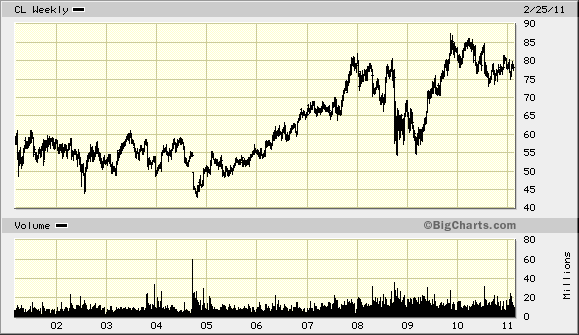
Stock Analysis: Colgate Palmolive

Colgate-Palmolive Company (CL), together with its subsidiaries, manufactures and markets consumer products worldwide. The company is a dividend champion which has increased distributions for 48 years in a row. The most recent dividend increase was in February, when the Board of Directors approved a 9.40% increase to 58 cents/share. The major competitors of Colgate-Palmolive include Clorox (CLX), Procter & Gamble (PG), Church & Dwight (CHD) and Kimberly-Clark (KMB).

Over the past decade this dividend stock has delivered an annualized total return of 4.20% to its loyal shareholders.

The company has managed to deliver an impressive increase in EPS of 9.60% per year since 2001. Analysts expect Colgate-Palmolive to earn $5.06 per share in 2011 and $5.50 per share in 2012. This would be a nice increase from the $4.31/share the company earned in 2010. The company has managed to decrease the number of shares outstanding by 1.30% per year over the past decade through share buybacks, which has aided earnings growth.
The company’s high return on equity has been on the decline since hitting a high of over 400% in the early 2000s. The company’s strong competitive advantages in the oral healthcare field plus the low capital requirements have enabled it to generate high returns on capital. This indicator is still impressive at 78.40%, but has been steadily decreasing, which means that new capital has been employed at progressively lower rates of return. Rather than focus on absolute values for this indicator, I generally want to see at least a stable return on equity over time.

The annual dividend payment has increased by 13% per year since 2001, which is higher than the growth in EPS.


A 13% growth in distributions translates into the dividend payment doubling every 6 years. If we look at historical data, going as far back as 1979, we see that Colgate-Palmolive has actually managed to double its dividend every eight years on average.
Over the past decade the dividend payout ratio has remained at or below 50% for a majority of the time. A lower payout is always a plus, since it leaves room for consistent dividend growth minimizing the impact of short-term fluctuations in earnings.

Currently Colgate-Palmolive is trading at 18.10 times earnings, yields 3.00% and has a sustainable dividend payout. The stock meets my entry criteria, and I will look forward to adding to my existing position in it.

Full Disclosure: Long CL, PG, CLX, KMB

Relevant Articles:


This article was written by Dividend Growth Investor. If you enjoyed this article, please subscribe to my feed [RSS], or have future articles emailed to you [Email] or follow me on Twitter [Twitter].


Continue Reading »

Power Financial Corporation (PWF) Dividend Analysis

Power Financial Corporation is a very interesting company to look at. It is mostly a holding company of a number of other companies with a couple of publicly traded companies in the mix. Namely, Great-West Life (TSE:GWO) and IGM Financial (TSE:IGM). What's interesting is that no only was Power Financial Corporation a Canadian Dividend Aristocrat but its parent company, Power Corporation (TSE:POW), was also an aristocrat along with its two major holdings; Great-West Life and IGM Financial.

By holding Power Financial, you partially own 2 other Canadian dividend aristocrats and minimize exposure of each company's niche markets. In fact, the full set of companies it has a stake in is as follow:

  • Great-West Lifeco Inc.
  • London Life Co.
  • Canada Life Assurance Company
  • IGM Financial Inc.
  • Investors Group In.
  • Mackenzie Financial Corporation
  • Pargesa Holdings SA

Quick Facts

  • Stock Ticker: PWF on TSX
  • Market Cap.: 21.96B$
  • P/E: 15.86
  • Forward P/E: 11.58
  • EPS: $1.95
  • Beta: 0.91
  • Quarterly Dividends: $0.35
  • Dividend Yield: 4.51%
  • ROE: 11.64%
  • 5 Year EPS Growth Average: -3.77%
  • 5 Year Dividend Growth Average: 10.17%
  • 52-Week Low: $27.00
  • 52-Week High: $34.23
  • 52-Week Range: 55.46%
PWF Stock Chart

Dividend Growth

PWF was a Canadian Dividend Aristocrat up until last year when it was dropped for failing to increase dividends during the year. The financial crisis delivered a set back on its ability to deliver a dividend increase. However, don't be fool by the one year miss. Over the past 12 years, PWF increased dividends 18 times with no increases in 2009 and 2010 which means it increased dividends TWICE per year for 9 years. Some companies struggle to increase dividends once  year and PWF managed to do it twice in 9 consecutive years. Even though it will take 5 years for the company to make it back in the dividend aristocrat list, you can't overlook those numbers.

PWF Dividend Growth


Dividend Payout Ratio

The payout ratio has grown above its average recently. If you exclude the last 2 years, its average payout was 38%. Over the past 10 years, it has average at 45%. It's in line with the banks if you want a comparison. It's also not an agressive payout and it can allow them to invest and grow their holdings. If the current payout level continues over the next few years, it could be a sign of concern. Something to pay attention to as the company needs to invest to grow and a high payout could not be sustainable for many years.

PWF Dividend Payout Ratio


EPS Growth

Growth appears to be minimal to flat. I did a test and looked at the growth for a 5 year rolling average and it has shown growth while flattening over the past few years. Not growing earnings is a concern as it increases the payout ratio and reduces the remaining cash on hand to re-invest for growth. While the last 2 years would have seen many of its financial holdings impacted by the financial crisis, I would like to see some growth quarter after quarter over the previous quarters a year ago to show a sign of recovery.

PWF EPS Growth


Thoughts

I have been moving PWF up my interest list this past week. I feel it is currently attractively priced  and ready to grow over the coming years. The financial industry is picking up and the life insurance industry should follow behind the financial services. The dividend yield is definitely attractive and if the company can get back to increasing dividends twice a year, you could expect a healthy dividend income.

Readers: Is Power Financial attractive at this price and yield?

Full Disclosure: At the time of writing I hold no position.

Disclaimer: The material presented should not be considered a recommendation. You should always do your own research and reach your own conclusion.
Enhanced by Zemanta

This article was written by The Passive Income Earner. If you enjoyed this article, please consider subscribing to my feed.


Continue Reading »

Is Walmart Finally A Value Play?

[Shares of Walmart have been in the dumps recently as the stock currently trades at $52 per share. The company’s recent earnings announcement was average at best and the stock dropped again. Walmart may not have much growth but the stock is starting to turn into an accidental high yielder.]

[Same store sales growth was down 1.8% this past quarter after declining 1.3% two quarters ago. This makes it seven straight quarters of negative same store sales growth. Next quarter, same-store sales for the first quarter should are projected to be flat to negative 2 percent. Sales in the United States also declined in the quarter, by 0.5 percent to $71.1 billion.

International earnings are solid with sales increasing 8.9 percent to $31.4 billion for the quarter. This would help to replace the lower domestic growth. Walmart had total revenues of $5.02 billion. Earnings per share came in at $1.41 a share. Both numbers are an improvement over last year’s Q4 numbers.  Earnings rose 6.3 percent to $15.4 billion dollars.

Walmart is a cash cow and has no problems earning cash. The company generates $23 billion dollars in free cash flow and has $7 billion dollars in cash. Shares trade at 11 times this year’s earnings and 10.5 times next year’s. The earnings are projected to grow 10% per annum over the next five years. EPS is up 8% over the previous five years. Walmart trades at 2.69 times sales and 0.44 times book value.

The most attractive aspect of Walmart is the dividend yield. Walmart is currently yielding 2.3%, which is close to solid dividend territory.  The current dividend payout could easily be boosted from its 29% payout ratio. If the company increases its dividend and correct’s its lagging domestic sales, Walmart just may become a value play.
This article was written by [Buy Like Buffett]. If you enjoyed this article, please consider subscribing to my feed at [RSS].


Continue Reading »

Stock Analysis: Medtronic Inc. (MDT)

Linked here is a detailed quantitative analysis of Medtronic Inc. (MDT). Below are some highlights from the above linked analysis:

Company Description: Medtronic Inc.is a global medical device manufacturer has leadership positions in the pacemaker, defibrillator, orthopedic, diabetes management, and other medical markets.

Fair Value: In calculating fair value, I consider the NPV MMA Differential Fair Value along with these four calculations of fair value, see page 2 of the linked PDF for a detailed description:

1. Avg. High Yield Price
2. 20-Year DCF Price
3. Avg. P/E Price
4. Graham Number

MDT is trading at a discount to 1.) and 3.) above. The stock is trading at a slight premium to its calculated fair value of $37.99. MDT did not earn any Stars in this section.

Dividend Analytical Data: In this section there are three possible Stars and three key metrics, see page 2 of the linked PDF for a detailed description:

1. Free Cash Flow Payout
2. Debt To Total Capital
3. Key Metrics
4. Dividend Growth Rate
5. Years of Div. Growth
6. Rolling 4-yr Div. > 15%

MDT earned two Stars in this section for 1.) and 2.) above. A Star was earned since the Free Cash Flow payout ratio was less than 60% and there were no negative Free Cash Flows over the last 10 years. The stock earned a Star as a result of its most recent Debt to Total Capital being less than 45%. The company has paid a cash dividend to shareholders every year since 1977 and has increased its dividend payments for 33 consecutive years.

Dividend Income vs. MMA: Why would you assume the equity risk and invest in a dividend stock if you could earn a better return in a much less risky money market account (MMA)? This section compares the earning ability of this stock with a high yield MMA. Two items are considered in this section, see page 2 of the linked PDF for a detailed description:

1. NPV MMA Diff.
2. Years to > MMA

MDT earned a Star in this section for its NPV MMA Diff. of the $549. This amount is in excess of the $500 target I look for in a stock that has increased dividends as long as MDT has. If MDT grows its dividend at 9.4% per year, it will take 7 years to equal a MMA yielding an estimated 20-year average rate of 3.9%.

Memberships and Peers: MDT is a member of the S&P 500 and a member of the Broad Dividend Achievers™ Index and a Dividend Champion. The company's peer group includes: Becton, Dickinson and Company (BDX) with a 2.1% yield, Baxter International Inc. (BAX) with a 2.4% yield and CR Bard Inc. (BCR) with a 0.7% yield.

Conclusion: MDT did not earn any Stars in the Fair Value section, earned two Stars in the Dividend Analytical Data section and earned one Star in the Dividend Income vs. MMA section for a total of three Stars. This quantitatively ranks MDT as a 3 Star-Hold.

Using my D4L-PreScreen.xls model, I determined the share price would need to increase to $40.23 before MDT's NPV MMA Differential decreased to the $500 minimum that I look for in a stock with 33 years of consecutive dividend increases. At that price the stock would yield 2.24%.

Resetting the D4L-PreScreen.xls model and solving for the dividend growth rate needed to generate the target $500 NPV MMA Differential, the calculated rate is 9.2%. This dividend growth rate is slightly below the 9.2% used in this analysis, thus providing a small margin of safety. MDT has a risk rating of 1.00 which classifies it as a Low risk stock.

MDT owns a diversified portfolio with a strategy to develop products for a wide range of chronic diseases. Although it is exposed to the highly competitive areas of the medical equipment markets, MDT enjoys many competitive advantages including scale (operations and sales), product breadth and financial strength. The stock was a 5-Star buy back in September 2010 when it was last reviewed. It was trading in the low to med-30's at that time. Since then, the price has seen a steady increase to where it is now trading at a slight premium to my fair value price of $37.99. I will continue to buy in moderation on dips and as my allocation allows. For additional information, including the stock’s dividend history, please refer to its data page.

Disclaimer: Material presented here is for informational purposes only. The above quantitative stock analysis, including the Star rating, is mechanically calculated and is based on historical information. The analysis assumes the stock will perform in the future as it has in the past. This is generally never true. Before buying or selling any stock you should do your own research and reach your own conclusion. See my Disclaimer for more information.


Full Disclosure: At the time of this writing, I was long in MDT (3.8% of my Income Portfolio). See a list of all my income holdings here.

Related Articles:
- T. Rowe Price Group Inc. (TROW) Dividend Stock Analysis
- Hormel Foods Corp. (HRL) Dividend Stock Analysis
- Lowe’s Companies, Inc. (LOW) Dividend Stock Analysis
- Southside Bancshares Inc. (SBSI) Dividend Stock Analysis
- More Stock Analysis

This article was written by Dividends4Life. If you enjoyed this article, please subscribe to my feed [RSS], or have future articles emailed to you [Email] or follow me on Twitter [Twitter].


Continue Reading »