Recent Posts From DIV-Net Members

Test Your Investment Strategies First

For some investors using a dividend growth investment approach to select equity investments may represent a new type of stock selection process. It is important for investors to test their investment strategies by constructing phantom stock portfolios before investing real dollars based on these new strategies.
A free website is available, Stocks Quest, where one can test investment strategies. The site is essentially set up like a stock market game. The only requirement for a user is he/she must register with an email address. Once a user is registered, the site provides an investor with $100,000 in fantasy cash. The user can then implement buy and sell transactions and track the performance of their phantom portfolio.

Using a site like Stock Quest site is a good way for an investor to determine how effective their investment strategy performs.

This article was written by Disciplined Approach to Investing. You can visit my site at http://disciplinedinvesting.blogspot.com/ or subscribe to my content by clicking here.


Continue Reading »

Weekend Reading Links - August 30, 2008

For your weekend reading pleasure, the articles listed below contain some of the best dividend and value investing insights found on the web. They were written by various members of the Dividend Investing and Value Network (DIV-Net) over the past week:

Articles From DIV-Net Members

There are some really good articles there, please take time and read a few of them.

If you enjoyed this article, please vote for it by clicking the Buzz Up! button below.


Continue Reading »

Hidden Bank Assets

I came across an article last week talking about banks with some hidden assets. When Visa went public, the banks that owned the network were given shares of the Visa IPO. The reason the stock does not show on bank balance sheets is because the stock can't be sold until 3 years after the IPO. So most of the banks that hold this asset have it listed as a zero balance.

Here are the highlights from the Bloomberg article. Hidden Visa Stake

National City Corp., the Ohio bank whose market value fell 70 percent this year on investor concern that capital may run short, has a $1 billion stake in Visa Inc. that doesn't get counted on its balance sheet.

National City gained $532 million by selling Visa stock when the credit-card company went public in March and still holds 19.7 million Class B shares, according to an August filing by Cleveland-based National City. The stake is probably worth about $1 billion and is carried at zero because sales are restricted, Treasurer Thomas Richlovsky said.

``There's value there that's not being reflected,'' said Charles Mulford, an accounting professor and director of Georgia Institute of Technology's Financial Reporting and Analysis Lab. The bank's stake in San Francisco-based Visa, the world's biggest card network, is ``certainly worth more than zero,'' and National City could sidestep the sale restrictions by using the shares as collateral to obtain financing, he said.

National City owns Class B Visa shares, each currently equal to 71 percent of Class A
shares, which closed at $74.38 on the New York Stock Exchange. The unlisted Class B shares are held by about 1,790 ``member'' banks that owned Visa before it became public, according to Visa's regulatory filings.

The banks must hold Class B shares for three years from the IPO or until settlement of remaining Visa litigation in which the banks may be liable, whichever is longer.

Exceptions include sales to another Class B holder, Visa's filing said. BB&T Corp., North Carolina's third-largest bank, posted a $47 million second-quarter pretax gain from selling Class B shares to an unnamed member bank, Chief Executive Officer John Allison said in a July conference call.

Wells Fargo & Co., Bank of America Corp., JPMorgan Chase & Co., Citigroup Inc. and U.S. Bancorp are among banks that may have held Class B shares after the IPO. Wells Fargo spokeswoman Julia Tunis Bernard said the lender carries Visa shares at a ``nominal amount.'' The San Francisco-based bank said in a first-quarter filing it gained $334 million from the IPO by redeeming 39 percent of its stake.

Bank of America's Scott Silvestri and Citigroup's Shannon Bell declined to comment. JPMorgan's Tanya Madison said the bank holds Class B shares and wouldn't elaborate.

U.S. Bancorp's Steve Dale said the lender holds a Visa stake ``at a zero-cost basis.'' The bank's quarterly filing didn't say how many shares are still held.
Disclosure: The Div Guy owns shares of BAC and USB at the time of this post.

This article was written by The Div Guy. You may email questions or comments to me at thedivguy@gmail.com.


Continue Reading »

The Rule of 72

The power of compounding can be truly amazing. An investment of only $1000 earning 12% will grow to $30,000 in 30 years, compounded annually. If the investment was only earning 6%, it would be worth less than $6,000 over the same time period.

In order to determine quickly how long it takes to double your investments at different rates, I usually use the rule of 72. I simply divide 72 by the annual percentage growth to obtain the time it would take me to double the investment. Thus if you earn 12% annually for example it would take you 6 years to double your investment. At 6% it would take you twice as long or twelve years to double your investment.

In order to determine quickly how long it takes to triple your investments at different rates, I usually use the rule of 115. I simply divide 115 by the annual percentage growth to obtain the time it would take me to double the investment. Thus if you earn 5% annually for example it would take you 23 years to triple your investment. At 13% it would take you nine years to triple your investment.

Relevant Articles:

- Dividend Aristocrats List for 2009
- Dividend Aristocrats
- Best Dividends Stocks for the Long Run
- Best High Yield Dividend Stocks for 2009
- Best CD Rates


This article was written by Dividend Growth Investor. You may email questions or comments to me at dividendgrowthinvestor at gmail dot com.


Continue Reading »

The Mother Lode - Part Two

Last week I wrote on the incredible finds that I discovered at the annual book sale at my local library. Here are the final four that I took home that day;

The Ordinary Business of Life – A History of Economics – Roger E. Backhouse

I think that most investors assume that Economics is a modern study, but Backhouse surveys its history from Ancient times to the present. He doesn’t seem to leave any society out, covering economic thought from Ancient Greece to Rome to Modern ideas that earned Economics its label as the Dismal Science. Economics is another weak spot for me and this should be a good primer on the subject.

The End of Oil – Paul Roberts

It’s no secret that I am bearish on oil prices, even after the decline from $140 to $115. If you don’t believe me then read these posts on my blog. This book looks like it covers both sides of the contentious issue of the timing of the depletion of oil reserves, written in a readable fashion.

The Game Makers – The Story of Parker Brothers – Philip E. Orbanes

I like to read books on individual companies, and how they were built. Although Parker Brothers is known mostly for bringing Monopoly to the public, its history predates that game by many years. George Parker self published his first game in 1883. The game was called the Game of Banking, and it featured bankers speculating and borrowing money to win. I guess some things never change.

Every Man a Speculator: A History of Wall Street in American Life - Steve Fraser

The last book is another tome that surveys the history of Wall Street from its beginnings in the late 1700’s up until the Modern Era. It is more than a dry historical rendering of the institution, but an account of how Wall Street has worked its way into the culture of each generation that it touched.

So now I have eight books to read. I’m not sure how long it will take to finish these off, but I will share any insights that I get from them. I bought these eight books for $24, compared to the published price of around $200. Now that’s Value Investing if I ever saw it.

This article was written by The Stock Market Prognosticator. You may email questions or comments to me at info@brittaincapitalmanagement.com.


Continue Reading »

My Brief Dividend Growth History

Two years ago this month I was 27 years old and I had just opened an online brokerage account with aspirations to build a portfolio for my family's future. I slowly put together a watchlist of stocks and concentrated on saving money and learning as much as I could about stocks and the market. Over time, and as I educated myself, I became naturally attracted to dividend growth investing. The characteristics of dividend growth investing which drew me in are many, and the enthusiastic authors of The DIV-Net will likely cover several of these attributes in detail.

In August of 2006 my dividend portfolio of stocks yielded less than $150/year in income. As the months went by I continued to save money regularly and buy dividend stocks when I felt that they offered good value. Many of the companies I own have raised their dividends several times since I originally bought chunks of them. By August of 2007 my yield had grown to $1,252/year, and today it sits at $2,087/year. Today I continue to view dividends as half of my journey to financial freedom. Dividends are the brushstrokes that I put on today, in creating a masterpiece for the future.

I've been through a lot as a dividend investor, but yet I've been through nothing. I'll write more about what I mean by this in next week's post.

This article was written by the moneygardener.


Continue Reading »

The Four Most Important Metrics When Evaluating Dividend Stocks

As an investor who buys individual dividend stocks, I have developed a pretty robust methodology for evaluating the stocks that I include in my portfolio. I know that I am in no way a perfect investor and my process is far from perfect. In fact, I look to invest in index and pension funds in addition to my dividend stocks as a way to round out my portfolio and balance the risk of buying individual stocks. Individual stocks are riskier than index funds because of the diversification factor. However, I still enjoy individual stock selection and have decided to continue with it. The primary reason is that I am comfortable with the four key metrics I use when selecting my stocks!

Before you freak out on me, please note that I don't only use these four pieces of data when deciding to buy or not buy a dividend stock. However, when examining dividend stocks I believe that these factors are the most important. They help set the tone for the performance of the stocks over the very long term (10 years plus). Not in any particular order, here are the four metrics:

1. At least 10 years of dividend increases
2. A three year dividend growth rate that is greater than 12%
3. An Earnings per share trend that is up, with no more than 2 down years in the past 10 years
4. A debt-to-equity ratio that is less than 50%


I believe that each of these metrics are what really sets a company up for success. The dividend increases is a no brainer - as dividend investors we want the compounding effects of a rising dividend. Add to that a dividend growth rate of 12% and the dividend doubles ever 6 years. If you reinvest your dividends this compound growth is dramatic. Dividends come from earnings so we want a company that is consistently growing their earnings. Finally, debt costs money and cash flow and if it is too high that can mean less for the company to pay out dividends. I want this number as low as possible.

I would love to hear your thoughts on this. If you have other metrics you believe are more important, please use the comments to let me know.

This article was written by The Dividend Guy. You may email questions or comments to me at info@thedividendguyblog.com.


Continue Reading »

Stock Analysis: Avery Dennison (AVY)

Linked here is a PDF copy of my detailed analysis of Avery Dennison (AVY) (alt.1, alt.2). Below are some highlights from the above linked analysis:

Company Description: Avery Dennison Corp. is a leading worldwide manufacturer of pressure-sensitive adhesives and materials, office products, labels, retail systems and specialty chemicals.

Fair Value: I consider four calculations of fair value, see page 2 of the linked PDF for a detailed description:

  1. Avg. High Yield Price
  2. 20-Year DCF Price
  3. Avg. P/E Price
  4. Graham Number
AVY is trading at a discount to 1.) and 3.) above. Since AVY's tangible book value is not meaningful, a Graham number can not be calculated. If I exclude the high and low valuations and average the remaining two, AVY is trading at a 29.2% premium. AVY had a Star deducted for trading at a premium in excess of 5%.

Dividend Analytical Data: In this section I consider five factors, see page 2 of the linked PDF for a detailed description:
  1. Rolling 4-yr Div. > 15%
  2. Dividend Growth Rate
  3. Years of Div. Growth
  4. 1-Yr. > 5-Yr Growth
  5. Payout 15% of avg.
AVY earned one Star in this section for 3.) above. AVY has paid a cash dividend to shareholders every year since 1919 and has increased its dividend payments for 29 consecutive years.

Dividend Income vs. MMA: Why would you assume the equity risk and invest in a dividend stock if you could earn a better return in a much less risky money market account (MMA)? This section compares the earning ability of this stock with a high yield MMA. Two items are considered in this section, see page 2 of the linked PDF for a detailed description:
  1. NPV MMA Diff.
  2. Years to >MMA
AVY earned no Stars in this section, and had one Star deducted for a negative NPV MMA Diff. The negative NPV MMA Diff. means that on a NPV basis for every $1,000 invested in AVY you would earn $1,387 less than a MMA earning a 20-year average rate of 4.61%. If AVY grows its dividend at 1.9% per year, it will never equal the cumulative earnings from a MMA yielding an estimated 20-year average rate of 4.61%.

Other: AVY is a member of the S&P 500, a Dividend Aristocrat and a member of the Broad Dividend Achievers™ Index. AVY is the market leader in pressure-sensitive adhesives and office products. It has enjoyed above-average growth rates in key end-markets and a relatively strong balance sheet. labels. In 2007 AVY acquired Paxar, a major competitor in the product identification industry. AVY should see significant cost savings over the next few years.

Conclusion: AVY lost one Star in the Fair Value section, earned one Star in the Dividend Analytical Data section and lost one Star in the Dividend Income vs. MMA section for a net total of negative one Star. Since my scale bottoms out at zero, this quantitatively ranks AVY as a 0 Star-Avoid stock.

Using my D4L-PreScreen.xls model, I determined the share price would have to drop to $31.03 before AVY's NPV MMA Diff. increases to the $3,000 NPV MMA Diff. I like to see. At that price AVY would yield 5.28%. At 1.9%, AVY's dividend growth rate is anemic. If AVY were to grow its dividend at 7.6% it would reach the desired $3,000 NPV MMA Diff. at the current yield. AVY will not be invited to join my income portfolio anytime soon.

Disclaimer: Material presented here is for informational purposes only. The above quantitative stock analysis, including the Star rating, is mechanically calculated and is based on historical information. The analysis assumes the stock will perform in the future as it has in the past. This is generally never true. Before buying or selling any stock you should do your own research and reach your own conclusion. See my Disclaimer for more information.

Full Disclosure: At the time of this writing, I did not own shares of AVY (0.0% of my Income Portfolio).

What are your thoughts on AVY?


Recent Stock Analyses:


Continue Reading »

Dividend Aristocrats Outperform S&P 500 Index Year To Date

It is expected that in downward trending markets that S&P's Dividend Aristocrats would perform well relative to the S&P 500 Index. In fact, on a year to date basis through August 22, 2008, the Aristocrats are outperforming the major domestic indexes.

As noted in the table below, the Dividend Aristocrats have generated a year to date market cap weighted return of -4.3% versus the S&P 500 return of -12.0%. One short term risk for the Aristocrats is they tend to lag markets that move higher quickly. The Aristocrats are underperforming the Nasdaq Index over the past four weeks.

Dividend Aristocrats performance summary August 22, 2008The table below contains some detail on the Aristocrats. The full Aristocrats spreadsheet can be viewed by clicking this Aristocrats link.


This article was written by Disciplined Approach to Investing. You can email questions or comments to me by clicking here.


Continue Reading »

The Natural Contrarian's Way to Get Poor Quick

I open my mailbox and I see an attractive and colorful envelope with big attention grabbing text shouting "They're back...! Dot-Com Profit Stocks. Inside: $2 Net-stock to Blow Google away!". Thinking about my last loss, I lick my lips in anticipation and tear the envelope apart throwing aside the torn paper towards the bin, not caring whether it went in or not. I feel my heart race and gulp as my trembling fingers reach inside and slowly pull out the piece of paper.

I unfold the letter and the words reveal,

"YOU can make $MILLIONS this time - Here's how"
Yup, sounds like a marketing scam to me.

The reason I bring this up is because Scott Fraser calls himself The Natural Contrarian and a proven master of contrarian strategies. The only contrary thing about this type of investing and marketing is that it goes against all investing basics. Let's see how this contrarian technique holds up against the logical contrarian.

Manipulation of Emotions

The dirty thing with marketing gimmicks to separate innocent people, who want to start investing or learn, from their hard earned money is that they aim and prod at your emotions. We've all regretted to some point not investing in Google at its IPO and this is the type of sly strategy employed.
"Many of you who hesitated and missed out during the first dot-com stock-boom of the late 1990's on Yahoo!, Amazon, and AOL - now have a second chance for fortune with CrowdGather."
IF you had done this, you would be better off. IF you do this, you can get rich quickly. Full of empty IF's.

Why isn't the fact that the majority of internet stocks went bankrupt revealed? People didn't miss out on anything during the tech boom because too many lost everything they had by listening to such folly.

Next Never Comes

One of the biggest and simplest rule of investing is that when someone touts a stock as the "next" or "new era", you should put your head down and run like Bolt. That stock tipper is mostly trying to get into your pockets. The stock that the report pumps up is CrowdGather (CRWG). After visiting the site and running through the SEC filings, it is clearly a don't bother stock for any long term focused investor.

Remember when the universal remote or some other idea was supposed to the next thing? LCD's were indeed the "next" items and it has become a standard, but it also brought about a boatload of competitors and essentially wiped out the "next" factor.

No Basics. Only Speculation.

If you or your financially less inclined family, relatives or friends come across such reports, point them to the fact that these reports have no factual information. The one I have in front of me is filled with "I project", "I'm tell you to buy" and "you will miss out if you wait".

Here is another sample of what I am talking about.
"Two recent developments strongly support my high profit expectations for early CRWG shareholders:

1. CrowdGather's new management team has logged extensive histories at such media titans as Yahoo! ,AOL, LionsGate, and Playboy.

2.CrowdGather's streamlines $65 million market cap makes the company an almost irresistable acquisition target."
Who but speculators buy based on their hunch that it could be a takeover target? I call this hunch the "it's time to sit on the toilet" hunch.

So it seems like this technique revolves around buying penny stocks, spreading rumors, hyping it up some more and then dump it for a personal gain.

Looking at the Natural Contrarian's site and his buy recommendations, people who listened to him would be poor over and over again. His "recommendations" are ALL OTC, recently public, no history companies now trading around 60% lower from its initial price.

Get Rich Quick and You'll Die Trying

It's a perverse human nature to want things immediately. We don't want to wait for anything. It's been like that since we were born. This is especially more true when it comes to money and it's a shame that too many eager people fall victim to such rubbish in the hopes of making a million dollars overnight. The sad thing is, you'll probably die first before it happens.

Why not stick with the safe and sensible way of gaining wealth? Do you hand your money to a gambler and ask him to multiply it 10 fold the next time he goes to the casino?

I also believe that an investor's role isn't just constrained to building personal wealth but extends to helping others obtain financial understanding and helping them succeed financially.

This article was written by Old School Value. You may email questions or comments to me at jjun0366@gmail.com


Continue Reading »

New High Yield Dividend Stock: DCP Midstream Partners LP (DPM)

I was looking through the 52 week stock lows the other day for some ideas for a new stock purchase and came across a couple of natural gas pipeline companies that had come down in price over the past few months. I looked over several other pipeline companies and found that most were down over the past six months, some were down over 40% so far this year.

I currently own the natural gas pipeline company Kinder Morgan Energy Partners which has performed very well for me. I first started purchasing shares of Kinder Morgan Energy Partners (KMP) in October of 2002 and I have been very happy with the long term stock performance as well as the increasing dividend income. KMP is my largest stock holding and I think at the current price the stock is fairly valued. Since I have a large holding in KMP and receive a large quarterly dividend I decided I would look to purchase another pipeline company that may be a better value at this time.

I did some further research using S&P data and I selected DCP Midstream Partners (DPM) as the stock I will purchase with my distributions from KMP. While researching DPM in S&P, I also realized that one of my current holdings Spectra Energy (SE) is an owner of DCP Midstream. SE was spun off from Duke Energy last year and the partnership was named DCP from Duke and ConocoPhillips which originally started the partnership.

DPM is a midstream master limited partnership formed by DCP Midstream to own, operate, acquire and develop a diversified portfolio of complementary midstream assets. DCP Midstream leads the midstream segment as one of the nation's largest natural gas gatherers and processors, the largest natural gas liquids (NGLs) producer and one of the largest NGL marketers in the U.S. DCP Midstream was formed in December 2005 and is a 50-50 joint venture between Spectra Energy and ConocoPhillips.

What I like about DPM
1. DPM continues to have strong earnings growth.
2. DPM has increased quarterly distributions from $.35 to $.60 with increases every quarter since the first payment in May 2006.
3. The majority owners of DPM are Spectra Energy and ConocoPhillips which are well run companies and have very deep pockets.
4. They have several projects nearing completion and in planning stages which will help the company grow organically
5. The dividend yield is over 9%

Disclosure: The Div Guy owns shares of SE and DPM at the time of this post

This article was written by The Div Guy. You may email questions or comments to me at thedivguy@gmail.com.


Continue Reading »

Diageo (DEO) Dividend analysis

Diageo plc engages in producing, distilling, brewing, bottling, packaging, distributing, developing, and marketing spirits, beer, and wine worldwide.

Diageo is an international dividend achiever. It has been increasing its dividends for the past 10 consecutive years. From the end of 1997 up until August 2008 this dividend growth stock has delivered an annual average total return of 10.90 % to its shareholders. Diageo is the first international dividend company that I have analyzed in my pursuit of international exposure for my stock portfolio.


At the same time company has managed to deliver a 7.20% average annual increase in its EPS since 1998.

The ROE has increased from 29% in 1998 to 36% in 2007.

Annual dividend payments have increased over the past 10 years by an average of 8.10% each year, which is higher than the growth in EPS. An 8% growth in dividends translates into the dividend payment doubling almost every 9 years. DEO has indeed managed to double its annual dividend payment of $1.395 in 1999 last year (2007).

If we invested $100,000 in DEO on December 31, 1997 we would have bought 2892 shares. In April 1998 your semi-annual dividend income would have been $2406. If you kept reinvesting the dividends though instead of spending them, your semi-annual dividend income would have risen to $6582 in September 2007 and $4272 by June 2008. For a period of 10 years, your annual dividend income would have increased by 67%. If you reinvested it though, your annual dividend income would have increased by 129.60%.


The dividend payout has remained above 50% for the majority of our study period with the exception of 2006. A lower payout is always a plus, since it leaves room for consistent dividend growth minimizing the impact of short-term fluctuations in earnings.


I think that DEO is attractively valued with its low price/earnings multiple of 16 and above average yield at 3.60%. Even though the dividend payout is higher than the 50% I like the fact that it is has been steadily decreasing over the past decade.


I will keep looking for growing internationally based corporations which have increased their dividends and earnings consistently for at least five to ten years.

Disclosure: I do not own shares of DEO

Relevant Articles:

- Dividend Aristocrats List for 2009
- Dividend Aristocrats
- Best Dividends Stocks for the Long Run
- Best High Yield Dividend Stocks for 2009
- Best CD Rates

This article was written by Dividend Growth Investor. You may email questions or comments to me at dividendgrowthinvestor at gmail dot com.


Continue Reading »

The Mother Lode

Every year my local library holds a book sale to get rid of its excess books. I’m not sure why they do this rather than put the books on the shelves for people to check out, but it is a much anticipated event in my household.

The book sale was last weekend and I appeared to have hit the Mother Lode in my shopping. I specifically targeted books that dealt with investing or the history of business. Here is what I came up with:

Reminiscences of a Stock Operator - Edwin Lefèvre

This is the classic book on trading that was first published in 1923, and it has been circulating at Wall Street firms for generations. I was always on the list to get the house copy at every firm I worked for but I always moved on before I could get a crack at it. The legend is that it is about the life of Jesse Livermore, who is widely regarded as the greatest trader who ever lived. I’ve read about 70 pages, and all I can say so far is thank God I didn’t live in his era. If you think that speculators and short term investors are a problem now, it was nothing compared to the early part of the twentieth century.

The Great Wall Street Scandal – Raymond L. Dirks

Before Ken Lay at Enron and Bernie Ebbers at WorldCom, there was Equity Funding, an insurance company that was the darling of Wall Street in the 1970’s and then became the biggest scandal to hit the Street in a generation. Ray Dirks, an analyst, discovered it was a fraud after getting tipped by an employee at Equity Funding. He made it public and then spent the next ten years fighting the SEC over insider trading.

His legal case was a CFA reading when I took Level I, and years later he visited Morgan Stanley, where I was working, and I ended up meeting him. It’s not that easy to face down the legal power of the Federal Government, but he stuck to his guns and he won in the end. The book was co written by Dirks and should be some good reading.

Greenback – The Almighty Dollar and the Invention of America – Jason Goodwin

The dollar has been in the news lately, and I have to admit that I should know more about my own currency. This looks like a very readable history of the dollar from Colonial Times to the present. Did you know that the U.S invented paper currency? That nobody really knows the origin of the ubiquitous $ (dollar sign) - although an enterprising writer tracked its first use to a letter written in 1778?

Of Permanent Value – Andrew Kilpatrick

This one, of course, needs no introduction. It is the story of Warren Buffett, and I am actually ashamed that I haven’t read it yet despite being a fairly hard-core Value guy. This is the 1998 hardcover edition and it runs nearly 900 pages, and doesn’t seem like it leaves out much.

More Next Thursday

This article was written by The Stock Market Prognosticator. You may email questions or comments to me at info@brittaincapitalmanagement.com.


Continue Reading »

Value Stimulus - PFBC:

Value Stimulus – PFBC:
In my posts labelled Value Insight I enjoy giving readers a perspective of my investing habits and what stocks or themes I might be currently researching, investigating or investing in that I perceive to hold value.

I focus a great deal on management in my stock analysis because through experience I've found that the habits, actions and personal interests of those in a decision making role can indicate what goes on behind the scenes of a company with certain accuracy and confidence. While this may or may not always lead me to invest in a company; it often helps to provide a balanced perspective of other factors I'm analyzing that influence my investing decisions.

I'm a firm believer that actions speak louder than words based on my personal and professional experiences. Investors over history have been badly led astray by CEO's and corporate officers who promise one thing and then do the opposite. Investors' base their decisions at times on these statements by management and often vent their frustrations with not knowing how to differentiate between the good & bad or when to steer clear of obvious trouble.

My 5% Rule and previous post on the Importance of Management might still leave some investors with their eyebrows raised, so I thought that I'd use a recent example as a better description of how I put the concepts of management to successful use when investing. In the wake of the subprime mortgage crisis and subsequent collapse of financial stock valuations I made a few key observations that went against the trend of the past few years. It's not uncommon for financial officers of large or small corporations to own a significant number of shares in their company through stock option plans or direct share purchases. Over the past twelve months I made the observation that CEO's, Board of Directors and other corporate officers weren't buying shares in any significant amount throughout this credit crisis.

The conclusions I came to were:

  • The current share prices, although having dropped 20-50%, didn't appear to offer management tangible value
  • Sale of shares was indicating that management had a lack of faith in the ability of the companies to curb losses.
  • Management anticipated the share price to continue dropping by not buying or stopping share purchases altogether on previously regular schedules
  • Share dilution via issuance of common & preferred shares to raise capital has yet to cease
  • Losses & write downs were still imminent and expected
  • Finding any bank stock where management was aggressively buying shares might indicate stronger fundamentals and a miss pricing by the market.

Of course the last conclusion, finding a bank whose management was buying shares aggressively, turned out to be similar to finding a needle in a haystack. To further frustrate my initial research I continuously found that the management of many of the large-cap stocks I was investigating were continuously making adamant statements that their dividends were safe, but weren't buying shares at these historically high yields. I soon found out why when those CEO's subsequently slashed the dividends weeks later and were given their walking papers shortly after.


Even though the US financial industry is highly fragmented, I decided to give up on my research of the large capitalized banks and instead focus on many of the smaller regional banks.


The criterion for further investigation was fairly simple:


  • Firms whose management and/or Board of Directors were buying shares in the company more aggressively than the previous schedule
  • Firms with higher loan quality and diversified business operations
  • Firms with a Value Stimulus of one or more of my Value Rules

After weeding initially through 30-40 names I came across two promising prospects for further research: Preferred Bank of Los Angeles (PFBC) & Associated Banc-Corp (ASBC).

In my previous posts on management I've brought up a few key items that I concentrate on to evaluate management. One of the most important is weighing what a CEO or corporate officer is saying and evaluating their actions. I listen to what management has to say and then I scrutinize what those individuals are doing behind the scenes to see if they're backing up their statements where it counts the most. One of the most important factors for giving management a "pass" in my analysis is ensuring that their interests are aligned with those of me and shareholders. A CEO can "state" publically that the company's' dividend is safe, but what is he/she doing with their own shares of the company?


CEO's and other stakeholders are just like you and me when it comes to their money. They might make more than you or I, but money is just as important to them to fund their lifestyles, needs and wants. A manager who has a significant vested financial interest in the company is likely to have the same interests as me as a shareholder and when they buy shares at depressed prices are likely doing so because they know they're getting a deal.


Why would a CEO buy 80% of his/her annual share purchases at a 52-week high when they can buy that same allotment of shares at a 52-week low?


One of the first surprising developments that I noticed about PFBC was in their Insider Ownership Filings which are required to be made public and filed with the SEC. PFBC started 2008 with 8% of their total shares outstanding (TSO) held by members of the Board of Directors and upper management. From January 1st to June 18th of this year that number swelled to just under 20%.


To put this into perspective, although PFBC is a much smaller bank, this would be similar to watching Warren Buffett & Berkshire Hathaway (BRK.A) purchasing over $9B worth of Wells Fargo (WFC) during the same time period. Add in that bank employees already owned 10% of the TSO and PFBC had 30% of the company's shares held by direct stakeholders involved in the day-to-day activities of the business.


Through my subsequent research I was impressed with the following information:


  • PFBC had continued to pay a dividend in difficult market conditions in line with their previously targeted payout
  • Total assets vs. loans remained conservative
  • Capital ratios of the bank remained intact without raising additional equity
  • 41% of California's Chinese population (a key target market) live within the operating geography of the banks' branches
  • Loan portfolio was dominated by commercial loans
  • High focus on wealth management which diversified into other revenue sources unaffected by the housing market
  • Geographic penetration of the bank was spread conservatively between residential and commercial areas of LA County.

After running more numbers I felt confident in the actions of management and the BoD's and began to track the bank closely on my watchlist. I felt the risk/reward was balanced in my favour since the fundamentals of the business remained sound and as the market continued to heavily discount the stock in sympathy to other regional bank failures I made a purchase of PFBC on July 15th.

I came to the basic conclusion that either management & the BoD's had more money than brains OR they knew the shares were dramatically under-valued.


I certainly don't advocate that an investor simply use this as an example for an investing thesis and put their capital at risk blindly. My initial research amounted to nearly 15 hours of investigation before I had a reasonable comfort level with determining what price I was willing to pay and evaluating the risk/reward of this investment.


This simply serves as an insight into how I conduct some of my research in value stocks and how I use management at times to evaluate an investment.


Disclosure: I hold positions in PFBC, ASBC, & WFC

This article was written by Triaging My Way To Financial Success. You may email questions or comments to me at nurseb911[AT]gmail.com.


Continue Reading »

No Dividend, No Way

Sometimes being a dividend investor sucks. As part of my overall investing strategy, I state that 'dividends are half the journey'. This essentially rules out any potential investments that pay a very small, and/or non-growing dividend. There are a few stocks, with stories that I believe in long term that were eliminated from my watchlist because of this fact.

Google (GOOG) - This company is pure internet genius. Their products continue to amaze and delight me. Google should continue to find ways to profit from their innovation and dominance online well into the future. No dividend.

FedEx (FDX) - Globalization, barriers to entry, great brand. Too bad UPS pays a nice rising dividend. Low dividend.

Starbucks (SBUX) - Fabulous brand! Room for growth worldwide as developing country consumers indulge in coffee decadence. Also potential for growth of non-food products. No dividend.

In my opinion these three firms are all good long term investments, but without the power of dividend growth behind them, they're just not worth my investment dollars.

This article was written by the moneygardener. You may email questions or comments to me at [themoneygardener(at)gmail.com].


Continue Reading »

What a Couple of Days Away From the Stock Market Can Teach You

I have recently completely relocated my family from our comfortable lives in Canada to a much different life in Norway. My company has moved me and so far it has been the experience of our lives. Many new sites, things to do, and cultural experiences to learn from. Like any move, whether it is down the street or to a completely different continent 1000's of kilometers away, there are always issues that come up. One such issue has been the set up of our internet service and keeping a secure connection.

Norway is a very technically advanced country. In many ways I believe they are many years ahead. Banking is a good example. The entire banking system here is a seemless well oiled machine. There is absolutely no paper involved and things just work. However, my internet connection has not been as reliable, primarily because of some faulty setup of our modem. Completely at random, we would lose the connection to the internet and my blogging activities and ways to be connected with home disappeared - we use VoIP as our phone which means that when the internet is down so is our phone. However, as I was reflecting on the post I needed to write for this blog as the deadline was looming, one thing occurred to me - it was actually nice not to have to look at the market or even think about investing for a couple of days! And you know what, nothing happened while being disconnected and my stocks ebbed and flowed as they always do.

The lesson for me in all of this, is that it is ok not to watch the market all the time and worry about how your positions are doing, especially if you are a long-term investor. Stocks are going to go up and down. Your portfolio is going to go up and down. If your portfolio is well structured and you have a balanced asset allocation, then things will turn out just fine. Overactivity can actually be an investor's downfall - fees, emotional reactions etc. Disconnect yourself for a while and you will see!

Now I am going to go pick the kids up from school and take them to the beach to enjoy the sun.

This article was written by The Dividend Guy. You may email questions or comments to me at info@thedividendguyblog.com.


Continue Reading »

Stock Analysis: Walgreen Co (WAG)

Linked here is a PDF copy of my detailed analysis of Walgreen Co (WAG) (alt.1, alt.2). Below are some highlights from the above linked analysis:

Company Description: Walgreen Co is the largest U.S. retail drug chain in terms of revenues. It sells prescription and non-prescription drugs, beauty care, personal care, household items, candy, photofinishing, greeting cards, seasonal items and convenience foods.

Fair Value: I consider four calculations of fair value, see page 2 of the linked PDF for a detailed description:

  1. Avg. High Yield Price
  2. 20-Year DCF Price
  3. Avg. P/E Price
  4. Graham Number
WAG is trading at a discount to 1.), 2.) and 3.) above. If I exclude the high and low valuation and average the remaining two, WAG is trading at a 31.1% discount. WAG earned a Star in this section since it is trading at a fair value.

Dividend Analytical Data: In this section I consider five factors, see page 2 of the linked PDF for a detailed description:
  1. Rolling 4-yr Div. > 15%
  2. Dividend Growth Rate
  3. Years of Div. Growth
  4. 1-Yr. > 5-Yr Growth
  5. Payout 15% of avg.
WAG earned two Stars in this section for 3.) and 4.) above. WAG has paid a cash dividend to shareholders every year since 1933 and has increased its dividend payments for 33 consecutive years. It's one year dividend growth rate exceeded its 5-year growth rate. This could indicate the growth rate is accelerating.

Dividend Income vs. MMA: Why would you assume the equity risk and invest in a dividend stock if you could earn a better return in a much less risky money market account (MMA)? This section compares the earning ability of this stock with a high yield MMA. Two items are considered in this section, see page 2 of the linked PDF for a detailed description:
  1. NPV MMA Diff.
  2. Years to >MMA
WAG earned no Stars in this section, and had one Star deducted for a negative NPV MMA Diff. The negative NPV MMA Diff. means that on a NPV basis for every $1,000 invested in WAG you would earn $3,175 less than a MMA earning a 20-year average rate of 4.61%. If WAG grows its dividend at 11.9% per year, it will never equal the cumulative earnings from a MMA yielding an estimated 20-year average rate of 4.61%.

Other: WAG is a member of the S&P 500, a Dividend Aristocrat and a member of the Broad Dividend Achievers™ Index. WAG should benefit from increased generic drug sales, new Medicare legislation, new store growth and an aging U.S. population. Potential threats would include the growth of non-traditional competitors, such as Wal-Mart (WMT), et. al., and potential legislation changes.

Conclusion: WAG earned one Star in the Fair Value section, earned two Stars in the Dividend Analytical Data section and lost one Star in the Dividend Income vs. MMA section for a net total of two Stars. This quantitatively ranks WAG as a 2 Star-Weak stock.

Using my D4L-PreScreen.xls model, I determined the share price would have to drop to $17.27 before WAG's NPV MMA Diff. increases to the $3,000 NPV MMA Diff. I like to see. At that price WAG would yield 2.41%. As a value investment WAG could possibly have merit. However, as a dividend investment WAG comes up short at this time.

Disclaimer: Material presented here is for informational purposes only. The above quantitative stock analysis, including the Star rating, is mechanically calculated and is based on historical information. The analysis assumes the stock will perform in the future as it has in the past. This is generally never true. Before buying or selling any stock you should do your own research and reach your own conclusion. See my Disclaimer for more information.

Full Disclosure: At the time of this writing, I had no position in WAG (0.0% of my Income Portfolio).

What are your thoughts on WAG?


Recent Stock Analyses:
This article was written by Dividends4Life. You may email questions or comments to me at bbkjbbkj@gmail.com.


Continue Reading »

Media And The Market Often Disconnected

I recently read an article by Dick Davis of the famed Dick Davis Digest titled, The Stock Market and the Media: Turn It on, But Tune It Out, that essentially highlights the fact the news media tends to be out of sync with future market action. Dick Davis is also the author of The Dick Davis Dividend. My take on his media article is the news media tends to focus on short term news information that sometimes tends to impact a stock's price. However, the long run direction of a stock's price is going to be impacted by long term trends impacting a company's business.

Dick Davis makes the point that:
Part of the problem is that, while some news does involve sharp and sudden stock reactions (only when it involves surprise), most of the never-ending flood of daily news is routine, insignificant and meaningless in terms of durable impact. It is important to PR firms, journalists, TV reporters and traders because it gives them a means of making a living. But to the long-term investor, it is little more than filler and noise.

...The truth is that, except in cases of obvious causality (when the news triggers an immediate and decisive reaction), we never know for sure why the market or a stock does what it does. Since a stock is bought and sold by thousands of individuals every day, it’s reasonable to assume there is more than one reason causing its behavior. In fact, there can be a myriad of reasons, some knowable, others not knowable. Buy and sell decisions are often motivated by a host of non-news-related, silent triggers that are rarely cited by the media.
The article notes six points that should be alluded to in news reports trying to explain the gyrations in the market:
1. The stock market itself is the all-powerful final arbiter. The day, hour, or minute it feels the rubber band has been stretched too far, it’ll do something about it, not before.

2. Human emotions, responding to the markets’ gyrations and triggered by fear and greed, likely play a key role.

3. Worries over a wide range of overlapping factors, both fundamental and technical, may or may not be additional influences. (Future market historians may well cite long-standing housing and credit worries as major factors in shaping the market’s trend. The significance of their role on the particular day of July 26, however, is unknowable.)

4. A market that acts randomly and irrationally cannot be explained logically.

5. Except in cases of surprise, most news is irrelevant in explaining the market’s action on a particular day. The stock market leads; the news follows.

6. The answer to the question, “Why today?,” is: “I don’t know—nor does anyone else.” The markets are complex and perverse. They defy definitive answers.
As an investor then, remember the news media is most often reporting on events that are of a short term consequence and have occurred in the past. Certainly this is not the case with all news reports, but I do believe it is the case with most. An example of this might be the cover article I read on oil that appeared in a BusinessWeek magazine a few months ago. The word "Oil" took up a large portion of the cover. Well, the bubble in oil seems to be popping.

Source:

The Stock Market and the Media: Turn It on, But Tune It Out
The American Association of Individual Investors
By: Dick Davis
2008
http://www.aaii.com/includes/DisplayArticle.cfm?Article_Id=3516&digit=103

This article was written by Disciplined Approach to Investing. You can email questions or comments to me by clicking here.


Continue Reading »

Jazz Technologies Merger Arbitrage

Jazz Technologies (JAZ) announced on May 19, 2008 that they are being acquired by Tower Semiconductor (TSEM). The final decision of the deal is expected to announced dependent on the results of the special meeting of shareholders scheduled for September 17, 2008. When I started to look into this merger yesterday, the spread was at 15%. Today, August 13, the spread fluctuates between 6-9%. However, this still comes out to an annualized gain in the range of 40-72%.

Basics Of The Merger

  • If the deal goes through, each share of JAZ will be converted to 1.8 shares of TSEM.
  • Fractional shares will be paid in cash
  • JAZ options, vested or unvested, will be exercisable for 1.8x Tower ordinary shares.
  • All approvals received and the only hurdle left is shareholder approval by Jazz shareholders.
  • For more background on the merger and both companies, you can view a presentation by going here.

Termination Details

The termination conditions for this merger allow both parties to walk away fairly easily without much pain. The usual clauses pertaining to delays, failure to recommend the merger, failure to meet legal requirements etc are in there for good measure but the point that caught my attention is that the "Jazz has agreed to pay Tower a termination fee of $1.2 million and reimburse Tower for up to $1 million in expenses incurred in connection with the transaction..."

With this type of exit path, Jazz probably wouldn't feel any burden or impact if it did decide to cancel the merger. However, the chances of this happening at this stage is very low.

Ever since Jazz went public with an IPO price of $6, their stock price has been falling. Therefore a 120% premium offer at the time of the merger is a definite welcome one which the company and shareholders would gladly accept.

The merger also restricts Jazz from soliciting other transactions which means that it has to be Tower. Take it or leave it.

Approvals

The acquiring company, Tower Semiconductors, is an Israeli company and so the approval process is slightly different.

Tower's submission of form F-4 has been declared effective by the SEC, clearing the way for Jazz shareholder approval. Tower does not require approval by its own shareholders.

Additionally, Tower must receive the following approvals in Israel.
  1. approval of the Office of the Chief Scientist of the Israeli Ministry of Industry, Trade and Labor; (received June 3)
  2. approval of the Israeli Investment Center of the Israeli Ministry of Industry, Trade and Labor; (submitted)
  3. approval of the Israel Lands Administration; and
  4. approval of the Tel-Aviv Stock Exchange (listing of additional shares) (to be submitted at or around date of closing)
As it stands, all important milestones have been achieved in the merger process except the Jazz shareholder approval but this doesn't really worry me because as I stated above, it would be crazy for shareholders to go against the merger.

While insiders also own roughly 20% of common stock, there are two companies that own about 31% and 29%. I can't say for sure that it will be a unanimous vote, but insiders holding 20% is a large amount and one which could positively affect the outcome.

Completion Details

Since each share of Jazz is converted to 1.8 shares of Tower, the final closing price depends on Tower's share price. Looking at Tower's price, it isn't doing very well either and is continually falling. There is a high likelihood that it could erode the spread completely.

So far this is how I see the merger. I also outlined a process I learnt and follow here.
  1. Due diligence by both parties - Yes
  2. Financing and regulator approval - Yes. No financing involved since shares are converted to 1.8x Towers. However, Tower is currently in "negotiation of a restructuring arrangement of its long-term debt with its lender banks, Bank Leumi and Bank Hapoalim, and one of its major shareholders, Israel Corporation Ltd. The restructuring will include a substantial reduction in the level of the Company's debt to its banks and Israel Corporation, deferrals of remaining principal and interest, and a waiver from compliance with financial covenants for an extended period of time." - D&R News
  3. Get preliminary shareholder sentiment (or controlling shareholder approval) - N/A
  4. Obtain regulator (SEC, FCC, any and all) approval - Yes
  5. Get final shareholder approval at a meeting called for that purpose - TBD

Risks

The risks I see are as follows:
  • Tower shares are thinly traded so even if the merger is successful, it may be difficult to sell.
  • If Tower share price continues to fall, a loss could be incurred
  • Tower is not a company I want to hold onto. No moat company in a bad industry.
  • Merger could be canceled. (low chance)
  • May not pass shareholders

Conclusion

From the information I have gathered, the merger is likely to go through. However, what is important is the price of Tower on the date of closing. If it decline at its current rate, this merger may not be worth it if the entry price is any higher than what it is now.

The merger is very low profile without much information being given out by either party. Jazz made it clear in their latest conference call that they would not answer any detailed questions related to the merger itself.

In terms of probability, I see the merger has a greater probability of closing than failing.

Disclaimer

No positions in JAZ at this time but I am considering.

This article was written by Old School Value. You may email questions or comments to me at jjun0366@gmail.com


Continue Reading »

The Easy Way: Dividend ETFs

I realize some investors out there may be interested in investing in dividend stocks but may not be ready to purchase their own stocks and manage their own portfolio. Additionally some investors may not have the time or want to select their own stocks but want the benefits of investing in dividend stocks. Exchange Traded Funds (ETF's) are a great way way for investors to participate in stocks but not have the burden of selecting individual stocks.

First a definition of ETF's. An ETF is a group of stocks similar to a mutual except ETF's are traded on the stock exchange like other company stock. Most ETF's are based on a stock index such as the S&P 500.

ETF’s provide more flexibility since you can trade them on the stock market any time during the day. Low costs are another advantage of ETFs because their expenses are typically lower than mutual funds including index funds.

To get the maximum cost saving with ETF, look at using a low cost or no cost broker such as Zecco Trading. Even with low fees, brokerage commissions can seriously erode ETF costs when investing small sums of money.

The number of Dividend ETF's has been exploding with more coming to market each month. One of the oldest is iShares Dow Jones Select Dividend Index (DVY) from Barclays. DVY was started in 2003 and most Dividend ETF's can thank the Jobs and Growth Tax Relief Reconciliation Act of 2003 for their popularity. This tax act was signed into law in May of 2003 and lowered the tax rate on dividends to 15%. REIT's and foreign company dividends were excluded from the lower tax rate of this law.

Here are links to some popular Dividend ETF's
DTN WisdomTree Dividend Top 100
FDL First Trust Morningstar Dividend Leaders
VIG Vanguard Dividend Appreciation
VYM Vanguard High Dividend Yield
PEY Powershares High Yield Dividend Achievers
AGD Alpine Total Dynamic Dividend Fund

Here are links to some of the major providers of ETF's.
Barclays iShares
Vanguard
Powershares
WisdomTree


Disclosure: The Div Guy does not own any ETFs at the time of this post but I do own Shares of Barclays (BCS) which is the creator of iShares ETFs.


This article was written by The Div Guy. You may email questions or comments to me at thedivguy@gmail.com.


Continue Reading »

Dividend Growth and Earnings Per Share versus Total Return

Ever since I started analyzing stocks on my blog, I have been gathering information about several stocks in my data folders. I wanted to check what was the relationship between the ten year dividend growth rate and the ten year total return of the stocks that I previously covered on my blog. This is not a comprehensive list and the sample is biased as it mostly contains dividend aristocrats that I believed were priced attractively at the time (although most recently I have been writing about stocks that weren’t priced attractively). The average annual total return, eps and dividend growth for the 1998-2007 period were 8.8%, 9.9% and 10.5% respectively.


From that list I managed to select only the stocks which delivered at least a ten percent average annual EPS and dividend increases. A 10% increase in dividends double your annual dividend income after seven years. There were fifteen stocks that fit this list. The average total return was 10.46% for this group, with average dividend growth at 14% versus the 13.4% average EPS growth over the 1998-2007 period.

How did slower dividend growers perform over the past decade? I then screened for stocks which had EPS and dividend growth at less than ten percent. This screen produced thirteen candidates. The average total return was 8.35% for this group, with average dividend growth at 5.75% versus the 4.80% average EPS growth over the 1998-2007 period.

It’s interesting to note that stocks in the 46 company sample that merely raised their dividends by 10% on average over the past ten years achieved an average annual total return of 8.60%, which was slightly lower when compared to the 9.10% total return of stocks which had an annual dividend growth rate of less than 10% per annum.

The stocks that delivered at least a ten percent eps growth outperformed the rest of the group by over 2.4%. Companies that delivered an EPS growth which was higher than 10% per annum produced a total return of 10.2% versus 7.70% for the companies that produced EPS growth which was less than ten percent.

To summarize in order to be successful at dividend investing, the astute investor should not just check the dividend growth rate in isolation, but check the overall fundamental picture of the company in order to ensure that the dividend growth rate is covered by the growth in earnings per share.

This article was written by Dividend Growth Investor. You may email questions or comments to me at dividendgrowthinvestor at gmail dot com.


Continue Reading »

National Western Life Insurance (NWLIA) - An Update

On July 17, I wrote on The Div-Net on a little known life insurance company called National Western Life (NWLIA). The company reported earnings last week and I wanted to update my thoughts on the stock

NWLIA reported net earnings of $18.1 million, or $5.10 per diluted Class A share.

Operating revenues were $127.4 million. This measure excludes realized investment and derivative gains or losses. The company uses derivatives to hedge its exposure to the equity market due to its product mix.

Book value per share at June 30, 2008 increased to $283.94.

Due to the current market hysteria on fixed income investments held by financial institutions, NWLIA provided more detail on its investment portfolio as follows:

The total size of the portfolio is $5.8 billion, with 96% classified as debt securities.

NWLIA holds $98.2 million in asset-backed securities comprised of $47.4 million of manufactured housing bonds and $50.8 million of sub prime home equity loans. They also own one Alt-A security with a carrying value of $4.1 million.

No holdings in collateralized bond obligations (CBOs), collateralized debt obligations (CDOs), or collateralized loan obligations (CLOs).

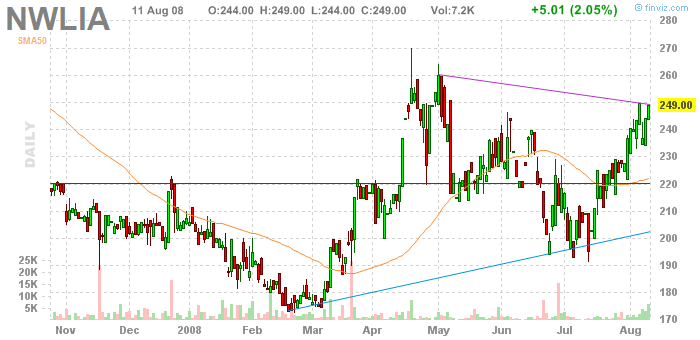
The stock has rallied nicely from around $200 to $249 at yesterday's close. This is getting closer to the last reported book value of $283.94.

I still own some shares of NWLIA. If you are a short term investor, you might want to think about getting out of the stock as it trades up above $250, as the stock rarely ever trades at more than one times its book value.


This article was written by The Stock Market Prognosticator. You may email questions or comments to me at info@brittaincapitalmanagement.com.


Continue Reading »

The Future of Canadian Dividend Growth II

In the quest to select solid dividend paying stocks that will appreciate over time and pay ever-increasing cash back to us in the form of dividends, success lies in the future, not the past. Sometimes the best dividend growing stocks for the future might be only in their infancy as far as dividend growth goes. As investors, if we can spot these stocks early we can be rewarded in spades as the years go by. A few Canadian companies strike me as fitting into this category very well.

Rogers Communications (RCI.B) operates in three segments: Wireless, Cable and Media in Canada. I'm not sure if you've noticed but a lot of people have cell phones now that didn't five years ago. Cellphones are a way of life in Canada, and with that status they'll join the realm of the household gas bill as far as necessities go. Starting out as a cable company, Rogers has done an excellent job of grabbing more customers by offering products such as home phone, high speed Internet, and in the process undercutting a large, stodgy competitor (Bell Canada). When you bundle all of Rogers products together households are spending upwards of $200 per month for the complete package. This consistent cash flow is the type of revenue that dividend investors should love. Did I mention Rogers runs on the geographically more broadly based GSM network and is the only Canadian provider of Apple's iPhone because of this. I see Rogers having a great future as Canadians move toward higher tech products and services as they age. They are well positioned to complete against competitors like Bell, Telus, and Shaw.

Here is a glance at Rogers Communications' recent dividend activity:

2005 = $0.07
2006 = $0.08
2007 = $0.43
2008 = $1.00 (EST)

This represents a compound annual growth rate of the dividend of 143%. As with Shoppers Drug Mart (SC) the caveat with Rogers Communications as an investment is the stock price. Rogers trades at a P/E of 20x earnings which at first glance seems expensive for a phone/cable company, but when you peel back the layers and really look at this company this may turn out to be a fair price as the stock has come off significantly in recent weeks. The stock currently yields 2.8%. Rogers is just starting out as a dividend growth name, but I have a feeling that in ten years dividend growth investors will look back and wish they had bought this name.

Disclosure - I do not own shares of RCI.B

This article was written by the moneygardener. You may email questions or comments to me at themoneygardener(at)gmail.com


Continue Reading »

Mutual Fund Returns Versus Individual Investor Returns

While listening to the podcast over at SoundInvesting.com, I was referred to an article by famed investment columnist Jason Zweig. In this article he spoke about the difference between what the mutual funds present as their investment returns in market materials and what individual investors actually made. To get to the point, here is the crux of the argument: The returns earned by mutual fund investors is much lower than that of the posted total returns.


Before I begin, I want to ensure you that this is not yet another bash the mutual fund post. I have enough of those over at The Dividend Guy. To prove this, have a look at this image from one of Zweig's articles that talks about this difference in market returns versus individual investor returns. The difference is stunning!


With respect to mutual funds, the difference in individual investor returns is also much different than the returns touted as total returns.

Stunningly, while the average fund generated a 5.7% annualized total return over the four years, the average fund investor earned just 1%. In every category except two (equity income and utilities), investors earned less than their funds did.

The main question from this research is why is there such a huge discrepancy between what mutual funds earn and what their investors actually achieve while invested in those funds. In my mind, the answer is very simple.

It has everything to do with individual investor behaviour and trying to chase those hot mutual funds. You know how it works - you go over to Monrningstar or MSN Money and do some extensive searches for mutual funds that have been kicking butt over the past 3, 5, or even 10 years. You arrive at a list of the best performing stocks and you invest in them, thinking that your returns are now going to match the returns of that fund. Guess what - on average your returns differ from those total returns posted by the fund by about 4.7%. Over a number of years that can translate into differences of thousands of dollars.

As investors, we need to change our behaviour and stop chasing the hottest mutual funds or the hottest dividend stocks. We also need to ensure that we do not get suckered into a fools game of trying to match those marketed returns of the mutual funds. We will not match those returns, no matter how hard you try or how lucky you get.

My suggestion is to avoid mutual funds altogether. The fees charged by these funds make it even harder (impossible) for you to earn the same posted returns they advertise. Instead, focus on building a core portfolio of internationally diversified index funds and if you want add some dividend growth companies, but only if you have the time and inclination to track those stocks. And most importantly do not get discouraged if your returns don't match the returns of what seems like everyone else's portfolio. Over the long term your returns will begin to match that of the market. The key is consistency and a long term focus.

This article was written by The Dividend Guy. You may email questions or comments to me at info@thedividendguyblog.com.


Continue Reading »