Recent Posts From DIV-Net Members

Risk Factors Are Not Just For Show

Last weekend, the Div Guy did a solid write up of the problems over at SemGroup Energy Partners, L.P. (SGLP), the publicly traded midstream entity that lost 80% of its value when SemGroup L.P., its General Partner, lost $2.4 billion on a bad bet on oil prices. There are just a few points I want to make on the situation.

Every Initial Public Offering (IPO) prospectus contains a list of boilerplate risk factors that investors are made aware of. Here are a few excerpts from the S-1 for SGLP:

"We depend upon SemGroup, L.P. for a substantial majority of our revenues, and any reduction in these revenues would have a material adverse effect on our results of operations and our ability to make distributions to our unitholders."

"We are exposed to the credit risk of SemGroup, L.P. and any material nonperformance by SemGroup, L.P. could reduce our ability to make distributions to our unitholders."

"SemGroup, L.P. controls our general partner, which has sole responsibility for conducting our business and managing our operations. SemGroup, L.P. has conflicts of interest with us and limited fiduciary duties, which may permit it to favor its own interests to your detriment."

How does all this tie into Value Investing?

1) Don't buy what you can't understand. This may seem like the old Warren Buffett cliche, but it does make sense. I have reproduced below the "simplified organizational structure" of SGLP post IPO that was in the S-1. This organizational chart alone should give anyone pause before investing.


2) These midstream companies are sold to investors by Wall Street as safe, stable and dividend paying entities, or as SGLP put it in one of its presentations: the company has "sustainable and stable fee-based cash flows." SGLP also noted that revenues are 100% fee based, under a long term contract and indexed to the inflation rate.

Almost all other publicly traded midstream companies are structured the same way as SGLP. I once worked for a Portfolio Manager who had a very specific rule - he would never buy a stock if it had more than 15% of its revenues from one customer. It was too much risk and not enough of a margin of safety for him.

This article was written by The Stock Market Prognosticator. You may email questions or comments to me at info@brittaincapitalmanagement.com.


Continue Reading »

Cash Rules Everything Around Me

The latest example of the power of dividends and dividend growth came on June 16 when U.S. Bank Wells Fargo (WFC) announced a 10% dividend increase. The stock market promptly celebrated big time. Normally dividend increases are hardly reported as news let alone get front page headlines. What made this raise by Wells Fargo so powerful was that it came after revelations about one of the largest, most widespread banking crisis's in history. Billions in mortgage related write downs and deteriorating credit quality brought financial stocks down hard in 2008. The XLF Financial Sector ETF was down over 40% since 2008 began.

Wells' announcement went completely contrary to all of the built up pessimism for the future of financial stocks. Dividends and dividend raises tend to do this. If Wells Fargo is able to pay shareholders 10% more now than they did last year, they must have some type of confidence in their future earnings power despite the sector crumbling around them. This is just a small piece of the puzzle as to why dividend growing stocks and dividends in general are my holy grail as an investor. Yes, in the word's of Wyclef Jean 'Where my money at?'

This article was written by the moneygardener. You may email questions or comments to me at [themoneygardener(at)gmail.com].


Continue Reading »

The Real Costs of Mutual Funds

I am not going to slam all mutual funds in this post. I believe that mutual funds have a place for some investors. What I am going to slam is the mutual funds that do two things: (1) Charge high management expense ratios (MERs) above 0.50; and (2) Charge either a front-end load or a back end load.

For those that do not know, a load is a sales charge or commission paid by the investor either when buying the fund (front-end load) or selling the fund (back-end load). It is bad enough when a fund charges a high MER, but if you choose a load fund the costs get way out of hand. Let's have a look and the impact both a high MER as well as a load has on your ability to earn and keep more of your hard earned money.

First, let's look at a low MER no-load fund offered by the folks at Vanguard. The fund I chose was the Vanguard Dividend Growth Fund, because I love dividend stocks! Here is a summary of how a $10,000 investment growing at 8% over 20 years will perform:

Remember, the Vanguard fund has a low MER at 0.32% and no sales charged. After 20 years at a constant growth rate of 8% the investor pays $1,462.90 in fess and is left with $43,720.29. Now lets look at a high MER loaded fund. This fund is the Eaton Vance Dividend Builder Fund Class A. Here is a summary of this fund:


I find this to be a very drastic difference. With the same initial investment and the same constant rate of return, the difference in what the investor is left with is very dramatic. With Eaton's 1.04% MER AND the sales charges the investor is left with only $35,680.54. That is an difference of over $8000. A retiree is going to rely on all their money to supply them with a fulfilling retirement so keeping more of your gains is crucial.

The key to any kind of investing, be it active or passive, is keeping fees down. If you are truly passive and turn your money over to an investment advisor, then please remember the above example and be sure your advisor chooses a fund with a low MER and pays absolutely no sales charge.

This article was written by The Dividend Guy. You may email questions or comments to me at info@thedividendguyblog.com.


Continue Reading »

Stock Analysis: Kimberly-Clark Corporation (KMB)

Linked here is a PDF copy of my detailed analysis of Kimberly-Clark Corporation (KMB) (alt.1, alt.2). Below are some highlights from the above linked analysis:

Company Description: This leading consumer products company's global tissue, personal care and health care brands include Huggies, Pull-Ups, Kotex, Depend, Kleenex, Scott and Kimberly-Clark.

Fair Value: I consider four calculations of fair value, see page 2 of the linked PDF for a detailed description:

  1. Avg. High Yield Price
  2. 20-Year DCF Price
  3. Avg. P/E Price
  4. Graham Number
KMB is trading at a discount to 1.) and 3.) above. If I exclude the high and low valuation and average the remaining two, KMB is trading at a 5.9% premium. KMB had a Star deducted for trading at a premium in excess of 5%.

Dividend Analytical Data: In this section I consider five factors, see page 2 of the linked PDF for a detailed description:
  1. Rolling 4-yr Div. > 15%
  2. Dividend Growth Rate
  3. Years of Div. Growth
  4. 1-Yr. > 5-Yr Growth
  5. Payout 15% of avg.
KMB earned one Star in this section for 3.) above. KMB has paid a cash dividend to shareholders every year since 1935 and has increased its dividend payments for 36 consecutive years.

Dividend Income vs. MMA: Why would you assume the equity risk and invest in a dividend stock if you could earn a better return in a much less risky money market account (MMA)? This section compares the earning ability of this stock with a high yield MMA. Two items are considered in this section, see page 2 of the linked PDF for a detailed description:
  1. NPV MMA Diff.
  2. Years to >MMA.
KMB earned both available Stars in this section. With a NPV MMA Diff. of $8,952, KMB is well above the $3,000 I look for in a company that is both an Achiever and an Aristocrat. KMB's current yield of 4.19%, exceeds the 20-year expected MMA rate of 4.61%.

Other: KMB is both an S&P 500 Dividend Aristocrat and a member of The Broad Dividend Achievers™ Index. The generally static demand for household and personal care products are usually not affected by changes in the economy or political events. KMB's 2008 earnings should benefit from the 2005 strategic cost reduction program, but for the most part, it will be over shadowed by higher commodity costs.

Conclusion: KMB lost a Star in the Fair Value section, earned a Star in the Dividend Analytical Data section and two Stars in the Dividend Income vs. MMA section for a net total of 2 Stars. This quantitatively rates KMB as a 2 Star-Weak stock.

Using my D4L-PreScreen.xls model, I determined the share price could go up to $73.97 before KMB's NPV MMA Diff. drops to the $3,000 NPV MMA Diff. I like to see. At that price KMP would yield 3.14%. Like the analysis on LLY earlier this month, KMB is a 2 Star-Weak stock that is very close to being a 4 Star-Buy. Given KMB's strong NPV MMA Diff., I would be very comfortable initiating a position at $55.50, or 5% above the $52.87 calculated fair value. This would be a $0.49 or 0.9% decrease from KMB recent price of $55.99.

Disclaimer: Material presented here is for informational purposes only. The above quantitative stock analysis, including the Star rating, is mechanically calculated and is based on historical information. The analysis assumes the stock will perform in the future as it has in the past. This is generally never true. Before buying or selling any stock you should do your own research and reach your own conclusion. See my Disclaimer for more information.

Full Disclosure: At the time of this writing, I do not own shares of KMB (0.0% of my Income Portfolio).

What are your thoughts on KMB?

This article was written by Dividends4Life. You may email questions or comments to me at bbkjbbkj@gmail.com.


Continue Reading »

DIY Investment Calculator

I adhere to the concept of dollar cost averaging by investing in my portfolio every month. The theory is that if you invest the same amount into a stock each month, then you reduce risk by spreading your investment out over time. You gain the advantage of buying more shares when the stock price lowers and less shares when the stock price rises.

I take this concept one step further by adjusting my target investing percentages based on the stock price relative to the 52 week high and 52 week low. A spreadsheet helps me easily calculate my target percentages and investment amounts each month. One of the best free solutions for a spreadsheet is Google Docs. Not only is Google Docs easy to use, but they also have many useful functions for creating an Investment Calculator.

The first thing to do is to create a new spreadsheet in Google Docs.

Picture 8.png

Next, enter "Monthly Contribution" into cell A2. Followed by "Max %" in A3 and "Min %" in A4. The Monthly Contribution is pretty self explanatory. This is the amount you want to invest in your portfolio. The Min/Max % values are used to determine the minimum target weight and maximum target weight. These values can be adjusted later, but for now I will use the default which is 50% and 150%. Your spreadsheet should now look like the following:


Picture 10.png

The next step is to setup each stock in our portfolio and all pertinent cells in the row. In order to do this, we will put labels on top of each column of row 6.

Picture 11.png

Now we will create our first row of calculations. Let's start with cell A7. Enter the stock symbol for Intel, INTC. In cell B7, we want to get the current price for Intel. Lucky for us, Google has a wonderful function called GoogleFinance which will do that work for us. Type in the following into cell B7 and press Enter:

=GoogleFinance(A7,"price")
You should see the current stock price for Intel appear in cell B7. Next, we want to get the 52 week high and 52 week low. This is just as easy. In cell C7 enter =GoogleFinance(A7,"Low52") and in cell D7 enter =GoogleFinance(A7,"High52").

Now that we have the current stock price and the 52 week high/low, it is time to calculate the weighting based on this information. Enter the following formula into cell E7.

=$B$4 + ($B$3-$B$4)*((D7-B7)/(D7-C7))
It is important to note here what we are doing. We weight the stock based on the current price relative to the 52 week high and 52 week low. You can see that there is a maximum weight of 1.5 or a minimum weight of 0.5. It is your prerogative to increase or decrease these weightings using the Max/Min Percentages found in cells B3 and B4.

The next step is to calculate our Target % for the stock. For this we should enter the following into cell F7:
=E7/SUMIF($E$7:$E$100,">0",$E$7:$E$100)
This formula divides the Weight by the sum of all Weights in column F but only if there is a value in a cell in column F. This is important because it allows us to add new stocks with very little work which will become clear soon.

You will notice the value in the Target % is 1. We can format this value as a percentage very easily in Google Docs. Click on cell F7 and then select Edit->Format->Percent from the toolbar. You should now see the Target % as 100.00%.

Now that we have the Target %, the final step is to calculate the amount allocated to each stock. This value can be calculated using the following formula in cell G7:
=$B$2*F7

We now have the building block for our Investment Calculator. Right now it is not very useful. We did all these calculations to find out we are going to invest 100% of our monthly contribution into Intel. Here is the real payoff after all your hard work. We now want to expand our Investment Calculator to include more stocks. Highlight cells A7 through G7 and A8 through G8 on the spreadsheet. Press CTRL-D on your keyboard (Mac users COMMAND-D). You should now have two identical rows.


Picture 12.png

This still is not very useful since both rows show Intel. Enter the stock symbol AAPL in cell A8. Presto! The calculator just updated all the cells with calculations for technology giant Apple Inc. Notice the Target % and Amount columns now reflect the contribution you should make to each stock.


Picture 13.png


At this point you can keep expanding your list of stocks using the copy down function (CTRL-D or COMMAND-D) followed by inserting the proper stock symbol in the first cell. You can easily adjust your Monthly Contribution and Max/Min % to suit your situation. I have published this spreadsheet for everyone to view HERE. Good luck.

This article was written by The Dividend Investing Blog . You may email questions or comments to me at jake@dividendinvestingblog.com.


Continue Reading »

Do Dividend Paying Stocks Really Underperform The Market?

I recently ran across an interesting article on Charles Schwab's (SCHW) Market Insights page titled, Dividends: Myths and Realities. The conclusion of the article noted:

"...contrary to conventional wisdom, our research finds that dividend yielding stocks as a group have underperformed the market during recent years..."
The article goes on to state:
"...the rules of the game have changed so much in recent (emphasis added) years that some of the most common strategies for picking dividend-paying stocks no longer appear to work very well."
The Schwab article is one example of why investors need to pay attention to the time period over which returns and research conclusions are based. In the Schwab strategy piece, the period being evaluated is from 1990-2008. Certainly, late in the 1990's, the technology run left many high quality dividend stocks trailing the S&P 500 Index. Then, the bursting of the real estate bubble in 2007 pulled down the financial sector and dividend paying stocks tend to be concentrated in financials. The Schwab article contained the below table that outlines the performance of dividend and non dividend paying stocks over this 1990 - 2008 time period.

(click on table for large image)

dividend paying versus non paying table 1990-2008
Although the above table does show dividend paying stocks under performing non-dividend paying stocks, the risk adjusted returns tell a different story. The level of return for each unit of risk for dividend payers is 1% (15.7%/15.7%). For the non-payers, the return for each unit of risk equals .73% (18.0%/24.6%). Lastly, and Schwab's article does highlight this, the dividend payers are less volatile than the non-payers and the payers exhibit strong outperformance in down markets.

What if one evaluates payers versus non-payers over a longer time period? Ned Davis Research recently published a chart showing just this going back to 1972. And yes, the payers do outperform the non-payers over a longer time period.

(click on chart for larger image)


The return differences result in dramatic differences in the absolute dollar growth of investment portfolios as well. The growth of a $100,000 portfolio invested in 1972 through September 2007 would equal:
  • Non-dividend paying stocks: $240,000
  • Dividend paying stocks: $3,223,000
  • Dividend growers and initiators: $4,059,000
In the end, when evaluating conclusions from research reports and the like, it is important to be aware of the time period being evaluated.

Source:

Dividends: Myths and Realities
Charles Schwab & Co.
By: Greg Forsythe, CFA
July 25, 2008
http://www.schwab.com/public/schwab/research_strategies/market_insight/investing_strategies/stocks/dividends_myths_and_realities.html

Dividend Paying Stocks: Why This Chart Says It All...
Investment U
By: Mark Skousen
November 14, 2007
http://www.investmentu.com/IUEL/2007/November/dividend-paying-stocks.html

This article was written by Disciplined Approach to Investing. You can email questions or comments to me by clicking here.


Continue Reading »

Where Do You Get Ideas From?

Good ideas are hard to come by. There are dry spells as well as an occasional monsoon of ideas. But how does one maintain a steady influx of ideas and knowledge?

Screens

The most popular would be a stock screener. There are a many free ones but here is a list that I refer to:
Although screens are an easy method of finding companies, I rarely use them.

Blogs and Sites

Another form of idea generation is obviously visiting other blogs and sites. Everyone has a different type and size circle of competence, so gathering a good range of sites that are not identical to your views and processes will keep you on your toes and will definitely help you expand your own circle of competence and see things from different angles.

For example, I'm a value guy but I still look into dividend, growth and even occasionally technical investing. The purpose isn't to apply it, but to know whether it can benefit my strategy. Plus, it's always important to know why something won't work.

You can view my list of recommended sites here.

Weekly & Monthly Journals

Reading company related news and short articles will help you get an overview of the company and all the noise that goes with it, but nothing much beyond that.

Reading high quality journals will help you get informed about many different issues beyond stock analysis. In weight lifting, you can't continue to increase your bench press by just performing chest exercises. You need to have an equally strong back.

Analyzing companies all day won't increase your ideas or increase your circle of ideas. You'll just end up looking for and at the same things.

Forbes, Smart Money, Wall Street Journal and even the free Morningstar articles are good places to start.

Books

I'm ashamed to say it, but until last year, I hadn't read a complete book for over 5 years. Ironically, it's through books where I get most of my ideas. Now I've been able to finish at least 1 book a month.

Good investing books often mention examples which I always jot down to review later and it isn't these companies that I find interesting, it's the competitors, suppliers or customers of the company that show up in my radar.

Conference Calls, Transcripts and SEC

This is probably the most time consuming, but what better way to learn about a company than to listen to the conference calls or read the transcripts. Seeking Alpha publishes conference call transcripts for free which EVERYONE should take advantage of. I even have the transcripts set up with my RSS reader so I receive all transcripts. I've also come across some ideas this way.

The SEC website is also another vital location. It won't necessarily give you ideas, but it will definitely plant conviction and understanding into your brain. The SEC site is quite daunting and confusing at first, but just browse through and you'll get used to it in no time.

Good Ideas Rarely Come From These

To finish off, here are some places where I do NOT get good ideas from.
  • Radio, TV, newspaper news announcements
  • People around the water hole
  • Brokers
  • Financial advisors
Do you have anything to add?

This article was written by Old School Value. You may email questions or comments to me at jjun0366@gmail.com


Continue Reading »

The Demise of SemGroup and SemGroup Energy Partners (SGLP)

On July 16 2008, SemGroup Energy Partners (SGLP) was trading for around $22 a share. SGLP provides terminalling, storage, gathering, and transportation services for companies engaged in the production, distribution, and marketing of crude oil. In addition, it owns and operates two pipeline systems with approximately 1,150 miles of pipelines that gather crude oil for its parent company SemGroup LP and other third-party customers. SGLP seems on the surface very much like other storage and pipeline companies such as Kinder Morgan Energy Partners (KMP), Williams Pipeline Partners (WMZ), and Magellan Midstream Partners (MMP). So what happend to SGLP and why is it now trading for less than $8 a share?

SGLP went public on July 18, 2007 at a price of $22 a share. With strong demand of their IPO, the stock ended the day at $29.32 for a gain of 33% on its first day of trading. SGPL was created by the SemGroup LP which owns 37% of SGLP. SemGroup is a privately held company that was started in April 2000 and led until recently by co-founder Tom Kivisto. The company grew rapidly through dozens of acquisitions, becoming the 12th-largest privately held company in the United States last year, according to Forbes.com.

One huge problem for SGLP, SemGroup accounts for about 80% of sales to SGLP.

On a Tuesday July 15 conference call with lenders, SemGroup revealed its massive bets that oil prices would fall had gone spectacularly wrong and that it was out of cash. The next day, Bank of America, the administrative agent for three secured loan facilities totaling $2.55 billion, issued a default notice to SemGroup. I also heard CEO and co-founder, Tom Kivisto was walked out his office by security on Thursday July 17th.

With the parent company on the brink of bankruptcy, SGLP stock plummets with few prospects for continuing operations. Since SemGroup provides the vast majority of income, SGLP has to come up with a plan to find new customers or to start selling off assets.

On Tuesday July 22nd, SemGroup filed Chapter 11 bankruptcy in Delaware and indicates they are planning to lay off 276 employees and offer them $1.1 million in total severance benefits. The Tulsa energy firm also indicated that it owed $2.4 billion to creditors. The list of top creditors include BP Oil Supply Co., that is owed $159 million by SemGroup. Sunoco Partners Marketing and Terminals LP and Pimco are second and third on the debt list, at $88.9 million and $86 million, respectively. SemGroup has not yet listed its top bank creditors.

Two hedge funds with a considerable stake in SemGroup Energy Partners LP gained control of the company. Manchester Securities in New York and Alerian Capital Management of Dallas took voting power over publicly traded company. They are keeping its daily management but are replacing several longstanding board members. The hedge funds took voting control upon a default in their credit agreement with SemGroup.

Bank of Oklahoma Financial is apparently exposed to $147 million in losses through loans or financing for hedging efforts by SemGroup, according to a report it filed with the SEC on Thursday.

The dramatic energy trading collapse of SemGroup also shocked the private firm's backers who until last week had little idea of the size of the oil trading losses. Since SemGroup is a privately held company, creditors said they had little idea of the extent of the firm's losses and were surprised by the much larger than expected size of the hedging program. SemGroup reportedly lost vast amounts of cash over the past two years as it tried to guess the direction of oil futures markets.

Some creditors suggested on Wednesday the possibility that fraudulent trades may have caused the collapse and several lawsuits have been brought against the company as well. SemGroup is also the center of investigations by the Securities and Exchange Commission and the U.S. Attorney's Office in Oklahoma City. The SEC's staff notified managers of SemGroup Energy Partners about the inquiry earlier this week. Federal trade regulators want to examine SemGroup Energy Partners' documents and information related to the parent company's cash-flow problems and hedging mistakes that culminated with its sudden collapse and Tuesday's filing for Chapter 11 bankruptcy protection.

We will have to wait and see how this story ends but I would not be a shareholder of SGLP at this time. Who knows if there will be any assets left to justify the current price of $7.55 a share. My guess is SGLP will have to file bankruptcy and the assets will be sold off to the highest bidder but I think it will go for much less than Friday's close $7.55.

Disclosure: The Div Guy does not own shares of SGLP

This article was written by The Div Guy. You may email questions or comments to me at thedivguy@gmail.com.


Continue Reading »

How much money do you really need to achieve financial independence?

I am constantly being asked by people about the amount of money they have to invest in order to achieve a stable dividend income stream. I am primarily discussing low current dividend, higher dividend growth stocks in my blog, which have the potential for at least market average stock price appreciation.

So how much money do you need to invest, in order to generate the amount of dividend income that will set you free from the 9 to 5 job? Well, a good starting point would be first to track analyze your expenses for the past twelve months. Unless you live in Canada, you might have to purchase your own health insurance, which might have been previously subsidized by your employer.

Another additional expense that you might want to consider will be your hobby, assuming that you will retire and do what you really like to do. Some people might like to spend their time fishing, while others might like traveling. Try brainstorming with your spouse about any additional expenses that you might think about, and then add them to your income requirements. Assuming that you won’t be working a full-time job anymore, you will need to subtract from your income requirements the amount of money that you currently spend on transportation to your job, as well as other work related activities like buying suits, restaurant meals, professional dues, courses etc. You should also subtract the amount of money you are currently saving for retirement through a 401K, IRA or in a simple savings/brokerage account.
I would also recommend to cut back on certain fixed and recurring expenses such as your mortgage payment or student loans before you retire. And last but not least, the taxes that you will be paying on your dividend income will be much lower than the income taxes that you are currently paying.

After you have determined exactly how much you really need to live comfortably in retirement now comes the fun part – investing in the right dividend stocks for you. Let’s say to you have determined that you need $20,000/year in retirement before taxes. You have identified several diversified income producing portfolios yielding from 1% to 10%. So how much do you need to save? It all depends based off the dividend yield (I am assuming that the dividend growth will at least equal inflation, so that inflation would not decrease your standard of living).

Yield Amount to invest
1% $2,000,000.00
2% $1,000,000.00
4% $ 500,000.00
6% $ 333,333.33
8% $ 250,000.00
10% $ 200,000.00

Based off these calculations you would need to save and invest anywhere from $200,000 to $2,000,000. It is easy to find stocks which yield 2%-4%. Getting to stocks that pay 6% and even 8% consistently, who also increase their dividend payments is getting even harder. Finding enough high-yielding stocks in order to construct a stable dividend income producing portfolio, whose income increases each year in order to compensate for inflation, is a pretty difficult task in today’s environment. You might get there however, by buying strong dividend growers whose yield is at least equal to the yield on the S&P 500.

This article was written by Dividend Growth Investor. You may email questions or comments to me at dividendgrowthinvestor at gmail dot com.


Continue Reading »

Farmers & Merchants Bank of Long Beach (FMBL)

Another financial I want to talk about is a bank called the Farmers & Merchants Bank of Long Beach. I suspect that most people have not even heard of this company. This stock trades on the OTC Bulletin Board under the symbol FMBL. It is a bank that is headquartered in California which is ground zero for the Housing downturn.

The first thing you should know about FMBL is that its trading situation gives new meaning to the word "illiquid." FMBL trades very infrequently, and with a wide spread between the bid and offer. The current market is $4,750-4800. The stock trades, as the saying goes, "by appointment."

The company has been punished and put into the doghouse by the market with the rest of the Financial Sector and has sold off from a high of $6900 a share to its current $4750. It seems many investors assume that a bank in California can't be doing well in our current environment.


FMBL has a book value of $ 4,432 as of 3/31/2008, so it sells slightly above book. Although there may be downside as illiquid and family controlled public companies are typically discounted by the market, we don't understand why a bank with such a strong balance sheet should trade at a discount.

Its capital ratios are shockingly high and far in excess of all the regulatory standards established by the government.

Equity capital to assets - 19.94%
Core capital (leverage) ratio - 20.03%
Tier 1 risk-based capital ratio - 33.15%
Total risk-based capital ratio - 34.40%

A case can be made that the bank is severely overcapitalized, and a shareholder of FMBL is in litigation currently, claiming that the bank accumulated too much of a capital surplus.

As many of its competitors suffer from the poor decisions they made during the last few years, FMBL should pick up business.

Its percent of loans noncurrent is at 1.82% as of 3/31/2008, and while this is up year over year, it is far less than its peers in California. Its excess capital also provides a safety net to absorb higher losses.

Almost 33% of its deposits are non-interest bearing, giving it a low cost of funds in any environment, but particularly one where interest rates may rise and banks are desperate for funding.

The bank is run by the Walker Family, which has a majority of the stock in various entities under its control.

I need to do a little more work on this name before taking a position, but it certainly should be on a watch list for bargains in the Financial Sector.

Here are some links if you want to read up more on the company:

OTC Profile.

First Quarter of 2008 Earnings.

Annual Financials for 2007.

This article was written by The Stock Market Prognosticator. You may email questions or comments to me at info@brittaincapitalmanagement.com.


Continue Reading »

Brands Grow Dividends

I previously wrote about my dividend growth philosophy. This is my investing plan that I employ through good times and bad, no matter what the market throws at me. One factor in the last point within my investment philosophy, and a factor that I consider crucial when selecting and analyzing investments, is brands.

A brand is the most valuable asset that many companies own. This product or company identity captures a corner of the consumer's mind, which is the most valuable real estate that they can own for future growth and stability. In simple terms, a strong brand offers the benefit of repeatability of sales through loyalty and trust. These factors are perfect traits for us to look for in a company that we might be considering for a long term dividend growth investment. Brands are a piece of the puzzle that can go a long way towards creating consistency, which is another key feature of a dividend growth company.

Brands are one of the factors that allow the company's customers to continue to buy their products or services as the years go by. In some ways, brands can contribute in creating a 'moat' around the company that inhibits other entrants from taking market share or gaining confidence in the market.

If you ever doubt the power of brands consider the following: Some brands are confused with actual item names: Examples include Kleenex®, Band-Aid®, iPod®, and Ziploc®. Some brand names are actual words for items in different languages than they originated in. For example, 'Gillette' is the word for shaver in some developing countries. Some brand names pervade vocabulary in other ways, as an example consider the saying "That is a Band-Aid solution".

In summary, brands are a key factor that I consider when analyzing a potential dividend growth investment. Due to the loyalty, trust, and the competitive advantages that brands build, they create moats and allow companies to build consistency of sales.

This article was written by the moneygardener. You may email questions or comments to me at [themoneygardener(at)gmail(dot)com].


Continue Reading »

The Top 10 Highest Yields of the S&P 500

In light of the financial disaster the U.S. financial institutions have subjected the world to, I thought it would be interesting to run a quick screen of the top dividend yielding stocks in the S&P 500. I thought it might be real interesting to see given the nose-dive many stocks have taken in the past few week.

To get the list of stocks, I used the real simple, but pretty basic stock screener at MSN Money. Here is the criteria that I changed in the stock screen (all other fields I left as is):

S&P Index Membership = S&P 500
Dividend Yield = As high as possible

That's it. A really simple screen that should yield very interesting results. Here are the top 10 dividend yield stocks that MSN returned with the above criteria:

It is really no surprise that most of these stocks are banks with large mortgage exposure. Look at Fannie Mae with a current yield of 19.80% - wouldn't that be a nice yield to realize. The results in this list provide a very clear reminder of why having a strictly high dividend yield strategy can be very risky. I think it is a very good probability that Fannie Mae will not be paying out the current dividend and that a dividend cut or an all out dividend suspension is soon to become a reality. Many of these stocks are also in the same boat - have cut the dividend or at a high risk of a dividend cut. With my dividend growth strategy, these stock are ones that I want to avoid buying or add additional money to.

This article was written by The Dividend Guy. You may email questions or comments to me at info@thedividendguyblog.com.


Continue Reading »

Stock Analysis: Consolidated Edison, Inc. (ED)

Linked here is a PDF copy of my detailed analysis of Consolidated Edison, Inc. (ED) (alt.1, alt.2). Below are some highlights from the above linked analysis:

Company Description: Consolidated Edison, Inc., through its subsidiaries, provides electric, gas, and steam utility services in the United States serving parts of New York, New Jersey and Pennsylvania.

Fair Value: I consider four calculations of fair value, see page 2 of the linked PDF for a detailed description:

  1. Avg. High Yield Price
  2. 20-Year DCF Price
  3. Avg. P/E Price
  4. Graham Number
ED is trading at a discount to 1.), 3.) and 4.) above. If I exclude the high and low valuation and average the remaining two, ED is trading at a 14.8% discount. ED earned a Star in this section since it is trading at a fair value.

Dividend Analytical Data: In this section I consider five factors, see page 2 of the linked PDF for a detailed description:

  1. Rolling 4-yr Div. > 15%
  2. Dividend Growth Rate
  3. Years of Div. Growth
  4. 1-Yr. > 5-Yr Growth
  5. Payout 15% of avg.
ED earned one Star in this section for 3.) above. ED has paid a cash dividend to shareholders every year since 1885 and has increased its cash dividend payment for 35 consecutive years.

Dividend Income vs. MMA: Why would you assume the equity risk and invest in a dividend stock if you could earn a better return in a much less risky money market account (MMA)? This section compares the earning ability of this stock with a high yield MMA. Two items are considered in this section, see page 2 of the linked PDF for a detailed description:

  1. NPV MMA Diff.
  2. Years to >MMA.
ED earned both available Stars in this section. With a NPV MMA Diff. of $4,321, ED is well above the $3,000 I look for in a company that is both an Achiever and an Aristocrat. ED's current yield of 6.16%, exceeds the 20-year expected MMA rate of 4.61%.

Other: ED is both an S&P 500 Dividend Aristocrat and a member of The Broad Dividend Achievers™ Index. As a regulated electric and gas utility, ED produces a strong and steady cash flows. It has a solid balance sheet, an A- credit rating and operates in a historically supportive regulatory environment.

Conclusion: ED earned a Star in the Fair Value section, earned one Star in the Dividend Analytical Data section and two Stars in the Dividend Income vs. MMA section for a net total of 4 Stars. This quantitatively rates ED as a 4 Star-Buy.

Using my D4L-PreScreen.xls model, I determined the share price could go up to $41.39 before ED's NPV MMA Diff. drops to the $3,000 NPV MMA Diff. I like to see. At that price ED would yield 5.65%. I would be very comfortable adding to my position at the current price of $38.48 and a 6+% yield.

Disclaimer: Material presented here is for informational purposes only. The above quantitative stock analysis, including the Star rating, is mechanically calculated and is based on historical information. The analysis assumes the stock will perform in the future as it has in the past. This is generally never true. Before buying or selling any stock you should do your own research and reach your own conclusion. See my Disclaimer for more information.

Full Disclosure: At the time of this writing, I owned shares of ED (2.9% of my Income Portfolio).

What are your thoughts on ED?


Recent Stock Analyses:

This article was written by Dividends4Life. You may email questions or comments to me at bbkjbbkj@gmail.com.


Continue Reading »

Are Stocks A Good Hedge Against Inflation?

Much has been written about inflation and its impact on stock prices. A common question that arises is whether or not stocks are a good hedge against inflation. The accurate question that should be asked is whether inflation expectations impact stock prices.

A recent New York Times article, Inflation? Stick With Stocks, began with the question: "...is inflation bad for stocks?" Then answered the question: "The simple answer is, not necessarily." The research notes the real question should be more specific and centered around the anticipated future direction of inflation.

In a strategy article by John P. Hussman, Ph.D. of the Hussman Funds, he notes:

In short, looking at the historical data, we do observe that low trailing inflation rates have been associated with high P/E ratios, and that high trailing inflation rates have been associated with low P/E ratios. But – and this is crucial – we still find that those P/E ratios led to exactly the long-term consequences you would expect. High P/E ratios were associated with poor long-term returns, while low P/E ratios were associated with elevated long-term returns (emphsis added)...

What's really going on is that when inflation rates have been low, investors have had a historical tendency to overprice stocks on the basis of excessive optimism. When inflation rates have been high, investors have had a tendency underprice stocks on the basis of excessive pessimism.

If this “mispricing” interpretation is true, we would expect to find that high one-year rates of inflation have actually been related to high subsequent long-term rates of return, and low rates of year-over-year inflation have actually been related to poor subsequent long-term rates of return.
Dr. Hussman notes in his article the above relationship did prove to be true. What he found was high inflation periods were usually followed by high returns but lower inflation. And, low inflation periods were generally followed by poor returns but somewhat higher inflation.

Additional support was found in an article by Frank Reilly, The Impact of Inflation on ROE, Growth and Stock Prices (PDF). A key summary of the Reilly article was the importance of investors to focus on inflation expectations. I would recommend investors read both the Hussman article and the Reilly article given the level of current inflation. The Reilly article ties his analysis in with the Dividend Discount Model and the Dupont formula. The Reilly article does conclude:
...the negative impact of inflation of the implied growth rate is confirmed, which helps explain why investigators find consistent empirical results that common stocks are poor inflation hedges.
Just because the rate of inflation is high does not necesarily indicate future stock price returns will be negative. On the contrary, it is the direction of future inflation that has an impact on stock price returns. Consequently, if the trend in future inflation is down (i.e., the second derivative is negative) then stock prices could move higher. The New York Times article notes:
According to Ibbotson Associates, in 1980, the Consumer Price Index rose by more than 12 percent, but stoocks still gained more than 32 percent. Why? Perhaps because in 1979 inflation was even higher, at more than 13 percent.
In conclusion, in these tough times in the market, stock price returns will be impacted by events happening in the future and not by those that have already occurred. From an emotional standpoint, it easy to let ones feelings for future stock expectations get clouded by past events. Being able to overcome these past influences is important in achieving positive investment returns.

Source:
Inflation, Correlation, and Market Valuation
Hussman Funds
By: John P. Hussman, Ph.D.
May 29, 2007
http://hussmanfunds.com/wmc/wmc070529.htm

The Impact of Inflation on ROE, Growth and Stock Prices (PDF)
Financial Services Review
Frank K. Reilly
1997
http://www.rmi.gsu.edu/FSR/abstracts/Vol6_1/v6-1a1.pdf

Inflation? Stick With Stocks
The New York Times
By: Paul J. Lim
June 8, 2008
http://www.nytimes.com/2008/06/08/business/yourmoney/08fund.html?ref=yourmoney

This article was written by Disciplined Approach to Investing. You can email questions or comments to me by clicking here.


Continue Reading »

Solid Dividend Stock: Kinder Morgan Energy Partners (KMP)

KMP is my favorite conservative dividend stock that has consistently increased their distribution and stock price in good as well as difficult times. I started purchasing shares of Kinder Morgan Partners (KMP) in October of 2002 at prices between $30 and $32 a share. KMP is now my largest portfolio holding and I have a dividend yield of over 9% on my original cost of shares. This means that as long at the dividend increases with the rate inflation I will beat my 8% expected rate of return needed to make my retirement goal with the dividend alone and no stock appreciation.

On July 16, 2008, KMP increased its quarterly cash distribution per unit to $0.99 ($3.96 annualized) from $0.96 ($3.84 annualized) which is up 16% over Q2 2007. Distributable cash flow per unit before certain items was $1.14, up 31 percent from $0.87 per unit for the comparable period last year. KMP has increased the distribution 33 times since current management took over in February of 1997.

KMP operates mostly fee-based businesses and is the largest independent transporter of refined petroleum products in the United States, a major transporter and storage operator of natural gas, the largest transporter and marketer of CO2 for enhanced oil recovery projects in North America, the largest independent terminal operator in America and a large transporter of crude oil and petroleum products from Alberta to British Columbia, Washington state and the midwestern United States.

KMP focuses on growing stable, fee-based assets which are core to the energy infrastructure through incremental acquisitions and expansions. This is a classic fixed cost business with very little variable costs.

S&P has a recent summery on KMP that states that their natural gas pipelines and terminal operations will be the main driver of earning for the company. KMP has over $6 billion of investments planned for the next four years as part of their long term growth plan. They should complete the Rockies Express Pipeline in 2009 which will allow KMP to benefit from increased natual gas production in the Rockies. They are working on the Lousiana LNG pipeline which will take advantage of the growing importation of LNG to the gulf coast. S&P has rated KMP as a 5 Star Strong Buy.

Master Limited Partnerships such as KMP also possess a unique tax advantage in that 80% to 90% of distributions typically are tax-deferred for federal income tax purposes. The distributions are subject to tax only when the units are sold, and if the units are held for more than a year, they are taxed as long-term capital gains (currently 15%) rather than ordinary income (marginal rates as high as 35%), as is the case for corporate bonds.

Disclosure: The Div Guy owns shares of KMP at the time of this post.


This article was written by The Div Guy. You may email questions or comments to me at thedivgy@gmail.com.


Continue Reading »

The ultimate passive investment strategy

I recently read a paper from Jeremy Siegel and Jeremy Schwartz titled “The Long-term Returns on the Original S&P 500 Firms”.

In this paper the authors calculate the total returns of a buy and hold of the original 500 companies in 1957. They found that on average 20 stocks annually have been added and deleted from the index (without considering that a merger of two S&P 500 companies is an addition to the index) since 1957. The authors also used three methods of calculating the returns:

Survivors’ Portfolio (SP). The survivor portfolio consists only of shares of the original S&P 500 firms. Shares of other firms received through mergers are immediately sold and the proceeds invested in the remaining survivor firms in proportion to their market value. For example, when Mobil Oil was merged into Exxon in 1999, shareholders of Mobil are assumed to sell the shares they received from Exxon-Mobil and invest the proceeds in the remaining survivor firms. All spinoffs are immediately sold and the proceeds reinvested in the parent firm. Funds received from privatizations are sold and the proceeds re-invested in the original surviving firms in proportion to their market value.

Direct Descendants’ Portfolio (DDP), which consists of the shares of firms in the survivors’ portfolio plus the shares issued by firms acquiring an original S&P 500 firm. In the case of the Mobil-Exxon merger discussed above, we assume that shareholders of Mobil Oil hold the shares of Exxon that were issued in the merger. If an original firm was taken private, we assume that the cash distributed from the privatization was invested in an indexed portfolio whose returns matched the standard S&P 500 Index.12 If a firm that was taken private is subsequently reissued to the public again, we assume the portfolio repurchases shares in the reissued company with the funds that had been invested in the index at the time the firm went private. As before, spinoffs are immediately sold and the proceeds reinvested in the parent.

Total Descendants’ Portfolio (TDP) and includes all firms in the DDP plus all the spinoffs and other stock distributions issued by the firms in the Direct Descendants’ Portfolio. The only difference between the TDP and the DDP is that the TDP holds all the spinoffs rather than sell them and reinvest in the proceeds in the parent firm. The TDP is identical to the portfolio of a totally passive investor who holds all the spinoffs and shares issued from mergers and never sells any stock.

My favorite portfolio is the Total Descendants portfolio, since it basically represents a very passive investment strategy – buying stock in 500 companies and then forgetting about them for 50 years.

The authors looked into the return of equal weighted and value weighted returns for the three calculation types.

At the end of the paper they determined that by not updating your portfolio of the original 500 companies, with the annual changes in the S&P 500, you’d have outperformed the average pretty handsomely.

My take on this research is that by purchasing the current 500 stocks in the S&P 500, and allocating all stock equally, an investor will be better off in the long run than simply purchasing an ETF. The reason is that ETF’s tend to charge fees of 0.1% annually, which could really add up over time.

Relevant Articles:

- Dividend Aristocrats List for 2009
- Dividend Aristocrats
- Best Dividends Stocks for the Long Run
- Best High Yield Dividend Stocks for 2009
- Best CD Rates


This article was written by Dividend Growth Investor. You may email questions or comments to me at dividendgrowthinvestor at gmail dot com.


Continue Reading »

National Western Life Insurance (NWLIA)

Last week, I said that I would be reviewing selected Financial Stocks that I believe have sold off below a price level that is justified based on fundamentals, as fear and panic reach what we all hope is a crescendo in the market. I recently established a small position in a company called National Western Life Insurance (NWLIA).

NWLIA is a life insurance company headquartered in Austin, TX. It sells a wide variety of life insurance products including annuities, universal life insurance, fixed indexed annuities, fixed indexed universal life, and term and whole life products. Most of its domestic sales are annuities. It also has a large international life insurance business marketed to high socioeconomic classes in Central America and the Pacific Rim. Brazil and Taiwan are the largest markets with 50% of its international insurance in those two countries.

The company is controlled by the Moody family, which maintains voting control with class B shares.

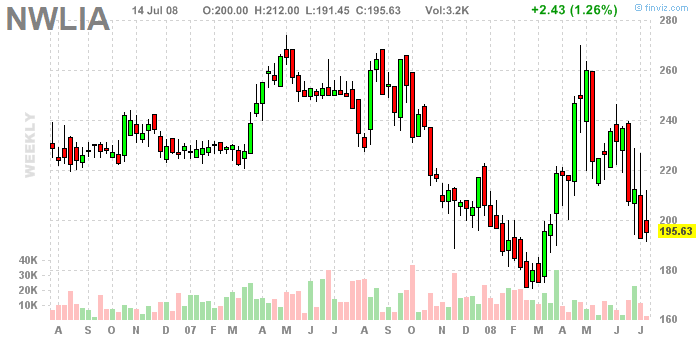
The chart below shows its performance the last two years:


The businesses that NWLIA operates in are very sensitive to the spreads between yields earned on investments less rates credited to policies. The company states it best in its annual 10-K, so I will reproduce its statement here:

“A decline in interest rates could expose the Company to reduced profitability due to minimum interest rate guarantees that are required in our products by regulation. A key component of profitability is investment spread, or the difference between the yield on our investments and the rates we credit to policyholders on our products.”

“A rise in interest rates will increase the net unrealized loss position of our investment portfolio and may subject the Company to disintermediation risk. Disintermediation risk is the risk that policyholders may surrender their contracts in a rising interest rate environment, requiring the Company to liquidate investments in an unrealized loss position.”

After reading this, you might wonder why anyone would even be in the annuity business, but the boilerplate risks listed above are offset by hedging, and new business that is written every year.

Reasons to Buy

NWLIA has an excellent long term record of increasing book value per share, which is the method that Value Investors tend to use to judge insurance companies. Book value was $172.26 at 12/31/2002 and increased to $283.27 at 3/31/2008. NWLIA has traded from 0.5 to 1.0 times book value, and is trading at 0.72 times book value currently. While this is not at rock bottom valuation, it does give us some margin of safety.

As of March 31, 2008, the company reported only $8.8 million in Level 3 assets in its investment portfolio totaling $1.9 billion. The company also reported no holdings in collateralized bond obligations (CBOs), collateralized debt obligations (CDOs), or collateralized loan obligations (CLOs).

NWLIA has a strong position internationally, which provides a hedge against the economic slowdown in the U.S. and the weak dollar.

NWLIA has traditionally sold below book value as the market discounts its value due to its control by the Moody family. There is a possibility one day that if the family should decide to sell out, its businesses would sell for more than book value, which is where most publicly traded insurers are valued in a normal market environment.

NWLIA also holds a common stock investment totaling approximately 9.4% of the issued and outstanding shares of Moody Bancshares, Inc. This is a bank that is also controlled by the Moody family. Although banking is a potential danger zone in the current environment, the bank is well capitalized, as seen below, and the ratio of noncurrent loans to total loans is only 0.48%. (All data as of 3/31/2008)

Equity capital to assets - 9.84%
Core capital (leverage) ratio - 9.05%
Tier 1 risk-based capital ratio - 16.61%
Total risk-based capital ratio - 17.36%

As its competitors stumble, this bank may gain market share and business, which would accrue to NWLIA through its ownership.

NWLIA can be difficult to buy due to liquidity issues. It trades infrequently and with a wide spread between the bid and ask, so be careful with this one.


This article was written by The Stock Market Prognosticator. You may email questions or comments to me at info@brittaincapitalmanagement.com.


Continue Reading »

GE Presents Dividend Opportunity

Diversified conglomerate General Electric (GE) announced their second quarter earnings this past Friday. GE's finance unit, GE money's profits fell 9% while the consensus estimate was for profits in that unit to drop 15-20%. Their Infrastructure unit's earnings, on the other hand, were up 24%. Overall the company met expectations by posting nearly flat earnings growth over the same quarter in 2007. Revenue actually rose 11% to $46.9 B.

GE's shares got hit hard last quarter when they surprised the market by announcing an unexpected drop in earnings due to weak credit markets. In this most recent earnings release GE affirmed it's full year earnings forecast of $2.20-$2.30 per share. This is barely above their 2007 earnings per share of $2.20. With plans to spin off their industrial and appliance units, and forecasting further lower profit from their finance segments, GE's earnings growth looks stagnant for the short term.

But really, here at The DIV-Net we don't care about the short term. Here are a few points to ponder with respect to GE as a potential long term dividend growing investment:

  • GE's current dividend pay out ratio is about 52% (they are paying out half of their earnings)
  • The current yield on the stock is around 4.5%
  • GE has grown earnings per share in 8 of the last 9 years
  • Their dividend growth has swift, consistent, and has stood the test of time
  • Global infrastructure, alternative energy, and emerging economies are great areas to be a leader in long term and GE is there with bells on
  • GE is already deriving about 50% of revenue from outside of the U.S.
  • The company currently has their hands in a lot of cookie jars. The main focus of management is to get their hands out of the cookie jars that are growing slower and keep searching for cookies in the faster growing jars. Maybe buy more nice jars too...
As of writing this GE shares of off about 25% year to date, and it's not a purely financial company. Yes GE has some financial exposure but one of the scary things about investing in financials, for a dividend growth investor, is the possibility of dividend cuts. Since GE has a pay out ratio of about 52%, and minimal exposure to finance as compared to, say a bank, the dividend is not at risk because their other divisions profits are looking pretty solid. This is a key point because as mentioned GE is now yielding about 4.5%, and probably has a bright future, even without light bulbs. A 'yield on cost' of 4.5% with solid growth potential is a great starting point for a position in this company.

This article was written by the moneygardener. You may email questions or comments to me at themoneygardener(at)gmail.com.


Continue Reading »

Lower Risk = Higher Investment Profits

Historically, a dividend based portfolio has proven to be less risky than alternative investment strategies. The caveat of course is that your portfolio is structured properly, you are well diversified, and you keep your fees super-low. Take the S&P Dividend Aristocrats for example. As highlighted in a 2005 article at IndexUniverse.com, "The Dividend Aristocrats Index has outperformed the S&P 500, S&P 500 Equal Weight and S&P 500 Barra Value indexes over the past three, five and ten-year periods - with less risk." The bonus is that over the 10 years prior, the Aristocrats has beaten the S&P 500 Index by 2.4%.

There is also evidence that other conservative investment strategies that are less risky have lead to increased profits. In an article at MarketWatch by Mark Hulbert, he presents his research that shows that those newsletters with less risky investment strategies have shown better results. The chart below highlights his research:


What does this information mean to us as dividend investors? It means that investing in a dividend strategy, which research has shown to be less risky, presents opportunities for higher investment profits if history repeats itself. Companies that consistently increase their dividends, like the Dividend Aristocrats, can provide higher profits if you are patient and let the strategy do its work.

This article was written by The Dividend Guy. You may email questions or comments to me at info@thedividendguyblog.com.


Continue Reading »

Stock Analysis: Abbott Laboratories (ABT)

Linked here is a PDF copy of my analysis of Abbott Laboratories (ABT) (alt.1, alt.2). Below are some highlights from the above linked analysis:

Company Description: Abbott Laboratories is engaged in the discovery, development, manufacture and sale of a diversified line of healthcare products including: drugs, nutritional products, diabetes monitoring devices and diagnostics.

Fair Value: I consider four calculations of fair value, see page 2 of the linked PDF for a detailed description:

  1. Avg. High Yield Price
  2. 20-Year DCF Price
  3. Avg. P/E Price
  4. Graham Number
ABT is trading at a discount to only 3.) above. If I exclude the high and low valuation, and average the remaining two valuations, ABT is trading at an astounding 61.6% premium. A Star is deducted since ABT is trading at a premium in excess of 5%.

Dividend Analytical Data: In this section I consider five factors, see page 2 of the linked PDF for a detailed description:
  1. Rolling 4-yr Div. > 15%
  2. Dividend Growth Rate
  3. Years of Div. Growth
  4. 1-Yr. > 5-Yr Growth
  5. Payout 15% of avg.
ABT earned two Stars in this section for 3.) and 4.) above. It has paid a cash dividend to shareholders every year since 1903 and has increased its quarterly cash dividend payments for 36 consecutive years. The 1-Yr. > 5-Yr Growth metric indicates that dividend growth has been accelerating.

Dividend Income vs. MMA: Why would you assume the equity risk and invest in a dividend stock if you could earn a better return in a much less risky money market account (MMA)? This section compares the earning ability of this stock with a high yield MMA. Two items are considered in this section, see page 2 of the linked PDF for a detailed description:
  1. NPV MMA Diff.
  2. Years to >MMA.
ABT was deducted one Star in this section for 1.) above. At its current yield of 2.51% and a dividend growth rate of 7.1%, ABT will under-perform a MMA averaging 4.61% by $957 per $1,000 invested over 20 years.

Other:
ABT is a member of the S&P 500, is an Achiever and an Aristocrat. Like all drug companies, ABT is facing challenges to their branded patents, drug development and regulatory issues. However, ABT has a relatively strong new product pipeline, with possible significant launches in both the medical device and pharmaceutical areas.

Conclusion: ABT lost a Star in the Fair Value section, earned two Stars in the Dividend Analytical Data section and lost one Stars in the Dividend Income vs. MMA section for a net total of 0 Stars. This quantitatively rates ABT as a 0 Star-Avoid stock.

Using my D4L-PreScreen.xls model, I determined the share price would have to drop to $40.55 for the NPV of MMA Differential to reach the $2,500 minimally acceptable level for from a company that is both an Achiever and an Aristocrat. In short, ABT is overvalued and not a good dividend investment at this time. Thus, I won't be buying ABT any time soon.

Disclaimer: Material presented here is for informational purposes only. The above quantitative stock analysis, including the Star rating, is mechanically calculated and is based on historical information. The analysis assumes the stock will perform in the future as it has in the past. This is generally never true. Before buying or selling any stock you should do your own research and reach your own conclusion. See my Disclaimer for more information.

Full Disclosure: At the time of this writing, I do not own shares of ABT (0.0% of my Income Portfolio).

What are your thoughts on ABT?

This article was written by Dividends4Life. You may email questions or comments to me at bbkjbbkj@gmail.com. Note: Last week the Carnival of Personal Finance published: Dividend Investing + Value Investing = Superior Returns


Continue Reading »

Unloved Stocks Outperform?

As they often say about real estate investing, one does not make money in real estate when it is sold, but when the real estate is purchased. The point in this statement is the profit is really determined based on the price paid for the real estate. In other words--don't over pay. Many real estate investors are finding this axiom true today. Well, what about stocks that are unloved by the so called investing experts?


The CXO Advisory Group website highlighted findings from a research report titled Stocks of Admired Companies and Despised Ones by Deniz Anginer, Kenneth Fisher and Meir Statman. In short, the study's authors tested whether the top companies in Fortune magazine's list of America's Most Admired Companies underperformed the companies that ranked in the bottom of the list. The following table taken from the study summarizes some of the findings.

Difference between the return of Industry-Adjusted Despised and Admired
portfolios during the ten years: April 1983 – March 2006.


In short, the CXO Advisory article notes:
...the stocks of companies least admired by the ostensibly well-informed may well outperform the stocks of the companies most admired.
More detail from the above noted study is outlined in the CXO Advisory article.

As Old School Value's post last Saturday noted, All Intelligent Investing IS Value Investing,
Value investing...revolves around paying less or a fair amount to [a company's] real value, referred to as intrinsic value...
I think Charles Kirk of The Kirk Report recently said it best in his post titled Your Comfort Zone:

"High achievers (in life and in the market) frequently step outside their comfort zone. That’s the way they learn and make progress. At the same time, they also expect to fail (more often than not), but do not see failure or mistakes they make as problems, but as educational experiences.

The natural instinct of all of us is to seek safety and shelter, unfortunately at the exact same time when we should be aggressive and risk tolerant. Those who do well in the market understand this natural human tendency and they consistently work against it when others are doing the exact opposite.

The key for today is to first understand what your comfort zone is and then take a step outside of it. Remember, the market doesn’t reward comfort and decisions that “feel” good to make. That’s the law of nature and it is true of this market like any other."

Source:
Buy Stocks of Companies Experts Hate?
CXO Advisory Group, LLC
February 14, 2007
http://www.cxoadvisory.com/blog/external/blog2-14-07/

Stocks of Admired Companies and Despised Ones
By: Deniz Anginer, Kenneth Fisher and Meir Statman
February 2007
http://papers.ssrn.com/sol3/papers.cfm?abstract_id=962168#PaperDownload

Your Comfort Zone
The Kirk Report
By: Charles Kirk
July 8, 2008
http://www.thekirkreport.com/2008/07/your-comfort-zo.html

This article was written by Disciplined Approach to Investing. You can email questions or comments to me by clicking here.


Continue Reading »

Throwing Out The Hammer

In my recommended reading post on Old School Value, I recommended people to read Ronald R Redfield's notes on Seth Klarman's book Margin of Safety - Risk Averse Value Investing Strategies for the Thoughtful Investor.

As I was going through it, it reminded me of many investing basics as well as investment principles and philosophies and I came to realize a couple of critical issues about my investing habits which I felt I had to evaluate.

  1. The man with a hammer mentality.
  2. Consider risks before gains.

Now I enjoy going to the gym and power lifting, but without reviewing my form, technique and fixing those little bugs, a short term gain is always there but over the long term, I'll probably have a jagged spine or crooked knee. You get the idea.

The Man With A Hammer

"To a man with a hammer, everything looks like a nail." - Mark Twain
I believe this quote to have been brought forth into the investing world most prominently by Charlie Munger and it seems like I have fallen into the same habit. I'm a big fan of spreadsheets and tools that help people become efficient in their activities, whether it be investing or in general. Many people that have downloaded my spreadsheets understand this, but it has come to a point where I find myself trying to apply the spreadsheet to every company.

The spreadsheet is my hammer, and every company is beginning to look like a nail.

A skilled and experienced tradesman knows which tools to use for a particular job. Investors should also be equipped with different tools to apply to different companies. This means looking beyond simply applying a growth rate to the Discount Cash Flow model.

Other aspects must be valued, financial statements must be torn through, not just looked through. Finding what the market is missing is also integral to the whole process and it has become something that I am spending less time on.
"You're neither right nor wrong because other people agree with you. You're right because your facts are right and your reasoning is right—and that's the only thing that makes you right. And if your facts and reasoning are right, you don't have to worry about anybody else." - Warren Buffett

Targeting Risk

As a hot blooded male, psychologically, my mind weighs gains and risks quite differently. Until now, I was targeting a return and was confident that it would play out as long as I kept buying with a large margin of safety. Now, a better idea has come along and for me, it's out with the old, in with the new.

Target risk BEFORE calculating investment returns
, where risk is defined as "both the probability and the potential of loss". Risk is not defined as volatility, trends or analyst downgrades in this case.
"Investors must be prepared for any eventuality." - Seth Klarman
Another point is that an investor targeting specific returns over time, will make it difficult to achieve the goal as he/she feels the need to take additional risk or speculation in order to meet their "target return".
"Targeting investment returns leads investors to focus on potential upside rather on downside risk... Rather than targeting a desired rate of return, even an eminently reasonable one, investors should target risk." - Seth Klarman

Putting It All Together

Given such economic downtimes which equates to times of opportunity, now is the perfect time to put it all together and see whether it holds.
"A market downturn is the true test of an investment philosophy." - Seth Klarman

This article was written by Old School Value. You may email questions or comments to me at jjun0366@gmail.com


Continue Reading »

Dividend Investment Styles - The Div Guy

With my first post on The DIV-Net, I wanted to cover the different styles of dividend and value investing I use in my stock portfolio. Investing is as much an art as a science so I use the different approaches to to cover my different personal styles. I like consistent slow growing companies and I like stocks that pay an above average dividend yield and I also like to purchase stocks that are out of favor which sell at a discount. My three styles of investing each make up a portion on my stock dividend account which I plan to grow dividend income to cover most of my basic expenses in retirement. I will also have my retirement plans to draw from and with any luck I may get some money from social security. I am not counting on Social Security for my retirement plan but it will be a bonus if I receive any.

1. Solid Slow Growth Stocks
The first style of dividend investing I started using about 10 years ago is selecting consistently growing companies that have a history of regularly increasing their dividends. These are your Blue Chip Stocks that also fall into the S&P 500 Dividend Aristocrats list of companies. I like to look for stocks in this group with a dividend yield over 2% but this is not a requirement and I will purchase a very good company that is paying less than 2%. These are stocks I do not plan to sell unless there are some major changes in the company. Some examples of the stocks I own that fall in this category include Procter & Gamble (PG), Wrigley (WWY) and General Electric (GE).

2. High Yield Dividend Stocks
The second style of investing I use is selecting companies that pay a higher that average dividend or distribution. I again look for companies with a solid financial background but I don't need to see the company increase it's dividend each year. One of my favorite investment books that chronicles this style of investing is The Single Best Investment by Lowell Miller. I look for dividend yields of over 4% for this group. These stocks are meant to be long term holding of at least 5 to 10 years. Some examples of these stocks in my portfolio include Kinder Morgan Energy Partners (KMP), Duke Energy (DUK) and American Capital Strategies (ACAS).

3. Value Stocks
The third group of stocks I invest in are stocks that are selling at a step discount to their book value or normal stock price. This is a category that is very difficult to measure and quantify. I started using this method in the ealy 90's by purchasing then Bank of New York that was selling in the single digits and it reminds me of today's financial stocks. Some of the other stocks that I purchased using this method include ING and AllianceCapital which is now AllianceBerstein during the mutual fund scandals of late 2003. I sold these stocks for nice gains and used the money to purchase some of my High Yield Dividend Stocks. Some people also will call this method of investing Vulture Investing meaning most investors have given these stock up for dead. I have no dividend yield requirements for this group but I prefer a stock that is paying a dividend or may pay a dividend in the future. The holding time is not certain for this group but can be less than a year to over a couple of years. Some current examples of this are some of my bank holding such as Bank of American (BAC) and Royal Bank of Scotland (RBS) and others such as Cooper Tire & Rubber (CTB) and Calpine Corporation (CPN).

I use these three investing styles to build a portfolio of invests that will help me reach my dividend income needs for retirement. One of my favorite expressions about investing is that retirement investing is an experiment that we each will take on and we will only know the final results when we reach retirement. So let's hope our dividend investment experiments work out well.

I hope you enjoy The DIV-Net site and follow us along on our experiment as we discuss dividend investing styles and stocks.

This article was written by The Div Guy. You may email questions or comments to me at thedivguy@gmail.com.


Continue Reading »