Recent Posts From DIV-Net Members

Happy Birthday DIV-Net!

Today marks DIV-Net's one year anniversary. It all began on June 30, 2008 with this post: Dividend Investing + Value Investing = Superior Returns, which continues to ring true. Over the last year we have have added many new Members and Associate Members.

Dividend and Value investing continues to see growth with more online sites/blogs added each week. DIV-Net has seen steady growth over the past year with over 400 RSS subscribers. You have our heartfelt thanks for allowing us to spend a little time with you each day. We look forward to the upcoming year and the prospects it brings!

If you enjoyed this article, please vote for it by clicking the Buzz Up! button below.


Continue Reading »

Stock Analysis: United Technologies Corp. (UTX)

Linked here is a detailed quantitative analysis of United Technologies Corp. (UTX). It is important to note that this is the first week of using my updated analysis model, so you will see some changes from earlier analyses. Below are some highlights from the above linked analysis:

Company Description: United Technologies Corp. is an aerospace-industrial conglomerate with a portfolio including Pratt & Whitney jet engines, Sikorsky helicopters, Otis elevators and Carrier air conditioners, among other products.

Fair Value: I consider four calculations of fair value, see page 2 of the linked PDF for a detailed description:

  1. Avg. High Yield Price
  2. 20-Year DCF Price
  3. Avg. P/E Price
  4. Graham Number
UTX is trading at a discount to 1.), 2.) and 3.) above. Since UTX's tangible book value is not meaningful, a Graham number can not be calculated. UTX is trading at a 29.5% discount to its calculated fair value of $73.14. UTX earned a Star in this section since it is trading at a fair value.

Dividend Analytical Data: In this section there are three possible Stars and three key metrics, see page 2 of the linked PDF for a detailed description:
  1. Free Cash Flow Payout
  2. Debt To Total Capital
  3. Key Metrics
  4. Dividend Growth Rate
  5. Years of Div. Growth
  6. Rolling 4-yr Div. > 15%
UTX earned three Stars in this section for 1.), 2.) and 3.) above. A Star was earned since the Free Cash Flow payout ratio was less than 60% and there were no negative Free Cash Flows over the last 10 years. UTX earned a Star as a result of its most recent Debt to Total Capital being less than 45%. UTX earned a Star for having an acceptable score in at least two of the four Key Metrics measured. Rolling 4-yr Div. > 15% means that dividends grew on average in excess of 15% for each consecutive 4 year period over the last 10 years (1999-2002, 2000-2003, 2001-2004, etc.) I consider this a key metric since dividends will double every 5 years if they grow by 15%. UTX has paid a cash dividend to shareholders every year since 1936 and has increased its dividend payments for 17 consecutive years.

Dividend Income vs. MMA: Why would you assume the equity risk and invest in a dividend stock if you could earn a better return in a much less risky money market account (MMA)? This section compares the earning ability of this stock with a high yield MMA. Two items are considered in this section, see page 2 of the linked PDF for a detailed description:
  1. NPV MMA Diff.
  2. Years to > MMA
UTX earned a Star in this section for its NPV MMA Diff. of the $6,624. This amount is in excess of the $1,800 target I look for in a stock that has increased dividends as long as UTX has. If UTX grows its dividend at 15.0% per year, it will take 3 years to equal a MMA yielding an estimated 20-year average rate of 4.06%. UTX earned a check for the Key Metric 'Years to >MMA' since its 3 years is less than the 5 year target.

Other: UTX is a member of the S&P 500 and a member of the Broad Dividend Achievers™ Index. Over the last ten years, UTX has shown steady growth in both earnings and dividends. UTX has a strong balance sheet with 38% debt to total capital and an excellent free cash flow payout of 29%. UTX should benefit from large backlogs at Airbus and Boeing, moderate demand for global infrastructure, and strong demand for military helicopters. Future risks could include a prolonged downturn in U.S. residential housing market, slowing of growth in commercial construction markets, and prolonged global recession.

Conclusion: UTX earned one Star in the Fair Value section, earned three Stars in the Dividend Analytical Data section and earned one Star in the Dividend Income vs. MMA section for a total of five Stars. This quantitatively ranks UTX as a 5 Star-Strong Buy.

Using my D4L-PreScreen.xls model, I determined the share price could increase to $82.70 before UTX's NPV MMA Differential fell to the $1,800 that I like to see for a stock with 17 consecutive years of dividend increases. At that price the stock would yield 1.86%.

Resetting the D4L-PreScreen.xls model and solving for the dividend growth rate needed to generate the target $1,800 NPV MMA Differential, the calculated rate is 10.7%. This dividend growth rate is well below the 15.0% used in this analysis, thus providing a margin of safety. UTX has a risk rating of 1.50 which classifies it as a low risk stock.

UTX is trading below its buy price of $73.14 and its 2.99% dividend yield is consistent with the 3.00% minimum that I am currently looking for. I would be very comfortable adding to my position at this price as my allocation allows. For additional information, including the stock's dividend history, please refer to its data page.

Disclaimer: Material presented here is for informational purposes only. The above quantitative stock analysis, including the Star rating, is mechanically calculated and is based on historical information. The analysis assumes the stock will perform in the future as it has in the past. This is generally never true. Before buying or selling any stock you should do your own research and reach your own conclusion. See my Disclaimer for more information.

As noted above, this is the first week of using my updated analysis model, so you will see some problems or error, be sure to let me know.

Full Disclosure: At the time of this writing, I was long in UTX (3.2% of my Income Portfolio).

What are your thoughts on UTX?

Recent Stock Analyses:
This article was written by Dividends4Life. If you enjoyed this article, please vote for it by clicking the Buzz Up! button below.


Continue Reading »

Weekend Reading Links - June 28, 2009

For your weekend reading pleasure, the articles listed below contain some of the best dividend and value investing insights found on the web. They were written by various members of the Dividend Investing and Value Network (DIV-Net) over the past week:

Articles From DIV-Net Members

There are some really good articles here, please take time and read a few of them.

If you enjoyed this article, please vote for it by clicking the Buzz Up! button below.


Continue Reading »

Does Price Matter?

Does the market price of a stock play a significant role in your decision to buy, or not buy shares in a company? For me the answer to this question has always been no, I look at rate of return and give almost no credence to stock price. If I invest $100K in a company it is of little interest to me if I get 5 stock or 500 stock in this company as long as I see a return on my initial investment. I have a good friend who will only buy a stock if it is trading for under $5. Are there advantages to his system?

Lower Price does not mean OTC & PK

A precursor; when we speak of lower stock prices in this article it is worthwhile to mention we are not talking about OTC or pinksheet stocks. The financial rules for these companies are loose and create a level of risk unto themselves. What we are talking about is index traded quality companies that just happen to be priced at a low value.

Lower Price = High Fluctuation

When a small or mid size investor goes to buy a stock they will often give little regard to buying a stock that is $0.15 more expensive today than it was a week previous. This is an advantage for this investment theory, a $0.15 shift in a stock price can equate out to a 3-10% increase in the stock's value if it was originally purchased at $1.50-$5. The same does not hold true of higher priced stocks. So, as a result of this mental block over small numbers an investor can get a sizable return with very little actually happening in the business to merit the change.

As easily as things fluctuate up though things can also fluctuate in the inverse direction, a drop of $0.15 can also easily occur for the same reasons.

Lower Price = Lower Volume

Often, but certainly not always, a lower price may be associated with a company that has limited trading volume, or may be dominantly owned by major institutions who don't trade the company frequently. This means that when it comes time to sell you may find you have trouble unloading your stock all at once, you may be forced to sell out gradually which can interfere with your liquidity plans.

Lower Price may = Small company

A lower price may mean that the company is a small cap business. Small caps are very different animals and as such there are a few pros and cons to dealing in these types of stock:
  • Management are often less experienced meaning they may not fully understand how to get you the return you desire.
  • Little may be understood of these companies by the larger investment world. Meaning if you have a solid understanding of the core business and are right with your predictions there may be substantial profit to be had.
  • A buyout is always possible, but so to is a bankruptcy.
  • There are less stock available meaning when people want it the price can easily get driven up, or alternatively driven down.

Weighing it out

There are some challenges and rewards in trading exclusively in cheaper stocks, the appeal of a larger fluctuation in price is very compelling. What do you think though?

This article was written by buyingvalue If you enjoyed this article, please vote for it by clicking the Buzz Up! button below.


Continue Reading »

Emerson Electric (EMR) Dividend Stock Analysis

Emerson Electric Co., a diversified global technology company, engages in designing and supplying product technology and delivering engineering services to various industrial and commercial, and consumer markets worldwide. The company operates through five segments: Process Management, Industrial Automation, Network Power, Climate Technologies, and Appliance and Tools. The company is member of the S&P 500 and the S&P Dividend Aristocrats indexes.
Emerson Electric Co.has paid uninterrupted dividends on its common stock since 1947 and increased payments to common shareholders every year for 52 years.


From the end of 1998 up until December 2008 this dividend growth stock has delivered a negative annual average total return of 4.90% to its shareholders. The stock is down over 50% from its 2007 and 2008 all-time highs.

The company has managed to deliver an 8.40% average annual increase in its EPS between 1999 and 2008. Analysts are expecting an increase in EPS to $2.35 for 2009 and $2.20 by 2010. This would be a decrease from the 2008 earnings per share of $3.11. The economic crisis is currently affecting the St. Louis based company, which recently announced a 25% decline in orders for the past three months. Emerson Electric does expect to restructure its operations in order to make them more cost effective. In addition to that the relative diversification of its revenue sources by continents and five major business segments should soften the fall in earnings. Another positive for the company is the fact that it focuses on new product introductions, which could add greatly to profitability. Strategic acquisitions could also add to the bottom line as well.

The Return on Equity has increased over the past decade from 22% in 1999 to 27% in 2008. The reason for the increase is managements implementing capital efficiency initiatives after a string of acquisitions. Rather than focus on absolute values for this indicator, I generally want to see at least a stable return on equity over time.

Annual dividends have increased by an average of 7% annually since 1999, which is slightly lower than the growth in EPS.
A 7 % growth in dividends translates into the dividend payment doubling every ten years. If we look at historical data, going as far back as 1982, Emerson Electric Co. has actually managed to double its dividend payment every nine years on average.
Despite the expectations for lower earnings and revenues for 2009 and 2010, I believe that the dividend payment would not be affected. The worst that could happen is that dividend growth slows down for the next two years, before resuming its 7% annual rate of increase. Despite being regarded as a cyclical company Emerson has raised distributions for over half a century, so a recession should not create a steep shift in the company’s dividend policy.

The dividend payout ratio remained below 50% for the majority of the past decade. The only exception was the 2001-2003 period, when profitability suffered from the economic downturn at the time A lower payout is always a plus, since it leaves room for consistent dividend growth minimizing the impact of short-term fluctuations in earnings.

Currently Emerson Electric Co. is trading at 13 times earnings and yields 4.00%. I believe that Emerson Electric Co.is attractively valued at the moment. I would be looking forward to adding to my position there.

Full Disclosure: Long EMR

Relevant Articles:


This article was written by Dividend Growth Investor. If you enjoyed this article, please vote for it by clicking the Buzz Up! button below.


Continue Reading »

Diversification In the Context of Number of Stocks

There is a general perception that higher number of stocks in a portfolio provides better diversification (i.e. better risk management). I am discussing the relationship between number of stocks and its effect on diversification. I am using very simple probability mathematics for an ideal scenario.

I am using a stock being positive or negative as measure of diversification. In an ideal scenario, at a minimum, one would like to have all stocks to be positive relative to the buy price. For example, if a portfolio has 5 stocks, then one would like to have all positive side. If a portfolio has 10 stocks, one would like to have all in positive side and so on. Please note that I am not discussing the value of individual stock or portfolio. It is likely that a positive value in one stock can offset the negative value of other stock.

My interest, here, is to break it down to the best possible scenario, and that is, stocks being +ve or stocks being –ve. I am calculating the probability of “one stock being +ve” in “one stock portfolio”, in a “two stock portfolio”, in a “five stock portfolio”, in a “10 stock portfolio”, and in a “20 stock portfolio”.

Furthermore, I am extending this probability to “two stocks being positive” or “three stocks being positive”. The results are then plotted for graphical presentation and discussion. The chart below shows the plot of probability of stock being positive vs. number of stocks in a portfolio. This chart is read as follows:

  • The curve, “1 +ve stock” is the curve (topmost curve, in red color) for probability of one stock being positive for a portfolio with 5 stocks, 10 stocks, 15 stocks, and 20 stocks.
  • If a portfolio consists of only one stock, then probability that it will be positive is 0.5 (i.e. 50% chance that it will be positive).
  • If a portfolio has 5 stocks, then the probability that at least one will be positive is 0.9.
  • If a portfolio has 10 stocks, then the probability that at least one will be positive is 0.95.
  • If a portfolio has 20 stocks, then the probability that at least one will be positive is 0.98.
  • The chart shows similar curves for probability of “two positive stocks”, three positive stocks, four positive stocks, and five positive stocks.


This chart shows that there is a significant increase in probability of stocks being positive until 5 or 10 stocks in the portfolio. Beyond that the change in probability of stocks being positive is very very small.

What we really want is to have a higher probability for stock to be positive. Let us say we want 0.8 probability, so we look at this chart horizontally at 0.8. We can have that with 5 stocks, 8 stocks, 10 stocks, and 12 stocks (intersection points between curve and full digit stock). As an individual investor what would you do? If the odds are same wouldn’t you try to use lesser number of stocks?

These simple probability curves show that there is an optimum point beyond which more stocks will not have any diversification benefits.

The best examples are DOW Index (with 30 stocks) and S&P500 index (500 stocks). I have superimposed these two indices on the same chart below. Both these index follow each other. If more stocks are supposed to provide diversification benefits, shouldn’t the S&P500 perform better than DOW?


In my next post, I will continue my discussion on some reason why quality is more important than quantity of stocks for better diversification.


This article was written by Dividend Tree. If you enjoyed this article, please vote for it by clicking the Buzz Up! button below.


Continue Reading »

Identifying Cheap

Most (though surprisingly not all!) investors like the idea of buying a stock for less than it is worth. But it's the calculation/determination of what a company is worth that trips most investors up. For some securities, however, determining this value can be relatively easy. For example, if a large proportion of a company's assets have a liquid market (e.g. a mutual fund), the calculation can be asserted with much more certainty.

While real estate is not quite as liquid as most stocks and bonds, it is not far-fetched to say that a company whose assets consist mostly of real estate should trade near its book value.

While some adjustments to book value may need to made to better approximate the current market value of the real estate (e.g. if the land was purchased long ago and has since appreciated), one might expect real estate companies to trade near their book values.

Consider Melcor (MRD), a property development company in Western Canada. A large component of Melcor's balance sheet consists of raw land (purchased over the course of a few years) which it prepares and sells as lots to builders. Another large component of its balance sheet consists of commercial property which it has owned and leased for several years or, in some cases, decades.

The following chart depicts Melcor's price to book ratio over the last two decades:

Melcor is trading, relative to its assets, at levels not seen since the mid-1990s. Readers who are pessimistic regarding the outlook for real estate should note that an investment in Melcor does not require a bullish stance on real estate, since this investment constitutes a purchase of real estate at a discount of approximately 50%! The value of the property does not appear in jeopardy either, as while the pace of sales has slowed down, Melcor is still selling its lots at a gain.

When investor sentiment sours, those who take advantage of the situation by purchasing assets at a discount stand the chance to gain the most over the long term.

Disclosure: Author owns a long position in shares of MRD

This article was written by Saj Karsan, who regularly writes for Barel Karsan. If you enjoyed this article, please vote for it by clicking the Buzz Up! button below.


Continue Reading »

The Magic of Dividends and Compounding Interest

Every once in a while on The Div-Net, I put up a video (or a link to a video) that is dividend related. I recently came across a really good one that discusses the true benefits of dividends as it relates to compound interest. When we boil it all down to the nuts and bolts, then the concepts discussed in this video are the most important aspects when it comes to dividend investing. Of course, our asset allocation is the most important, but the concepts in this video are close behind. Please take a look at the video and let me know what you think.


Clicking on the video will take you to the MSN page that hosts it - they do not allow embedding for some crazy reason!

This article was written by The Dividend Guy. You may email questions or comments to me at info@thedividendguyblog.com.


Continue Reading »

Stock Analysis: Cardinal Health Inc. (CAH)

Linked here is a detailed quantitative analysis of Cardinal Health Inc. (CAH). Below are some highlights from the above linked analysis:

Company Description: Cardinal Health Inc. is one of the leading wholesale distributors of pharmaceuticals, medical/surgical supplies and related products to a broad range of health care customers.


Continue Reading »

Weekend Reading Links - June 21, 2009

For your weekend reading pleasure, the articles listed below contain some of the best dividend and value investing insights found on the web. They were written by various members of the Dividend Investing and Value Network (DIV-Net) over the past week:

Articles From DIV-Net Members

There are some really good articles here, please take time and read a few of them.

If you enjoyed this article, please vote for it by clicking the Buzz Up! button below.


Continue Reading »

Dividend Cuts- New Management

cash cutIn our continuing series on dividend cuts, why they happen and how to learn to see them coming before they hit your portfolio today we are going to look at the curse of new management.

New Management

Bringing in new management is a regular occurrence in any large business. Management can be cycled in as a result of retirement or simply as the result of the board seeing the need for a changing of the guard. New management can come from one of two places, internal promotion and external hiring. The condition I will describe here comes as the result of both these types of hirings, but is a far more frequent occurrence with external hiring.

The Curse

When new management comes into a business they often have a honeymoon period where they can blame anything that is currently going wrong in the business on the previous management team. After about 6 months though this free pass period disappears and new management can no longer point fingers back at the old regime. The luxury of this honeymoon period affords management the ability to make all sorts of aggressive moves inside a company- lay off staff, close plants, and even cut dividends.

What you Can Do to See it Coming

Here are a few simple preventative measures you can take to avoid this happening to you. When new management are brought in:

  • Check the new management's history. See what they have done at other companies in the past, do they have a habit of making dividend cuts when times are bad. Some managers would sooner sell their children into slavery than make a dividend cut, others though are less troubled by it. There are lots of tools you can use to research executives, google finance and yahoo finance both provide info about current management in companies.

  • Listen. Surprises are expensive, and cause analysts to be cautious of a stock. Management will often tip its hand about a coming dividend cut so that analysts wont be caught off guard. Listen for phrases like "we expect hard times but believe we have a plan that can lead us into a profitable future which we will be making available in coming weeks." Ask yourself, why aren't they showing you the plan now?

  • Ask yourself what would you do. The best investors I have ever met are those that understand how to run a business. Look at the financials and ask yourself what you would do in the same situation, if a cut looks like the most appealing of options that may well be the way they are heading.

  • Use common sense. This plays into the last item. A friend of mine recommend a stock one time to me based entirely on the fact it had a 14% dividend rate. It was with little surprise that I saw the company bring in new management and cut that rate within a month.

Other parts in our series on Dividend Cuts:

This article was written by Buying Value If you enjoyed this article, please vote for it by clicking the Buzz Up! button below.


Continue Reading »

Coca Cola (KO) Dividend Stock Analysis

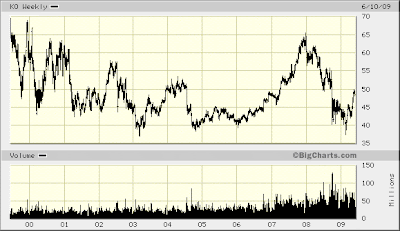
The Coca-Cola Company manufactures, distributes, and markets nonalcoholic beverage concentrates and syrups worldwide. It principally offers sparkling and still beverages. The company is member of the S&P 500, Dow Jones Industrials and the S&P Dividend Aristocrats indexes. Coca-Cola has paid uninterrupted dividends on its common stock since 1893 and increased payments to common shareholders every year for 47 years.

From the end of 1998 up until December 2008 this dividend growth stock has delivered a negative annual average total return of 2.10% to its shareholders. The stock has largely traded between $65 and $40 over the past decade.

The company has managed to deliver a 10.90% average annual increase in its EPS between 1999 and 2008. Analysts are expecting an increase in EPS to $3.05-$3.10 for 2009 and $3.25-$3.30 by 2010. This would be a nice increase from the 2008 earnings per share of $2.49. Future drivers for earnings could be the company’s tea, coffee and water operations. Cost savings initiatives could also add to the bottom line over time.
Some analysts believe that Coca Cola could follow arch rival Pepsi Co’s moves to acquire its own bottlers in an effort to gain more control over the production and distribution of its beverages in key markets. Coke holds a 35% interest in its largest manufacturer and distributor of Coca Cola products, Coca-Cola Enterprises In. (CCE). Coca-Cola Enterprises Inc. accounts for about 40% of Coke’s concentrate sales and 16% of the company’s worldwide volume, which makes it a likely target of acquisition, should Coca Cola decide to follow Pepsi Co’s strategy of buying back its bottling operations.

The Return on Equity has been in a decline after hitting a high in 2001. Rather than focus on absolute values for this indicator, I generally want to see at least a stable return on equity over time.

Annual dividends have increased by an average of 10.10% annually since 1999, which is slightly lower than the growth in EPS. The company last raised its dividend by 8% in February 2009, for the 47th year in a row.
A 10 % growth in dividends translates into the dividend payment doubling every seven years. If we look at historical data, going as far back as 1969, The Coca Cola Company has indeed managed to double its dividend payment every seven years on average.

The dividend payout ratio remained above 50% for the majority of the past decade. A lower payout is always a plus, since it leaves room for consistent dividend growth minimizing the impact of short-term fluctuations in earnings.

Currently Coca Cola is trading at 20 times earnings and yields 3.30%. In comparison arch rival in the cola wars Pepsi Co (PEP) trades at a P/E multiple of 16.5 and yields 3.40%. Check my analysis of Pepsi Co (PEP)

I believe that The Coca Cola Company is not as attractively valued at the moment as Pepsi Co. I would consider adding to my position there if it can cover its dividends at least two times by its earnings by the end of the year, and if the P/E ratio doesn’t increase above 20.

Full Disclosure: Long KO and PEP


This article was written by Dividend Growth Investor. If you enjoyed this article, please vote for it by clicking the Buzz Up! button below.


Continue Reading »

NGG – Stock Analysis for Dividend Growth Portfolio

National Grid plc (NGG) is a London based UK utility company. It owns and operates of regulated electricity and gas infrastructure networks in United Kingdom (Wales and Scotland) and North Eastern United States (upstate New York, NYC, Long Island, Massachusetts, New Hampshire, and Rhode Island). It served approximately 20 million consumers in the United Kingdom and the United States.

NGG is an international dividend achiever and has been paying growing dividends for last 12 years. In one of my earlier post, I listed few companies that may have potential for international dividend growth investments. I had shortlisted NGG for more analysis. Keeping with that, my objective here is to analyze if NGG is a good dividend growth stock and how it will rate on my scale of risk-to-dividends.

Trend Analysis
Here I am looking at trends for past 8 years of corporation’s revenue and profitability. These parameters should show consistently growth trends. The trend charts and data summary are shown in images below.

  • Revenue: Growing trends in revenue. The average revenue growth for last 8 years is 21.9% (with 42% standard deviation). Very high volatility. This is because of significant changes in revenue due to acquisitions.
  • Cash Flows: In general, an increasing trend for operating cash flow (except a dip in year 2004). The free cash flow as trended lower and is now less than net income. This would be a concern.
  • EPS from continuing operations: Consistently growing earnings after 2002.
  • Dividends per share: Consistently slow growth in dividends.

Risk Parameter Calculation
Here I use the corporation’s financial health to assign a risk number for measuring risk-to-dividends. The risk number for risk-to-dividends is 1.57. This is a medium risk category as per my 3-point risk scale.

Quality of Dividends
This section measures the dividend growth rate, duration of growth, consistency over a period of past five years.

  • Dividend growth rate: The average dividend growth of 7.8% (stdev. 21.79%) is less than average EPS growth rate of 48.9% (stdev. 76%). The dividends seem to be well covered and consistent with earnings growth. The higher standard deviation may indicate that dividends have negative growth rate (dividends cuts). However, that’s because of the currency fluctuations. NGG has been consistently growing dividends in its native currency.
  • Duration of dividend growth: 12 years.
  • 4 year rolling dividend growth rate for past ten years: Less than 10% for past 8 years. In native currency, it has been 4% to 8%
  • Payout factor: In the past 8 years, it has been in the varying over wide range. Since last four years, its trending downwards and now it is less than 50%.
  • Dividend cash flow vs. income from MMA: Here, I analyze how the dividend cash flow stacks up against the income from FDIC insured money market account. The baseline assumption is (a) stock is yielding 5.8%; and (b) MMA yield is 3.4%. With my projected dividend growth of 7.8%, the dividend cash flow is equal to 2.48 times MMA income.

Fair Value Calculation
This section determines what price I should pay to buy a given stock

  • Net present value (NPV) price based on 15 year DCF: $20.7
  • Average high yield price calculated based on past 8 years: $51.4
  • Pricing based on past 8 year relative price-to-earnings ratio: $73.8
  • Pricing based on price-to-earnings ratio of 12: $42.1
  • Graham number: $20.5

The range of fair value is calculated as $30.2 to $41.5.

Qualitative Analysis
NGG was primarily UK based utility company. Few years back it entered US markets by acquiring few regulatory businesses in north eastern part of the company.

  • It is a typical utility company with slow dividend growth but relatively higher dividend yield.
  • Its regulatory business gives it some level of stability in revenues. It is also continuing to invest in gas distribution and smart metering. It shows that it is not having problems in accessing capital.
  • The fluctuation in dividends is reflection of the impact of currency fluctuations.
  • Investing in NGG stock gives international exposure, hedge against dollar fluctuations, and hedge against increased energy commodity pricing. Regulatory businesses are able to pass on the higher cost to its customers slowly over a period of time.
  • It appears that debt increased year over year. Although, it is still below its historical levels, it is something that investors will need to keep track of.
  • Like any other company, I expect NGG to face challenges due to recession driven slow down. Consumers are likely to become more energy efficient and more conservative affecting the cash flow.

Conclusion
NGG is a international dividend achiever and has been raising dividends for last 12 years. The stocks current risk-to-dividend rating is 1.57 (medium risk). This is a typical utility stock with slow dividend growth. The projected dividend cash flow is 2.48 times MMA cash flow after 10 years (at price of $41.5). This analysis shows that NGG continues to be a good stock for potential international dividend growth investment. I already own common stock of NGG. I will be open adding to existing one as along as my allocation allows and it is within fair price range.

Full Disclosure: I am long on NGG.

This article was written by Dividend Tree. If you enjoyed this article, please vote for it by clicking the Buzz Up! button below.


Continue Reading »

Don't Just Buy Any Net-Net

During recessions, with this one being no exception, value investors usually rejoice at the opportunity to purchase stocks at discounts to their net current asset values. That is, stocks that trade for less than their current assets minus their entire liabilities. While purchasing an "index" of net-nets should result in above average profits (if history is any guide), further careful analysis can lead to even superior returns.

Not all net-nets are worth investing in. If the company is burning its assets due to floundering operations, its value (liquidation or otherwise) won't be worth much at all! Consider Shermag (SMG), a furniture manufacturer and distributor. Last year, it had current assets of $48 million and total liabilities of $36 million, yet it was trading at a market cap of just $6 million.

Great value? Hardly not. The company has lost about $15 million per year for the last three years. As it burns through its assets in this manner, it quickly erodes any balance sheet value it appears to have. Today, it trades for $300,000, but the drop in value should have caught no one by surprise.

When looking through net-nets, be sure to keep in mind that not all of them offer great value. It takes patience and an understanding of the underlying business to ascertain whether you've found a diamond in the rough.


This article was written by Saj Karsan of Barel Karsan. If you enjoyed this article, please vote for it by clicking the Buzz Up! button below.


Continue Reading »

Authentec a Deep Value Net Net in Deep Trouble

If you are unfamiliar with deep value investing and searching for net net's, it is a formula Ben Graham came up with and what Buffett calls cigar butt investing.

Net Net Definition

Basically, a net net is a company that is selling below liquidation value. That is, if the company was sold this instant, what would all of its assets minus its liabilities be worth.

The formula, known as Net Net Working Capital or Net Current Asset Value is:

Net Net Working Capital = Cash and short-term investments + (0.75 * accounts receivable) + (0.5 * inventory) - total liabilities


You can get more detailed explanation as well as a free automated investment spreadsheet that calculates this for you from Old School Value.

Net Net Calculation

Let's take a look at the latest financial statements for AUTH.

AuthenTec, Inc. is a mixed-signal semiconductor company providing fingerprint authentication sensors and solutions to the PC, wireless device, access control and other markets. The Company offers a range of fingerprint sensors that enable users to access and control multiple functions on an electronic device by touching or sliding their finger across the sensor.

From their latest filing on May 15 AuthenTec had:

  • $54.1 million in cash
  • $6.8 million in short term investments
  • $3.1 million in accounts receivables
  • $4.6 million in inventories
  • $8.5 million in total liabilities
  • 28.6 million shares outstanding
If these numbers are then plugged in to the formula above, the liquidation price for AUTH comes out to $1.99. This is a discount of 12% to the price of $1.75 as of June 12.

Depending on how you feel about the company's capability to collect payments and turn over its inventory, the discounted percentage for accounts receivables and inventories can be adjusted.

Net Nets in Deep Trouble

So what does this mean? Well, it means that AuthenTec is currently trading very close to what you would expect to receive if the company was to liquidate. However, when I previously calculated the liquidation value in the previous quarter, the value was at $2.09. The value of the business is declining and it isn't surprising. The company operates in a commodity business where there is no moat without any competitive advantages.

Net nets are extremely cheap for a reason so it is very important to determine which ones are unduly punished or mispriced.

Authentec is the type of business that should be avoided. Even though it is cheap, it will probably get cheaper and the 12% discount is not at a wide enough margin of safety.

This article was written by Old School Value. If you enjoyed this article, please vote for it by clicking the Buzz Up! button below.


Continue Reading »

The Broad Canadian Dividend Achievers

As a Canadian, I do invest in Canadian dividend stocks. Like the rest of my portfolio I use index funds as the core component however I have supplemented with select dividend growth companies. Just because they are stocks from companies in my own back yard, I still need to ensure I do the proper analysis. That typically always starts with a review of the Canadian Dividend Achievers list.

The Broad Canadian Dividend Achievers are stocks that have increased their annual regular dividend payments for the last five or more consecutive years. You will notice this is 5 years less than the U.S. counterpart - the reason is that there just are not that many companies in Canada and creating any kind of valid index meant that they had to lessen the requirements. What this means for the individual dividend investor is that the analysis must be just as thorough, or perhaps even more thorough than usual.

Another thing to note about the list of stocks in the index is the prevalence of income funds and REITs. These are different types of investment than stocks and need to be evaluated as such. Just watch out for that.

So what are the stocks in the index? Here is the list from the most recent download available at the above mentioned site.

AGF Management Ltd
Allied Properties Real Estate Investment Trust
AltaGas Income Trust
Atco Ltd
Bank of Montreal
Bank of Nova Scotia Halifax
Boardwalk Real Estate Investment Trust
Brookfield Asset Management Inc
Brookfield Properties Corp.
Calloway Real Estate Investment Trust
Cameco Corp.
Canadian Imperial Bank of Commerce
Canadian National Railway Co.
Canadian Natural Resources Ltd.
Canadian Pacific Railway Ltd.
Canadian Real Estate Investment Trust
Canadian Tire Corp., Ltd
Canadian Utilities Ltd.
Canadian Western Bank
CCL Industries Inc.
Cominar Real Estate Investment Trust
Consumers Waterheater Income Fund
Corus Entertainment, Inc.
Davis & Henderson Income Fund
Empire Co Ltd
Enbridge Inc
EnCana Corp
Ensign Energy Services Inc
Finning International Inc
First Capital Realty Inc.
Fortis Inc.
Great-West Lifeco Inc.
H&R Real Estate Investment Trust / H&R Financial Trust
Home Capital Group Inc
Husky Energy Inc.
IGM Financial Inc
Imperial Oil Ltd.
Industrial Alliance Insurance and Financial Services Inc
Just Energy Income Fund
Keyera Facilities Income Fund
Manulife Financial Corp.
Methanex Corp.
Metro Inc
National Bank of Canada
Northern Property Real Estate Investment Trust
Parkland Income Fund
Pason Systems, Inc
Petro-Canada
Peyto Energy Trust
Phoenix Technology Income Fund
Power Corp. of Canada
Power Financial Corp
Primaris Retail Real Estate Investment Trust
Reitmans (Canada), Ltd.
RioCan Real Estate Investment Trust
Ritchie Bros. Auctioneers, Inc.
Royal Bank of Canada
Russel Metals Inc.
Saputo Inc
Shaw Communications Inc
SNC - Lavalin Group Inc
Sun Life Financial Inc
Suncor Energy Inc
Talisman Energy, Inc.
Thomson Reuters Corp
Toromont Industries Ltd
Toronto Dominion Bank
TransCanada Corp
Transcontinental Inc
Uni-Select Inc
Yellow Pages Income Fund

This article was written by The Dividend Guy. You may email questions or comments to me at info@thedividendguyblog.com.


Continue Reading »

Stock Analysis: Emerson Electric Co. (EMR)

Linked here is a detailed quantitative analysis of Emerson Electric Co. (EMR). Below are some highlights from the above linked analysis:

Company Description: Emerson Electric Co. primarily makes backup power equipment for telecom and Internet providers and users, climate control components, and electric motors.

Fair Value: I consider four calculations of fair value, see page 2 of the linked PDF for a detailed description:

  1. Avg. High Yield Price
  2. 20-Year DCF Price
  3. Avg. P/E Price
  4. Graham Number
EMR is trading at a discount to 1.) and 3.) above. If I exclude the high and low valuations and average the remaining two, EMR is trading at a 8.6% discount. EMR earned a Star in this section since it is trading at a fair value.

Dividend Analytical Data: In this section I consider five factors, see page 2 of the linked PDF for a detailed description:
  1. Rolling 4-yr Div. > 15%
  2. Dividend Growth Rate
  3. Years of Div. Growth
  4. 1-Yr. > 5-Yr Growth
  5. Payout 15% of avg.
EMR earned one Star in this section for 3.) above. EMR has paid a cash dividend to shareholders every year since 1947 and has increased its dividend payments for 52 consecutive years.

Dividend Income vs. MMA: Why would you assume the equity risk and invest in a dividend stock if you could earn a better return in a much less risky money market account (MMA)? This section compares the earning ability of this stock with a high yield MMA. Two items are considered in this section, see page 2 of the linked PDF for a detailed description:
  1. NPV MMA Diff.
  2. Years to > MMA
EMR earned both of the available Stars in this section. The NPV MMA Diff. of the $4,373 is in excess of the $2,500 minimum I look for in a stock that has increased dividends as long as EMR has. If EMR grows its dividend at 6.4% per year, it will take 3 years to equal the cumulative earnings from a MMA yielding an estimated 20-year average rate of 4.06%. EMR earned a Star since its Years to >MMA of 3 is less than 5 years.

Other: EMR is a member of the S&P 500, a Dividend Aristocrat and a member of the Broad Dividend Achievers™ Index. Several of EMR's major end-markets are highly cyclical, but it is in a strong competitive position in most major product categories. Near-term EMR will likely experience soft end-market demand. However, the company's strong balance sheet and free cash flow should sustain them through the downturn. Long-term EMR should see continued organic revenue growth from international sales, new product introductions and bolt-on acquisitions. EMR's Risks include weak global economic growth and value-diminishing acquisitions.

Conclusion: EMR earned one Star in the Fair Value section, earned one Star in the Dividend Analytical Data section and earned two Stars in the Dividend Income vs. MMA section for a net total of four Stars. This quantitatively ranks EMR as a 4 Star-Buy.

Using my D4L-PreScreen.xls model, I determined the share price could increase to $38.34 before EMR's NPV MMA Differential fell to the $3,000 that I like to see for a stock with 52 consecutive years of dividend increases. At that price the stock would yield 3.44%.

Resetting the D4L-PreScreen.xls model and solving for the dividend growth rate needed to generate the needed $3,000 NPV MMA Differential, the calculated rate is 5.2%. This dividend growth rate is below the 6.4% used in this analysis, thus providing a margin of safety. EMR has a risk rating of 1.50 which classifies it as a low risk stock.

EMR was last reviewed in November 2008. Then it received a 3-Star rating. The difference between then and now is a higher calculated estimate of the dividend growth rate and a lower estimated 20 year MMA rate. EMR is trading below its buy price of $38.34. However, due to the current economic situation I believe there will be opportunities to initiate a position at a lower level. For additional information, including the stock's dividend history, please refer to its data page.

Disclaimer: Material presented here is for informational purposes only. The above quantitative stock analysis, including the Star rating, is mechanically calculated and is based on historical information. The analysis assumes the stock will perform in the future as it has in the past. This is generally never true. Before buying or selling any stock you should do your own research and reach your own conclusion. See my Disclaimer for more information.

Full Disclosure: At the time of this writing, I held no position in EMR (0.0% of my Income Portfolio).

What are your thoughts on EMR?

Recent Stock Analyses:
This article was written by Dividends4Life. If you enjoyed this article, please vote for it by clicking the Buzz Up! button below.


Continue Reading »

Weekend Reading Links - June 14, 2009

For your weekend reading pleasure, the articles listed below contain some of the best dividend and value investing insights found on the web. They were written by various members of the Dividend Investing and Value Network (DIV-Net) over the past week:

Articles From DIV-Net Members

There are some really good articles here, please take time and read a few of them.

If you enjoyed this article, please vote for it by clicking the Buzz Up! button below.


Continue Reading »

Why Dividend Rate Cuts Happen - Competition

CompetitionIn our continuing series on dividend cuts and how to avoid them, today we are going to look at what the effects that market and sector pressures have on making company's cut dividends, and how you can train yourself to see them coming.

As we discussed previously dividend cuts can beat up your portfolio so they should be avoided at all cost. By exploring some of the main reasons that cuts happen perhaps we will better understand why they happen and how to purge these stocks before the bad news hits.

I Cut Because You Cut

flach-tim-monkey-face-2410296Dividend payments come out of a company's income- never forget that. Almost every company that pays a dividend would love nothing more than to not have to pay that dividend or at least to cut it back and instead direct that income into growing the business or paying down debt. When a company sees its competitor slashing their rate they may see this as an opportunity to cut their rate also, they will say things like:
  • We feel it is necessary to reduce our rate to stay competitive with the market place...
  • At this time we feel our dividend rate is out of line with overall market trends...
  • With our competition reducing its rate we feel it will be necessary to follow suit in order to remain competitive...
I make this sound somewhat malicious, and believe me sometimes it can very well be. There are some companies out there that will take a competitor cut as an opportunity to do the same themselves, monkey see monkey do.

I Cut Because We All Need to Cut

dominosIt is not always as devious as my previous example indicates, sometimes there are market conditions that effect an entire sector. You need to look no further than the recent banking crisis in the US. Dividends were cut by several banks one by one as they approached their reporting period. There quarter end accounting showed that they really had no choice but to cut rates just to stay alive. Here it is like a game of dominoes, the fall of one indicates that the next will soon fall.

How to See These Dividend Cuts Coming

When you hear that a competitor to a company you own has slashed its rate don't laugh and think that you are safe. Think hard about how different your company has been performing in relation to the competitor. Is there something effecting the sector which is about to hit your company, or are the bad times limited to your competitor. Think also about what type of management you are dealing with- are they able and trustworthy managers or will they use this as an opportunity?

If you see the signs of trouble evaluate your position and you may well want to get out while you can.

Other Parts in the Series

Why Dividend Rate Cuts Happen- Financials


This article was written by Buying Value. If you enjoyed this article, please vote for it by clicking the Buzz Up! button below.


Continue Reading »

Analyzing Eli Lilly (LLY)

Eli Lilly and Company engages in the discovery, development, manufacture, and sale of pharmaceutical products in the United States, Puerto Rico, and internationally. The company offers neuroscience products, endocrine products, oncology products, and cardiovascular agents for the treatment of various diseases. The company is member of the S&P Dividend Aristocrats index. Eli Lilly has paid uninterrupted dividends on its common stock since 1885 and increased payments to common shareholders every year for 42 years.

From the end of 1998 up until December 2008 this dividend growth stock has delivered a negative annual average total return of 5.40% to its shareholders. The stock has lost over two thirds of its value from its peak in 2000. The stock performance resembles the continued slide in Pfizer (PFE) stock right before the dividend cut in January 2009.


The company has managed to deliver an unimpressive 2.10% average annual increase in its EPS between 1999 and 2007. Earnings per share were a negative $1.89 due to several factors. One of the factors was a $4.46/share net impact associated with the acquisition of Imclone in 2008 for acquired IPR&D related to this acquisition. Another major item that affected earnings per share was a $1.20/share charge related to federal and state investigations regarding the drug Zyprexa. If it weren’t for these adjustments in earnings, adjusted EPS would have been $4.02, versus $3.54 in 2007. Analysts are expecting an increase in 2009 earnings per share to $4.20 and $4.50 by 2010. This is a rather steep increase from the range in which the stock’s earnings remained between 1999 and 2007. The most important factor for Elli Lilly and Co is their pipeline. The company’s future success depends upon its ability to discover and develop innovative new medicines that help people live longer, healthier, and more active lives.

The Return on Equity has been in a steep decline, falling from 54% in 1999 to 24% in 2007. Rather than focus on absolute values for this indicator, I generally want to see at least a stable return on equity over time.

Annual dividends have increased by an average of 8.20% annually since 1999, which is much higher than the growth in EPS.
An 8 % growth in dividends translates into the dividend payment doubling every eight years. If we look at historical data, going as far back as 1974, Eli Lilly Company has actually managed to double its dividend payment every seven years on average.

The dividend payout ratio remained above 50% since 2002. A lower payout is always a plus, since it leaves room for consistent dividend growth minimizing the impact of short-term fluctuations in earnings.

Currently Eli Lilly and Co is trading at 8.20 times 2009 earnings and yields 5.70%. In comparison Pfizer (PFE) trades at a P/E multiple of 12.5 and yields 4.30%, Merck (MRK) trades at a P/E multiple of 10 and yields 5.50%, while Novartis (NVS) trades at a P/E multiple 11.60 while yielding 4.30%.
I believe that the company is somewhat attractively valued at the moment, especially if it can cover its dividends at least two times by its earnings by the end of the year. While the high yield is tempting, I don’t like the declining returns on equity, high dividend payout ratio and the very slow growth in earnings over the past decade. I also don’t like the continued weakness in the stock over the past decade. It seems as if the market is pricing in something that few investors are considering. I would consider initiating a position at Eli Lilly & Co. when its 2009 earnings per share are posted and cover dividends at least by a factor of two.

Full Disclosure: None
Relevant Articles:

This article was written by Dividend Growth Investor. If you enjoyed this article, please vote for it by clicking the Buzz Up! button below.


Continue Reading »

INTC – Stock Analysis for Dividend Growth Portfolio

Intel Corporation (INTC) designs, manufactures, and sells integrated circuits for computing and communications industries worldwide. It offers microprocessor products used in desktops, workstations, servers, embedded products, communications products, notebooks, netbooks, mobile Internet devices, and consumer electronics. It also offers chipsets with embedded designs for industrial equipments, point-of-sale systems, panel PCs, automotive information/entertainment systems, and medical equipment.

INTC is not a dividend achiever. It has been paying growing dividends for last 5 years. I had shortlisted INTC for more analysis in my list of potential for dividend growth investments and opportunities for technology dividends. Keeping with that, my objective here is to analyze if INTC is a good dividend growth stock and how it will rate on my scale of risk-to-dividends.

Trend Analysis
Here I am looking at trends for past 8 years of corporation’s revenue and profitability. These parameters should show consistently growth trends. The trend charts and data summary are shown in images below.

  • Revenue: Consistently slow growing revenue since 2001. The average revenue growth for last 8 years is 3.5% (with 12.4% standard deviation). This indicating negative growth rates.
  • Cash Flows: In general, a range bound operating cash flow. The free cash flow is generally close to net income.
  • EPS from continuing operation: In general, a range bound EPS from continuing operations.
  • Dividends per share: Consistently growing dividends since 2003.

Risk Parameter Calculation
Here I use the corporation’s financial health to assign a risk number for measuring risk-to-dividends. The risk number for risk-to-dividends is 2.3. This is a medium risk category as per my 3-point risk scale. The increased payout factor and erratic EPS makes it a medium risk to dividends.

Quality of Dividends
This section measures the dividend growth rate, duration of growth, consistency over a period of past five years.

  • Dividend growth rate: The average dividend growth of 34.3% (stdev. 41.57%) is more than average EPS growth rate of 24.0% (stdev. 67.82%). Dividends have grown faster than earnings per share.
  • Duration of dividend growth: 5 years.
  • 4 year rolling dividend growth rate for past ten years: Less than 10% for past 8 years. More than 10% for last five years.
  • Payout factor: In the past 8 years, it has been in the range of 10% to 60%. Very wide range. It is now at 60%.
  • Dividend cash flow vs. income from MMA: Here, I analyze how the dividend cash flow stacks up against the income from FDIC insured money market account. The baseline assumption is (a) stock is yielding 3.5%; and (b) MMA yield is 3.4%. Last 8 years average dividend growth rate has been 34%. I do not expect INTC dividend growth rate at 34%. With my projected dividend growth of 3.5%, the dividend cash flow is equal to MMA income.

Fair Value Calculation
This section determines what price I should pay to buy a given stock
• Net present value (NPV) price based on 15 year DCF: $6.2
• Average high yield price calculated based on past 10 years: $23.8
• Pricing based on past 8 year relative price-to-earnings ratio. $23.6
• Pricing based on price-to-earnings ratio of 12: $9.3
• Graham number: $10.4

The range of fair value is calculated as $10.5 to $14.7. This is determined by taking average (for high value) of above five parameters and then subtracting it with half the standard deviation (for low value).

Qualitative Analysis
INTC continues to remain un-challenged leader in the computing microprocessor market segment. Its sole challenger, AMD keeps raring its head every once in a while. However, it has not seen any sustained challenge. On occasions this makes the company complacent and ignoring what the markets wants.

  • Like with any other technology company it is operates in a cyclical industry. Current recession seems to have had a significant impact.
  • The company seems to have entered into stagnation phase where it already has majority of market share. It banks of expansion of market for growth.
  • INTC is continuously searching for new growth areas with not much success so far.
  • Lately, it has two initiatives to go into newer market segments viz. the health care products by tying up with GE and the MIDI devices using its low cost ATOM family of products. Time will tell whether these two areas provide any growth to the company.
  • The growth in dividends in last five years seems to be the result of historically low payout factor. This dividend growth does not seem to be as a result of the growth in EPS.

Conclusion
I like INTC technological driven supremacy in its product segment. It has been raising dividends for last five years only. This growth seems be due to historically low payout factor instead of growth in EPS. The stock’s current risk-to-dividend rating is 2.3 (medium risk). I will continue to hold my existing INTC stock in my dividend portfolio. However, I will not be adding to my INTC position.

Full Disclosure: Long on INTC.

This article was written by Dividend Tree. If you enjoyed this article, please vote for it by clicking the Buzz Up! button below.


Continue Reading »